


Review
doi: 10.1002/bdrb.20136.
Molecular basis for skeletal variation: insights from developmental genetic studies in mice
Affiliations
- PMID: 18157899
- PMCID: PMC3938168
- DOI: 10.1002/bdrb.20136
Item in Clipboard
Review
Molecular basis for skeletal variation: insights from developmental genetic studies in mice
Birth Defects Res B Dev Reprod Toxicol.
2007 Dec.
Abstract
Skeletal variations are common in humans, and potentially are caused by genetic as well as environmental factors. We here review molecular principles in skeletal development to develop a knowledge base of possible alterations that could explain variations in skeletal element number, shape or size. Environmental agents that induce variations, such as teratogens, likely interact with the molecular pathways that regulate skeletal development.
(c) 2007 Wiley-Liss, Inc.
Figures
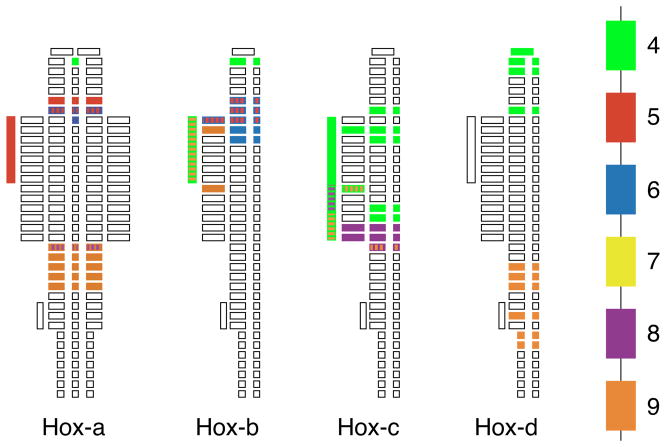
The regions of the skeleton affected in single Hox gene mutants were marked with respect to axial level and location of the respective genes on one of the Hoxa, Hoxb, Hoxc or Hoxd clusters. The template for the drawings was taken from (Rugh, 1968) and relevant references are found in the Legend to Fig. 1. The colors label the regions affected by genes in paralogous group 4 (green), group 5 (red), group 6 (blue), group 7 (yellow), group 8 (purple), group 9 (orange). Abnormalities in the sternum are indicated by bars to the left. Regions affected by more than one mutation contain several colors. No attempt was made to incorporate information on penetrance of an abnormality or the direction (loss or gain of character, rib bifurcation, sternal articulation, etc.). Except for more sacral and posterior lumbar regions, the developmental defects cluster in regions of morphological transitions, the cervico-thoracic and thoracic-lumbar transition as well as the transition between attached and floating ribs. Mid-cervical and mid-thoracic regions are relatively unaffected. References for the mutants are: Hoxa4 (Horan et al., 1994; Kostic and Capecchi, 1994), Hoxa5 (Jeanotte et al., 1993), Hoxa6 (Kostic and Capecchi, 1994), Hoxa9 (Fromental-Ramain et al., 1996a), Hoxb4 (Ramirez-Solis et al., 1993), Hoxb5 (Rancourt et al., 1995), Hoxb6 (Rancourt et al., 1995); (Kappen, 2000), Hoxb9 (Chen and Capecchi, 1997), Hoxc4 (Boulet and Capecchi, 1996; Saegusa et al., 1996), Hoxc8 (LeMouellic et al., 1992), Hoxc9 (Suemori et al., 1995), Hoxd4 (Horan et al., 1994), Hoxd9 (Fromental-Ramain et al., 1996a).
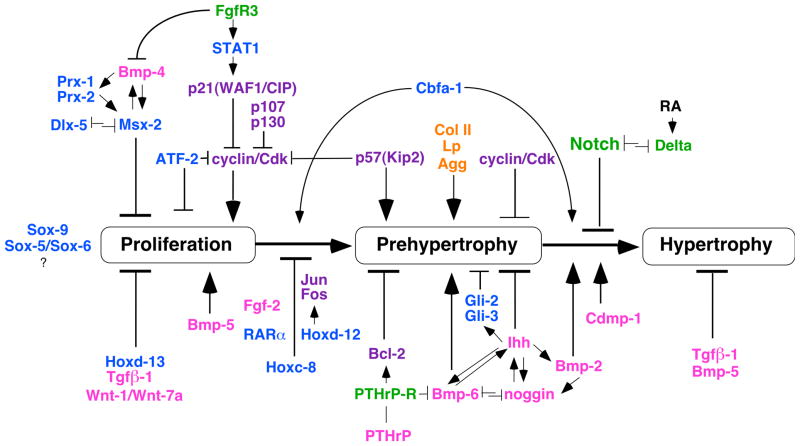
Transcription factors (blue), cell cycle regulators (purple), cell surface receptors (green), soluble mediators and growth factors (pink), and structural molecules (orange) have all been shown to affect chondrocyte maturation. Sox9 and additional factors are needed to induce the chondrocyte phenotype initially (for references, see text). The effects of other regulators are depicted as interpreted from phenotypes observed in in vivo overexpression or disruption paradigms (see text for details). The receptors for BMPs (Wozney and Rosen, 1998a) signal through Smad proteins (Massague, 1998) at various stages of chondrocyte differentiation and were not listed to reduce complexity of the graph.
References
-
- Adams JC, Watt FM. Regulation of development and differentiation by the extracellular matrix. Development. 1993;117:1183–1198. - PubMed
-
- Akasaka T, Kanno M, Balling R, Mieza MA, Taniguchi M, Koseki H. A role for mel-18, a Polycomb group-related vertebrate gene, during the anteroposterior specification of the axial skeleton. Development. 1996;122:1513–1522. - PubMed
-
- Amizuka N, Henderson JE, Hoshi K, Warshawsky H, Ozawa H, Goltzman D, Karaplis AC. Programmed cell death of chondrocytes and aberrant chondrogenesis in mice homozygous for parathyroid hormone-related peptide gene deletion. Endocrinology. 1996;137:5055–5067. - PubMed
Publication types
MeSH terms
Substances
Grants and funding
LinkOut - more resources
Full Text Sources
Medical
