


Tobacco use among those with serious psychological distress: results from the national survey of drug use and health, 2002
- PMID: 18158218
- PMCID: PMC2696205
- DOI: 10.1016/j.addbeh.2007.11.007
Tobacco use among those with serious psychological distress: results from the national survey of drug use and health, 2002
Abstract
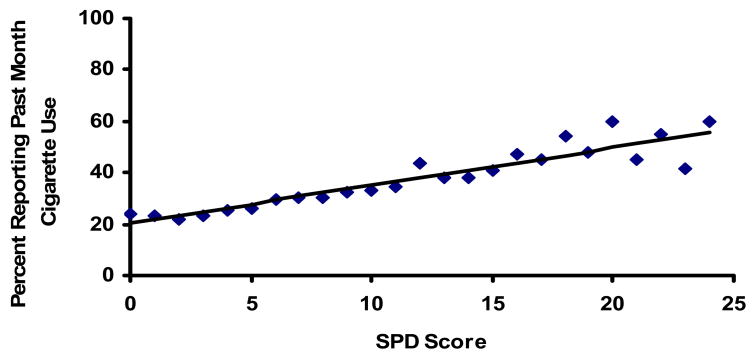
There have been relatively few population-based studies that have documented the extent of tobacco use among those with mental health disorders. Recently, the K6 scale, designed to assess serious psychological distress (SPD) at the population level, has been incorporated into a number of population-based health behavior surveys. The present study documented the prevalence of tobacco use products, dependence, and quit behavior among those with and without SPD utilizing the 2002 National Survey of Drug Use and Health. Results from the current study indicated that adults with SPD had greater odds of lifetime, past month, and daily use of cigarettes, cigars and pipes than adults without SPD. Common measures of nicotine dependence (e.g., Nicotine Dependence Syndrome Scale) indicated that a greater percentage of those with SPD were nicotine dependent compared to those without SPD. Lastly, quit ratios differed notably by SPD status. Among those with SPD, 29% quit or were former smokers compared to 49% of those without SPD. Findings highlight the importance of continuing to enhance public health efforts towards smoking cessation among those with mental health disorders, extensive tobacco surveillance and monitoring of tobacco trends among this group, and evaluating the extent to which this group of smokers may contribute to a hardening of the population.
Figures
References
-
- Babor TF, Steinberg K, Anton R, Del Boca F. Talk is cheap: measuring drinking outcomes in clinical trials. Journal of Studies on Alcohol. 2000;61:55–63. - PubMed
-
- Baker-Morissette SL, Gulliver SB, Wiegel M, Barlow D. Prevalence of smoking in anxiety disorders uncomplicated by comorbid alcohol or substance abuse. Journal of Psychopathology and Behavioral Assessment. 2004;26(2):107.
-
- Cooper L, Peters L, Andrews G. Validity of the Composite International Diagnostic Interview (CIDI) psychosis module in a psychiatric setting. Journal of Psychiatry Residence. 1998;32(6):361–8. - PubMed
-
- DeLeon J, Susce MT, Francisco JD, Rendon DM, Velasquez DM. Variables associated with Alcohol, Drug, and Daily Smoking Cessation in Patients With Severe Mental Illness. Journal of Clinical Psychiatry. 2005;66:1147–1455. - PubMed
-
- DeLeon J, Becona E, Gurpegui M, Gonzalez-Pinto A, Diaz FJ. The association between high nicotine dependence and severe mental illness may be consistent across countries. Journal of Clinical Psychiatry. 2002;63(9):812–6. - PubMed
Publication types
MeSH terms
Grants and funding
LinkOut - more resources
Full Text Sources
Medical
Miscellaneous
