


Symptoms across the continuum of acute coronary syndromes: differences between women and men
- PMID: 18158385
- PMCID: PMC2254515
Symptoms across the continuum of acute coronary syndromes: differences between women and men
Abstract
Background: The urgency and level of care provided for acute coronary syndromes partially depends on the symptoms manifested.
Objectives: To detect differences between women and men in the type, severity, location, and quality of symptoms across the 3 clinical diagnostic categories of acute coronary syndromes (unstable angina, myocardial infarction without ST-segment elevation, and myocardial infarction with ST-segment elevation) while controlling for age, diabetes, functional status, anxiety, and depression.
Methods: A convenience sample of 112 women and 144 men admitted through the emergency department and hospitalized for acute coronary syndromes participated. Recruitment took place at 2 urban teaching hospitals in the Midwest. Data were collected during structured interviews in each patient's hospital room. Forty-eight symptom descriptors were assessed. Demographic characteristics, health history, functional status, anxiety, and depression levels also were measured.
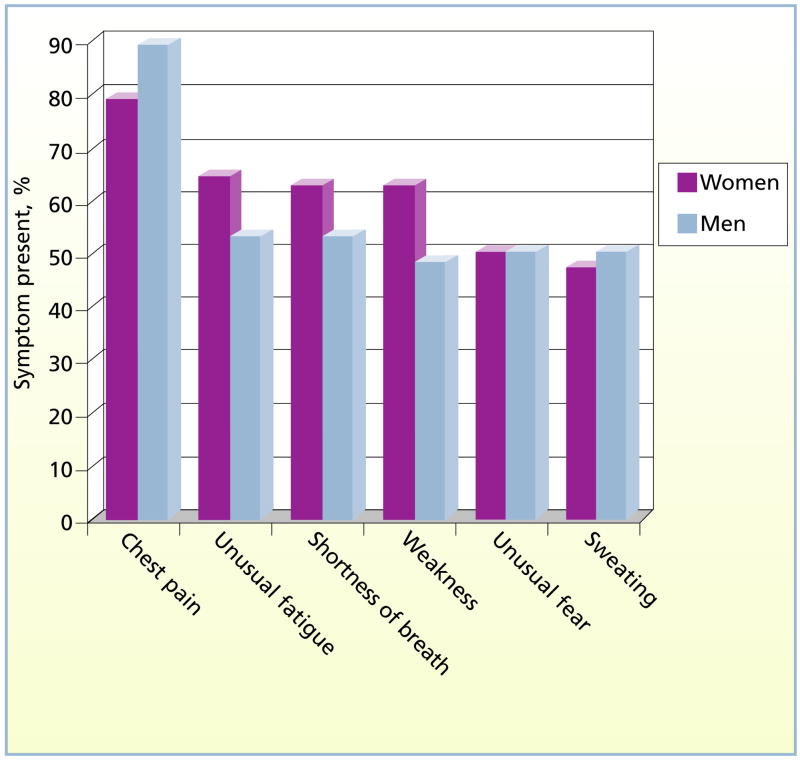
Results: Regardless of clinical diagnostic category, women reported significantly more indigestion (beta = 0.25; confidence interval [CI] = 0.01-0.49), palpitations (beta = 0.31; CI = 0.06-0.56), nausea (beta = 0.37; CI = 0.10-0.65), numbness in the hands (beta = 0.29; CI = 0.02-0.57), and unusual fatigue (beta = 0.60; CI = 0.27-0.93) than men reported. Differences between men and women in dizziness, weakness, and new-onset cough did differ by diagnosis. Reports of chest pain did not differ between men and women.
Conclusions: Women with acute coronary syndromes reported a higher intensity of 5 symptoms (but not chest pain) than men reported. Whether differences between the sexes in less typical symptoms are clinically significant remains unclear.
Figures
References
-
- Thom T, Haase N, Rosamond W, et al. American Heart Association Statistics Committee and Stroke Statistics Subcommittee. Heart disease and stroke statistics—2006 update: a report from the American Heart Association Statistics Committee and Stroke Statistics Subcommittee. Circulation. 2006;113(6):e85–e151. - PubMed
-
- Rossouw JE, Anderson GL, Prentice RL, et al. Writing Group for the Women’s Health Initiative Investigators. Risks and benefits of estrogen plus progestin in healthy postmenopausal women: principal results from the Women’s Health Initiative randomized controlled trial. JAMA. 2002;288(3):321–333. - PubMed
-
- Johnson BD, Shaw LJ, Buchthal SD, et al. National Institutes of Health-National Heart, Lung, and Blood Institute. Prognosis in women with myocardial ischemia in the absence of obstructive coronary disease: results from the National Institutes of Health–National Heart, Lung, and Blood Institute-Sponsored Women’s Ischemia Syndrome Evaluation (WISE) Circulation. 2004;109(24):2993–2999. - PubMed
-
- Lozzi L, Carstensen S, Rasmussen H, Nelson G. Why do acute myocardial infarction patients not call an ambulance? An interview with patients presenting to hospital with acute myocardial infarction symptoms. Intern Med J. 2005;35(11):668–671. - PubMed
-
- Hutchings CB, Mann NC, Daya M, et al. Rapid Early Action for Coronary Treatment Study. Patients with chest pain calling 9-1-1 or self-transporting to reach definitive care: which mode is quicker? Am Heart J. 2004;147(1):35–41. - PubMed
Publication types
MeSH terms
Grants and funding
LinkOut - more resources
Full Text Sources