Correlation between MRI and operative findings in Bell's palsy and Ramsay Hunt syndrome
- PMID: 18159587
- PMCID: PMC2628199
- DOI: 10.3349/ymj.2007.48.6.963
Correlation between MRI and operative findings in Bell's palsy and Ramsay Hunt syndrome
Abstract
Purpose: To investigate the correlation between gadolinium enhanced magnetic resonance image (MRI) results and surgical findings of facial nerves in Bell's palsy and Ramsay Hunt syndrome.
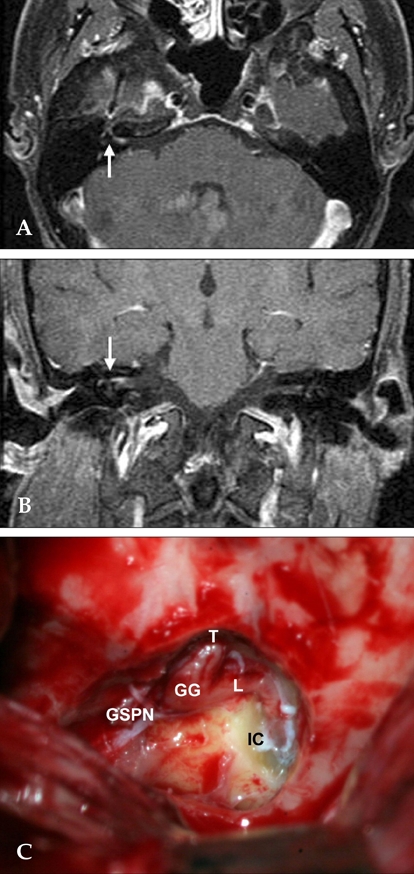
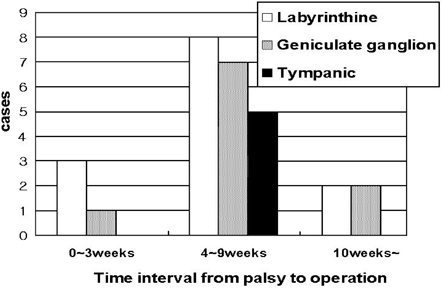
Materials and methods: From 1995 to 2004, MRI was performed on 13 patients with Bell's palsy or Ramsay Hunt syndrome, who were offered with surgical decompression of the facial nerve through the middle cranial fossa approach. Gadolinium enhanced MRI was performed on all patients and the enhancement of the facial nerve was evaluated by radiology specialists. Operative findings including the degree of the facial nerve segment swelling were examined. Furthermore, the time interval from the onset of palsy to surgery was evaluated.
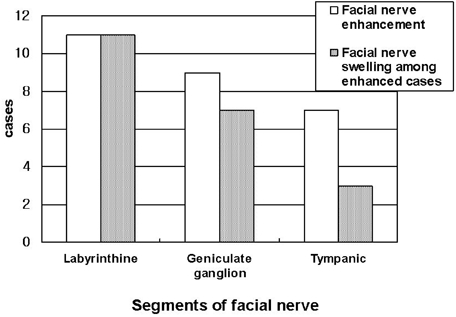
Results: Swelling of facial nerve segments was found in patients with enhanced facial nerves from MRI. The swelling of the facial nerve in the labyrinthine segment in particular was identified in all patients with enhanced labyrinthine segments in MRI. The intraoperative swelling of geniculate ganglion of facial nerve was found in 78% of patients with enhanced facial segment in MRI (p=0.01). The intraoperative swelling of tympanic segment was observed from fourth to ninth weeks after the onset of palsy.
Conclusion: MRI enhancement of facial nerves in Bell's palsy and Ramsay Hunt syndrome is associated with the extent of intratemporal lesions of facial nerves, especially in the labyrinthine segment.
Figures
References
-
- Adour KK, Bell DN, Hilsinger RG., Jr Herpes simplex virus in idiopathic facial paralysis (Bell's palsy) JAMA. 1975;233:527–530. - PubMed
-
- Giannoni E, Corbacelli A. Virological findings and their correlation with immunological findings in Bell's paralysis. Boll Soc Ital Biol Sper. 1975;51:139–143. - PubMed
-
- Engström M, Thuomas KA, Naeser P, Stålberg E, Jonsson L. Facial nerve enhancement in Bell's palsy demonstrated by different gadolinium-enhanced magnetic resonance imaging techniques. Arch Otolaryngol Head Neck Surg. 1993;119:221–225. - PubMed
-
- Murphy TP. MRI of the facial nerve during paralysis. Otolaryngol Head Neck Surg. 1991;104:47–51. - PubMed
-
- Brändle P, Satoretti-Schefer S, Böhmer A, Wichmann W, Fisch U. Correlation of MRI, clinical, and electroneuronographic findings in acute facial nerve palsy. Am J Otol. 1996;17:154–161. - PubMed
MeSH terms
LinkOut - more resources
Full Text Sources
Medical