Differences in young people's reports of sexual behaviors according to interview methodology: a randomized trial in India
- PMID: 18160677
- PMCID: PMC2156054
- DOI: 10.2105/AJPH.2006.099937
Differences in young people's reports of sexual behaviors according to interview methodology: a randomized trial in India
Abstract
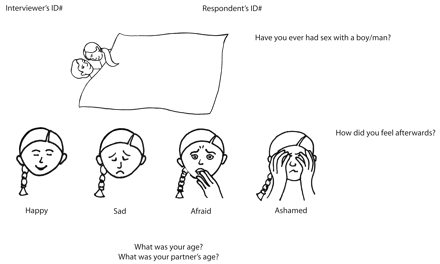
Objectives: We compared reports of sexual behaviors given in standard face-to-face interviews with reports given in audio computer-assisted self-interviews (ACASIs) and culturally specific interactive interviews among adolescents in India. We sought to determine which of the interview methods leads to higher reporting of sexual behaviors among economically disadvantaged 15-19-year-olds in urban India.
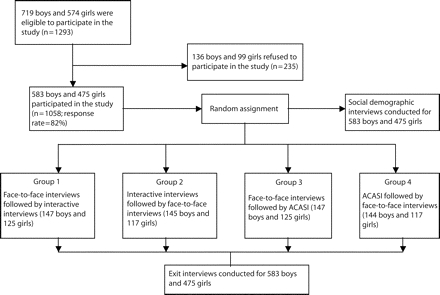
Methods: We conducted a randomized trial in which each participant (583 boys and 475 girls) was assigned to 2 interview methods: face-to-face interview and ACASI or interactive interview. We used matched case-control analyses to assess differences in the individual's reporting on the 2 methods.
Results: Female participants consistently reported fewer sexual behaviors in ACASIs than in face-to-face interviews, whereas male participants' reports differed according to type of sexual behavior and interview mode. Both male and female participants reported more sexual behaviors during interactive interviews than during face-to-face interviews. Twenty-eight percent of male participants reported having engaged in heterosexual intercourse in interactive interviews, as compared with 20% in face-to-face interviews (P< .01); the corresponding percentages for female participants were 7% and 2% (P<.01).
Conclusions: Our results showed that young people were more likely to report sexual behaviors in culturally specific interactive interviews than in face-to-face interviews. By contrast, ACASIs did not uniformly lead to higher reporting levels than did face-to-face interviews.
Figures
References
-
- Des Jarlais D, Paone D, Milliken J, et al. Audio-computer interviewing to measure risk behavior for HIV among injecting drug users: a quasi-randomized trial. Lancet. 1999;353:1657–1662. - PubMed
-
- United Nations. World population prospects: the 2004 revision population database. Available at: http://esa.un.org/unpp/. Accessed August 1, 2005.
-
- National Family Health Survey (NFHS-2) 1998–99. Mumbai, India: National Institute for Population Sciences; 2000.
-
- Putting reproductive health within the wider context of adolescent lives: challenges and experiences. Paper presented at: International Conference on Adolescent Reproductive Health: Evidence and Program Implications for South Asia, November 2000, Mumbai, India.
-
- Report of the Working Group on Adolescents for the Tenth Five Year Plan (2002–2007). New Delhi, India: Planning Commission, Government of India; 2001.
Publication types
MeSH terms
LinkOut - more resources
Full Text Sources