


Review
doi: 10.1016/j.bbrc.2007.12.114.
Epub 2007 Dec 26.
The unique functions of cardiac troponin I in the control of cardiac muscle contraction and relaxation
Affiliations
- PMID: 18162178
- PMCID: PMC2365727
- DOI: 10.1016/j.bbrc.2007.12.114
Item in Clipboard
Review
The unique functions of cardiac troponin I in the control of cardiac muscle contraction and relaxation
Biochem Biophys Res Commun.
.
Abstract
We review development of evidence and current perceptions of the multiple and significant functions of cardiac troponin I in regulation and modulation of cardiac function. Our emphasis is on the unique structure function relations of the cardiac isoform of troponin I, especially regions containing sites of phosphorylation. The data indicate that modifications of specific regions cardiac troponin I by phosphorylations either promote or reduce cardiac contractility. Thus, a homeostatic balance in these phosphorylations is an important aspect of control of cardiac function. A new concept is the idea that the homeostatic mechanisms may involve modifications of intra-molecular interactions in cardiac troponin I.
Figures
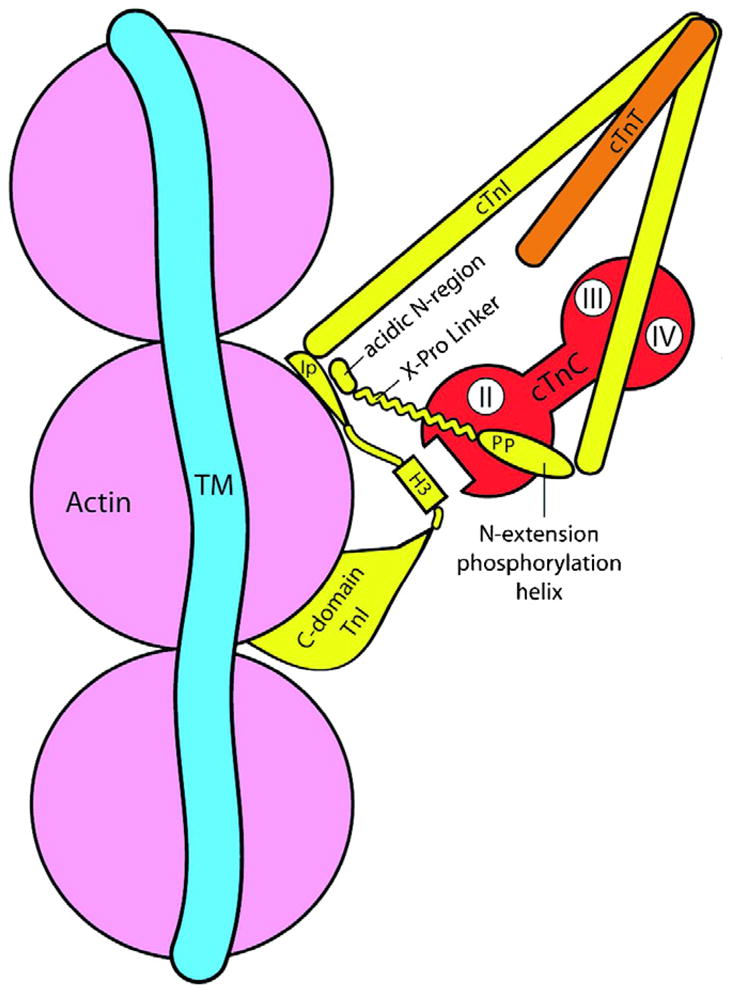
Model illustrating interactions of troponin (Tn) components in the diastolic state and with phosphorylation of Ser-23, Ser-24 in the unique N-terminal extension containing a phosphorylation helix, a proline helix linker and an acidic region. Tm, tropomyosin, cTnI, cardiac troponin I, cTnT, cardiac TnT, H3, the switch peptide that binds to a hydrophobic patch on cTnC as indicated, Ip, a basic inhibitory peptide. cTnC is illustrated in apo state and indicates the N-lobe regulatory Ca-binding domain (II) and C-lobe slowly exchanging Ca/Mg sites in the mobile C-domain demonstrates a second actin binding site. The model emphasizes the potential for the phosphorylated N-extension of cTnI to interact with the inhibitory peptide. See text and Ref. [47] for details.
References
-
- Ebashi S, Kodama A. A new protein factor promoting aggregation of tropomyosin. J Biochem. 1965;58:107–108. - PubMed
-
- Solaro RJ. Modulation of cardiac myofilament activity by protein phosphorylation. In: Page E, Fozzard H, Solaro RJ, editors. Handbook of Physiology: Section 2. The Cardiovascular System. Vol. 1. Oxford University Press; New York: 2001. pp. 264–300.
-
- Kobayashi T, Solaro RJ. Calcium, thin filaments, and integrative biology of cardiac contractility. Annu Rev Physiol. 2005;67:39–67. - PubMed
-
- Solaro RJ, Westfall MV. Physiology of the myocardium. In: Sellke FW, del Nido PJ, Swanson SJ, editors. Surgery of the Chest. Elsevier Sanders; Philadelphia: 2005. pp. 767–779.
-
- Solaro RJ. Integration of myofilament response to Ca2+ with cardiac pump regulation and pump dynamics. Am J Physiol. 1999;277:S155–S163. - PubMed
Publication types
MeSH terms
Substances
Grants and funding
LinkOut - more resources
Full Text Sources
Research Materials
