


Testability of the Retinomax autorefractor and IOLMaster in preschool children: the Multi-ethnic Pediatric Eye Disease Study
- PMID: 18164067
- PMCID: PMC4848014
- DOI: 10.1016/j.ophtha.2007.10.036
Testability of the Retinomax autorefractor and IOLMaster in preschool children: the Multi-ethnic Pediatric Eye Disease Study
Abstract
Purpose: To determine the testability of Retinomax and IOLMaster ocular biometry in preschool children.
Design: Population-based study of inner city preschool children in Los Angeles County.
Participants: Two thousand five hundred forty-five Hispanic and 2178 African American children 6 to 72 months old.
Methods: Subjects were identified by door-to-door screening within previously identified contiguous census tracts. Pediatric ophthalmologists or optometrists performed comprehensive eye examinations on all subjects. Refractive error and keratometry measurements were attempted on all subjects with the Retinomax autorefractor after cycloplegia. Axial length measurements with the IOLMaster partial coherence interferometer were attempted on those subjects ages 30 to 72 months.
Main outcome measures: Ability to obtain high confidence autorefraction readings or axial length measurements on both eyes.
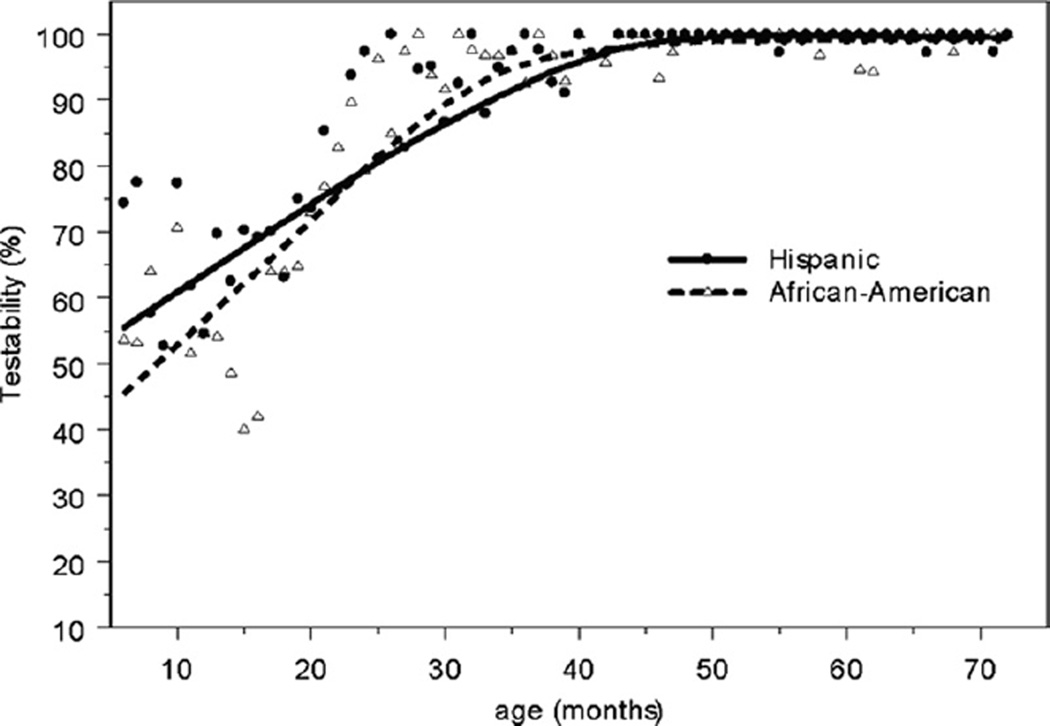
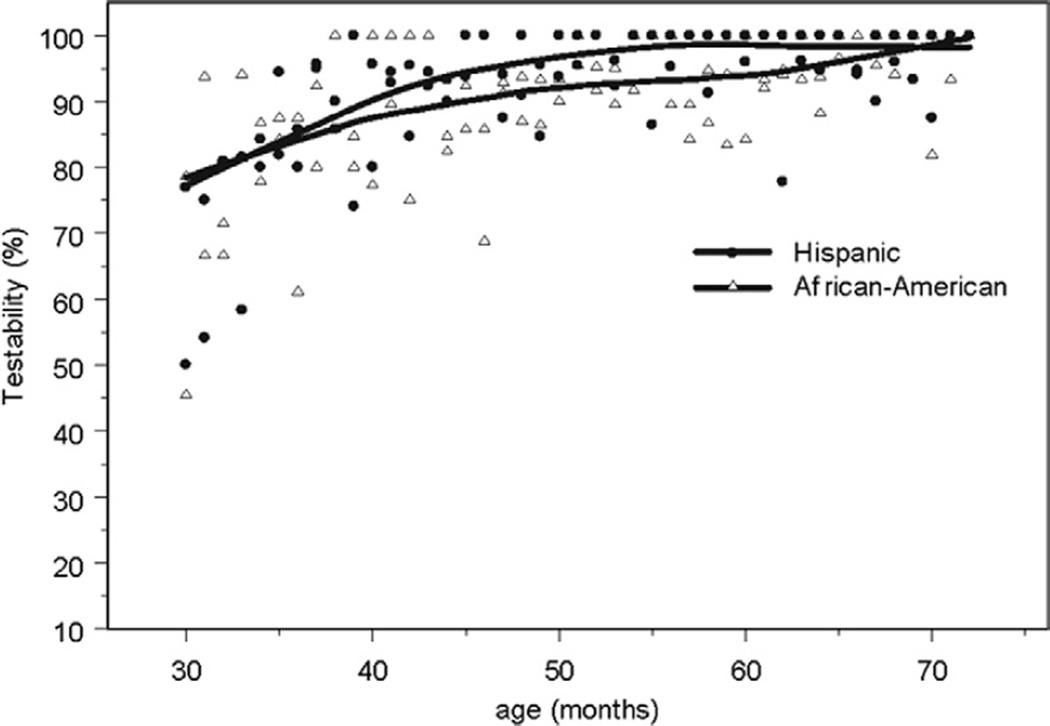
Results: Overall, 89% were testable in both eyes with the Retinomax device, and 91% of the children were testable with the IOLMaster. Testability rose sharply with age, so that by age 36 months 98% of children were testable with the Retinomax device and 90% were testable with IOLMaster. There were no consistent gender- or ethnicity-related differences in testability overall or when stratified by age for either device.
Conclusions: Young children can be reliably tested for ocular biometry with the Retinomax and IOLMaster devices. This may impact strategies for management of cataracts and refractive errors in preschool children.
Figures
References
-
- Donahue SP, Arnold RW, Ruben JB AAPOS Vision Screening Committee. Preschool vision screening: what should we be detecting and how should we report it? Uniform guidelines for reporting results of preschool vision screening studies. J AAPOS. 2003;7:314–316. - PubMed
-
- Donahue SP, Baker JD, Scott WE, et al. Lions Clubs International Foundation Core Four photoscreening: results from 17 programs and 400,000 preschool children. J AAPOS. 2006;10:44–48. - PubMed
-
- Vision in Preschoolers Study Group. The Electronic Visual Acuity Tester: testability in preschool children. Optom Vis Sci. 2004;81:238–244. - PubMed
-
- Varma R, Deneen J, Cotter S, et al. The Multi-Ethnic Pediatric Eye Disease Study: design and methods. Ophthalmic Epidemiol. 2006;13:253–262. - PubMed
-
- Vision in Preschoolers Study Group. Comparison of preschool vision screening tests as administered by licensed eye care professionals in the Vision in Preschoolers Study. Ophthalmology. 2004;111:637–650. - PubMed
Publication types
MeSH terms
Grants and funding
LinkOut - more resources
Full Text Sources
Medical
