


A threading-based method (FINDSITE) for ligand-binding site prediction and functional annotation
- PMID: 18165317
- PMCID: PMC2224172
- DOI: 10.1073/pnas.0707684105
A threading-based method (FINDSITE) for ligand-binding site prediction and functional annotation
Abstract
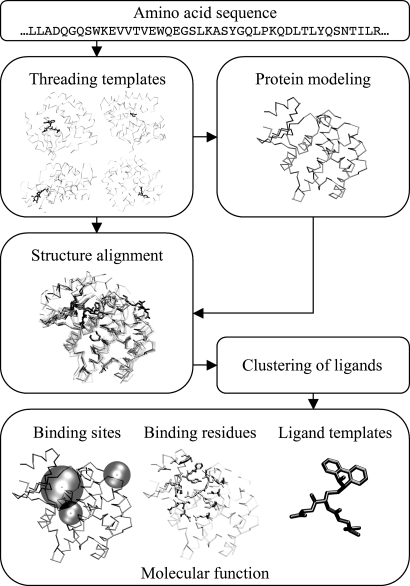
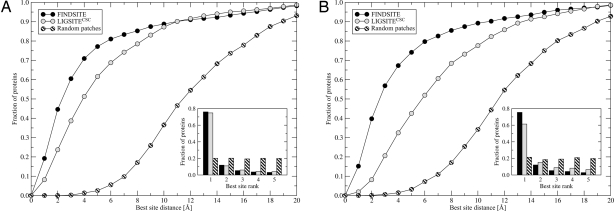
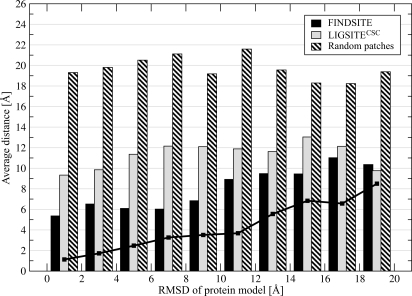
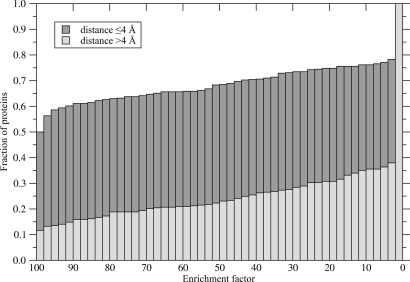
The detection of ligand-binding sites is often the starting point for protein function identification and drug discovery. Because of inaccuracies in predicted protein structures, extant binding pocket-detection methods are limited to experimentally solved structures. Here, FINDSITE, a method for ligand-binding site prediction and functional annotation based on binding-site similarity across groups of weakly homologous template structures identified from threading, is described. For crystal structures, considering a cutoff distance of 4 A as the hit criterion, the success rate is 70.9% for identifying the best of top five predicted ligand-binding sites with a ranking accuracy of 76.0%. Both high prediction accuracy and ability to correctly rank identified binding sites are sustained when approximate protein models (<35% sequence identity to the closest template structure) are used, showing a 67.3% success rate with 75.5% ranking accuracy. In practice, FINDSITE tolerates structural inaccuracies in protein models up to a rmsd from the crystal structure of 8-10 A. This is because analysis of weakly homologous protein models reveals that about half have a rmsd from the native binding site <2 A. Furthermore, the chemical properties of template-bound ligands can be used to select ligand templates associated with the binding site. In most cases, FINDSITE can accurately assign a molecular function to the protein model.
Conflict of interest statement
The authors declare no conflict of interest.
Figures
References
-
- Adams MD, Celniker SE, Holt RA, Evans CA, Gocayne JD, Amanatides PG, Scherer SE, Li PW, Hoskins RA, Galle RF, et al. Science. 2000;287:2185–2195. - PubMed
-
- Venter JC, Adams MD, Myers EW, Li PW, Mural RJ, Sutton GG, Smith HO, Yandell M, Evans CA, Holt RA, et al. Science. 2001;291:1304–1351. - PubMed
-
- Baker D, Sali A. Science. 2001;294:93–96. - PubMed
-
- Sanchez R, Pieper U, Melo F, Eswar N, Marti-Renom MA, Madhusudhan MS, Mirkovic N, Sali A. Nat Struct Biol. 2000;7(Suppl):986–990. - PubMed
-
- Shah M, Passovets S, Kim D, Ellrott K, Wang L, Vokler I, LoCascio P, Xu D, Xu Y. Bioinformatics. 2003;19:1985–1996. - PubMed
Publication types
MeSH terms
Substances
Grants and funding
LinkOut - more resources
Full Text Sources
Other Literature Sources
