


Effects of feeding Spodoptera littoralis on lima bean leaves: IV. Diurnal and nocturnal damage differentially initiate plant volatile emission
- PMID: 18165324
- PMCID: PMC2259069
- DOI: 10.1104/pp.107.111088
Effects of feeding Spodoptera littoralis on lima bean leaves: IV. Diurnal and nocturnal damage differentially initiate plant volatile emission
Abstract
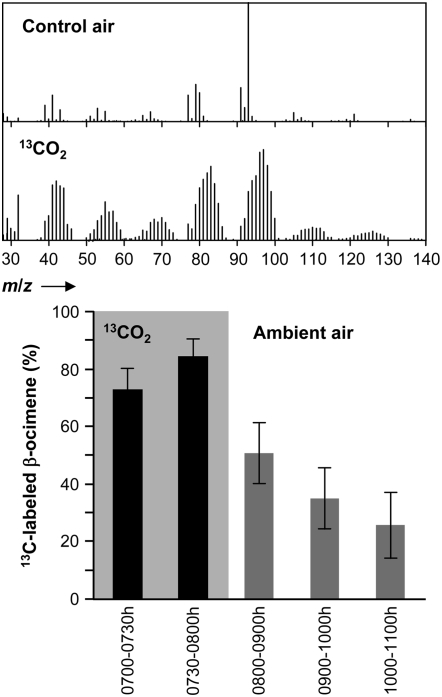
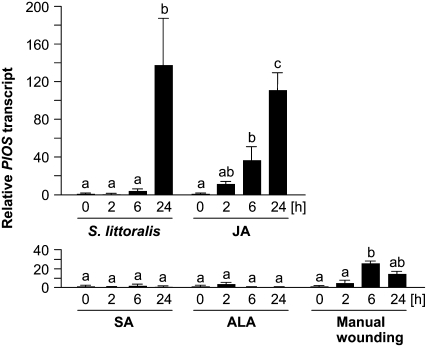
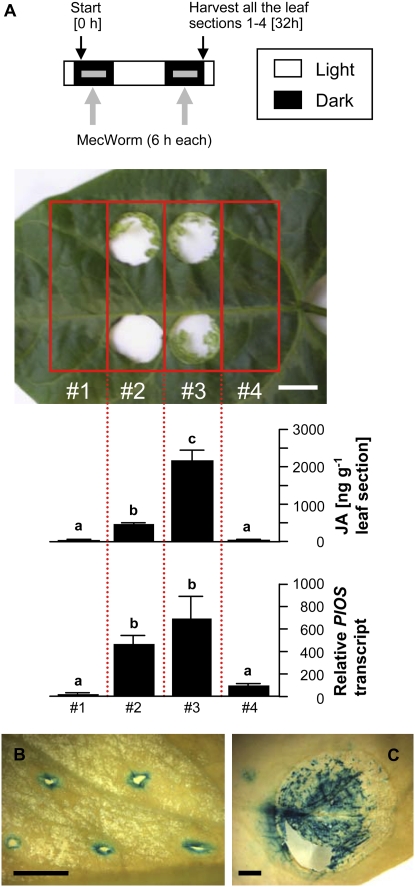
Continuous mechanical damage initiates the rhythmic emission of volatiles in lima bean (Phaseolus lunatus) leaves; the emission resembles that induced by herbivore damage. The effect of diurnal versus nocturnal damage on the initiation of plant defense responses was investigated using MecWorm, a robotic device designed to reproduce tissue damage caused by herbivore attack. Lima bean leaves that were damaged by MecWorm during the photophase emitted maximal levels of beta-ocimene and (Z)-3-hexenyl acetate in the late photophase. Leaves damaged during the dark phase responded with the nocturnal emission of (Z)-3-hexenyl acetate, but with only low amounts of beta-ocimene; this emission was followed by an emission burst directly after the onset of light. In the presence of (13)CO(2), this light-dependent synthesis of beta-ocimene resulted in incorporation of 75% to 85% of (13)C, demonstrating that biosynthesis of beta-ocimene is almost exclusively fueled by the photosynthetic fixation of CO(2) along the plastidial 2-C-methyl-D-erythritol 4-P pathway. Jasmonic acid (JA) accumulated locally in direct response to the damage and led to immediate up-regulation of the P. lunatus beta-ocimene synthase gene (PlOS) independent of the phase, that is, light or dark. Nocturnal damage caused significantly higher concentrations of JA (approximately 2-3 times) along with enhanced expression levels of PlOS. Transgenic Arabidopsis thaliana transformed with PlOS promoter :: beta-glucuronidase fusion constructs confirmed expression of the enzyme at the wounded sites. In summary, damage-dependent JA levels directly control the expression level of PlOS, regardless of light or dark conditions, and photosynthesis is the major source for the early precursors of the 2-C-methyl-D-erythritol 4-P pathway.
Figures



References
-
- Arimura G, Huber DPW, Bohlmann J (2004. a) Forest tent caterpillars (Malacosoma disstria) induce local and systemic diurnal emissions of terpenoid volatiles in hybrid poplar (Populus trichocarpa x deltoides): cDNA cloning, functional characterization, and patterns of gene expression of (-)-germacrene D synthase, PtdTPS1. Plant J 37 603–616 - PubMed
-
- Arimura G, Kost C, Boland W (2005) Herbivore-induced, indirect plant defences. Biochim Biophys Acta 1734 91–111 - PubMed
-
- Arimura G, Ozawa R, Horiuchi J, Nishioka T, Takabayashi J (2001) Plant-plant interactions mediated by volatiles emitted from plants infested by spider mites. Biochem Syst Ecol 29 1049–1061
Publication types
MeSH terms
Substances
Associated data
- Actions
- Actions
LinkOut - more resources
Full Text Sources
Molecular Biology Databases
