. 2007 Dec;3(12):e255.
doi: 10.1371/journal.pcbi.0030255. Epub 2007 Nov 14.

Determination of the processes driving the acquisition of immunity to malaria using a mathematical transmission model

Affiliations

Determination of the processes driving the acquisition of immunity to malaria using a mathematical transmission model

João A N Filipe et al. PLoS Comput Biol. 2007 Dec.

Abstract

Acquisition of partially protective immunity is a dominant feature of the epidemiology of malaria among exposed individuals. The processes that determine the acquisition of immunity to clinical disease and to asymptomatic carriage of malaria parasites are poorly understood, in part because of a lack of validated immunological markers of protection. Using mathematical models, we seek to better understand the processes that determine observed epidemiological patterns. We have developed an age-structured mathematical model of malaria transmission in which acquired immunity can act in three ways ("immunity functions"): reducing the probability of clinical disease, speeding the clearance of parasites, and increasing tolerance to subpatent infections. Each immunity function was allowed to vary in efficacy depending on both age and malaria transmission intensity. The results were compared to age patterns of parasite prevalence and clinical disease in endemic settings in northeastern Tanzania and The Gambia. Two types of immune function were required to reproduce the epidemiological age-prevalence curves seen in the empirical data; a form of clinical immunity that reduces susceptibility to clinical disease and develops with age and exposure (with half-life of the order of five years or more) and a form of anti-parasite immunity which results in more rapid clearance of parasitaemia, is acquired later in life and is longer lasting (half-life of >20 y). The development of anti-parasite immunity better reproduced observed epidemiological patterns if it was dominated by age-dependent physiological processes rather than by the magnitude of exposure (provided some exposure occurs). Tolerance to subpatent infections was not required to explain the empirical data. The model comprising immunity to clinical disease which develops early in life and is exposure-dependent, and anti-parasite immunity which develops later in life and is not dependent on the magnitude of exposure, appears to best reproduce the pattern of parasite prevalence and clinical disease by age in different malaria transmission settings. Understanding the effector mechanisms underlying these two immune functions will assist in the design of transmission-reducing interventions against malaria.


Conflict of interest statement

Competing interests. The authors have declared that no competing interests exist.

Figures

Figure 1
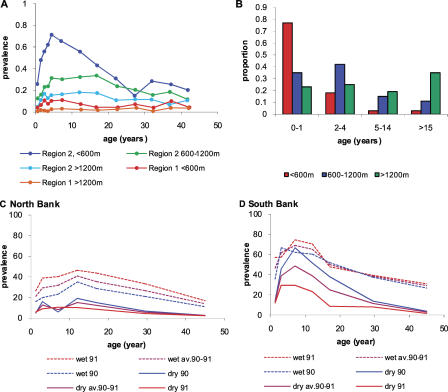
Figure 1. Observed Patterns of Parasitaemia and Clinical Episodes by Age in Areas and Seasons with Differing Transmission Intensity
(A) Prevalence of parasitaemia by age, region, and altitude (<600 m, 600-1200 m, and >1200 m) from studies in Northern Tanzania. (B) Clinical episodes by age and altitude for region 2 (Usambara mountains) from severe malaria admissions to district, regional, and referral hospitals. (C,D) Prevalence of parasitaemia by age, year, and season (wet/dry) from North Bank (C) and South Bank (D) of River Gambia.
Figure 2
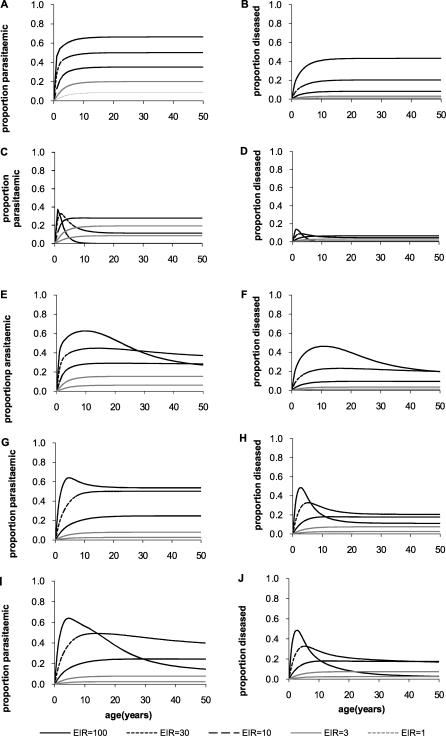
Figure 2. Predicted Relationship between Age and Parasitaemia or Clinical Disease for the Different Models of Immunity
(A,B) No immunity; (C,D) immunity acting on clearance of subpatent parasites (immunity function 3); (E,F) immunity acting on clearance of detectable parasites (immunity function 2); (G,H) immunity acting on susceptibility to clinical disease (immunity function 1); (I,J) immunity acting on clearance of detectable parasites and susceptibility to clinical disease (immunity functions 1 and 2). Parameters are as shown in Table 1.
Figure 3
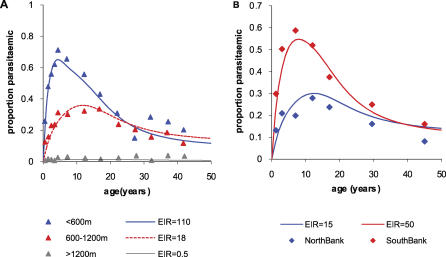
Figure 3. Predicted Relationship between Age and Parasitaemia at Different Levels of Transmission Intensity for the Model Incorporating Immunity Functions 1 and 2 and in Which Recovery from Infection Is Determined Solely by Age
(A) Patterns predicted by the model compared to those observed in region 2 in Northern Tanzania by altitude. EIRs for the model are 110 for low altitude (measured EIR 28–108), 18 for medium altitude (measured EIR 0.4–7.6), and 0.5 for high altitude (measured EIR 0.01–0.32), percentage treated f = 50%. (B) Patterns predicted by the model compared to those observed on the north and south banks of the River Gambia. Model EIRs were 50 for the north bank and 15 for the south bank. Percentage treated f = 50%. All other parameters are as in Table 1. Our estimates of EIR are inversely proportional to the assumed value of parameter b; EIR estimates would be halved if we would assume b to be twice as large.
Figure 4
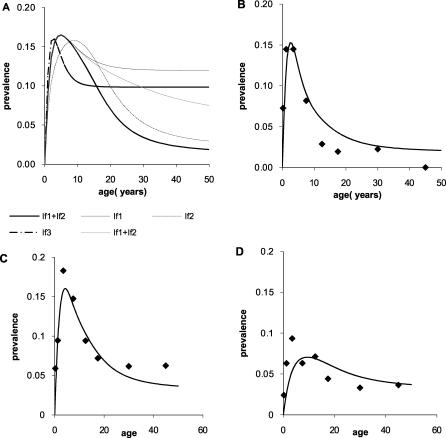
Figure 4. Observed and Predicted Patterns of Infectivity (Gametocytaemia) by Age in Tanzania and in The Gambia
(A) Predicted infectivity by age from the model with different immunity functions. If1= immunity function 1 (susceptibility to clinical disease); If2 = immunity function 2 (clearance of detectable parasites); If3 = immunity function 3 (clearance of subpatent infection), If2* denotes EIR-independent version of If2. Parasitaemia is calculated in the model as symptomatic cases plus asymptomatic infections (DH+AH). All runs assume an annual EIR = 40 ibppy and that parameters are as before (Table 1), except cD is adjusted (for If2 and If3) to make comparable the curves corresponding to different immunity function models. (B–D) Observed gametocytaemia by age from (B) the low altitude area of region 2 in Tanzania, (C) The Gambia south of the river bank, and (D) The Gambia north of the river bank. Parameters for the model are annual EIR = 110 (B), 50 (C), 15 (D), infectivity CD = 0.3 as before (B,D), 0.4 (C), percentage treated f = 50%. All other parameters are as in Table 1.
Figure 5
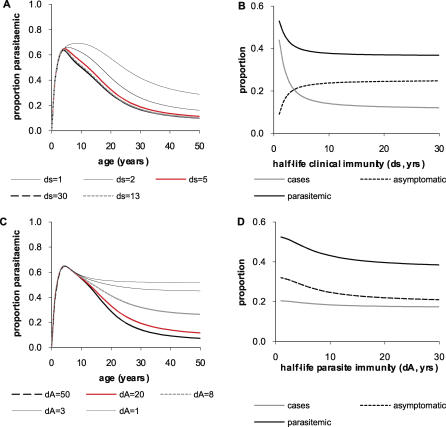
Figure 5. Sensitivity of the Relationship between Parasitaemia, Clinical Disease, and Age to Assumptions about the Duration of Acquired Immunity
(A,B) Sensitivity to the duration of the immune response that reduces susceptibility to clinical disease where dS is the half-life; (A) shows the relationship between parasitaemia and age, and (B) shows the proportion of people predicted by the model to be symptomatic cases, have asymptomatic infections, and be parasitaemic (i.e., have patent infections) for different values of dS. Subpatent infections are not shown. For dS less than 5 y, the model predicts too high a proportion of all infections to be symptomatic cases rather than asymptomatic (B). (C,D) Sensitivity to the duration of the immune response that increases clearance of detectable parasites where dA is the half-life; (C) shows the relationship between parasitaemia and age, and (D) shows the proportion of people predicted by the model to be symptomatic cases, asymptomatic infections, and parasitaemic for different values of dA. For dA less than approximately 20 y, the model predicts that high levels of parasitaemia will persist into adulthood (C). Results are presented for an annual EIR of 110 ibppy. Similar patterns are obtained for lower EIR values.
Figure 6
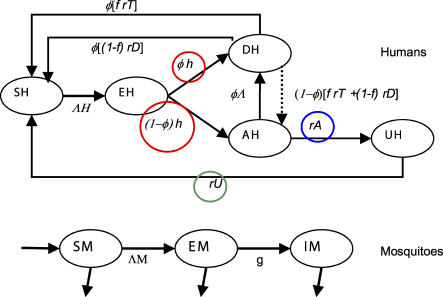
Figure 6. Schematic Illustration of the Full Transmission Model for Humans and Mosquitoes (without Explicit Ageing in Humans)
States are shown in circles, and subscripts denote the population (H = humans, M = mosquitoes): susceptible SH/SM, latent infection EH/EM, infected with symptomatic disease (severe and clinical cases) DH, asymptomatic patent infection AH, infected with undetectable (subpatent) parasite density UH, infectious mosquitoes IM. ΛHM is the force of infection on the human and mosquito populations, respectively, 1/h is the mean latent period in humans, 1/g the mean latent period in mosquitoes, φ is the proportion of human infections that develop disease, f the proportion of symptomatic cases that receive effective drug treatment, rT the rate of recovery on treatment, rD the rate of recovery without treatment, rA the rate at which asymptomatic infections become subpatent, and rU the rate at which subpatent infections are cleared. The coloured circles denote the stages at which acquired immunity can have an effect (modifying φ, rA, and rU). The parameters and their values are described in Table 1.
Figure 7
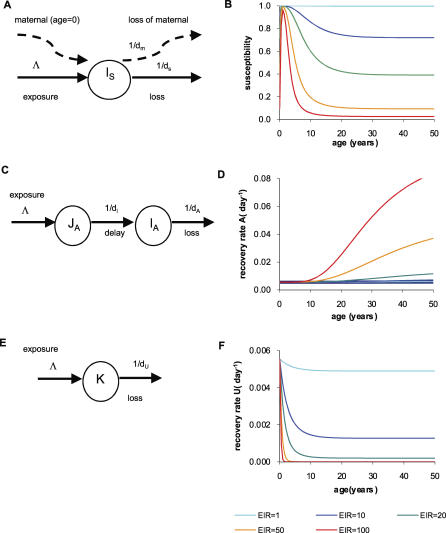
Figure 7. Immunity Functions That Act on: (A,B) the Susceptibility to Developing Clinical Disease; (C,D) the Clearance of Detectable Parasites, and (E,F) the Clearance of Subpatent Infection
(A,C,E) Show schematically how each model assumes that immunity is developed (through exposure and/or age) and lost. (B,D,F) Show the resulting effect of these immunity levels on (B) susceptibility to clinical disease, (D) the rate of clearance of detectable parasites, and (F) the clearance of subpatent infection as people age and for five different transmission settings (identified by the EIR in ibppy). Further mathematical details are given in Protocol S1.

References

    1. Hay SI, Guerra CA, Tatem AJ, Noor AM, Snow RW. The global distribution and population at risk of malaria: past, present, and future. Lancet Infect Dis. 2004;4:327–336. - PMC - PubMed
    1. Snow RW, Nahlen B, Palmer A, Donnelly CA, Gupta S, et al. Risk of severe malaria among African infants: Direct evidence of clinical protection during early infancy. J Infect Dis. 1998;177:819–822. - PubMed
    1. Trape JF, Rogier C. Combating malaria morbidity and mortality by reducing transmission. Parasitology Today. 1996;12:236–240. - PubMed
    1. Snow RW, Omumbo JA, Lowe B, Molyneux CS, Obiero JO, et al. Relation between severe malaria morbidity in children and level of Plasmodium falciparum transmission in Africa. Lancet. 1997;349:1650–1654. - PubMed
    1. Smith TA, Leuenberger R, Lengeler C. Child mortality and malaria transmission intensity in Africa. Trends Parasitol. 2001;17:145–149. - PubMed

Publication types