


Cardiac function in young and old Little mice
- PMID: 18166681
- PMCID: PMC2771398
- DOI: 10.1093/gerona/62.12.1319
Cardiac function in young and old Little mice
Abstract
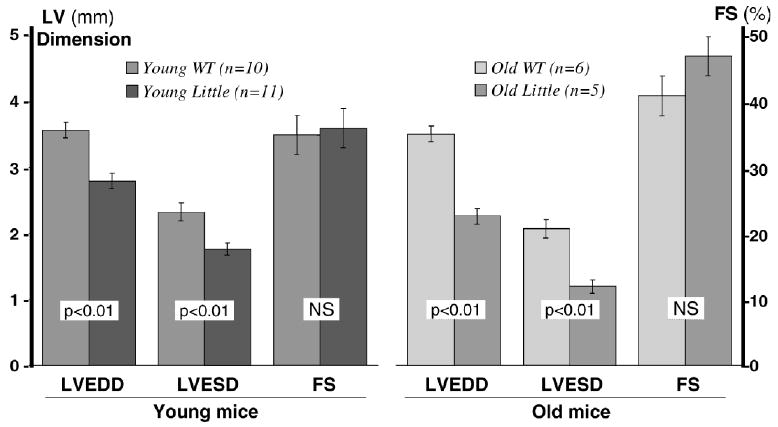
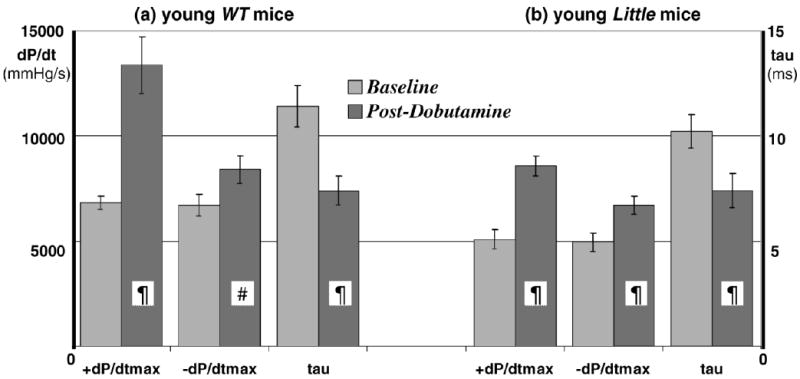
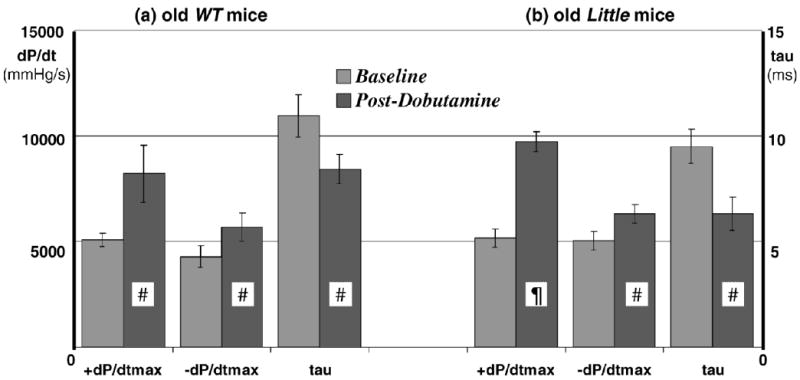
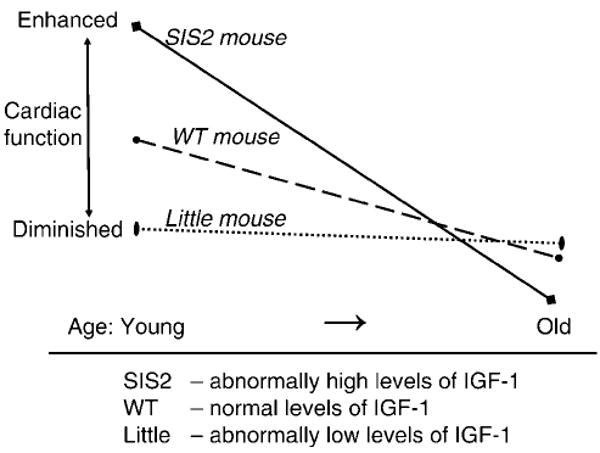
We studied cardiac function in young and old, wild-type (WT), and longer-living Little mice using cardiac flow velocities, echocardiographic measurements, and left ventricular (LV) pressure (P) to determine if enhanced reserves were in part responsible for longevity in these mice. Resting/baseline cardiac function, as measured by velocities, LV dimensions, +dP/dt(max), and -dP/dt(max), was significantly lower in young Little mice versus young WT mice. Fractional shortening (FS) increased significantly, and neither +dP/dt(max) nor -dP/dt(max) declined with age in Little mice. In contrast, old WT mice had no change in FS but had significantly lower +dP/dt(max) and -dP/dt(max) versus young WT mice. Significant decreases were observed in the velocity indices of old Little mice versus old WT mice, but other parameters were unchanged. The magnitude of dobutamine stress response remained unchanged with age in Little mice, while that in WT mice decreased. These data suggest that while resting cardiac function in Little mice versus WT mice is lower at young age, it is relatively unaltered with aging. Additionally, cardiac function in response to stress was maintained with age in Little mice but not in their WT counterparts. Thus, some mouse models of increased longevity may not be associated with enhanced reserves.
Figures
References
-
- Liang H, Masoro EJ, Nelson JF, Strong R, McMahan CA, Richardson A. Genetic mouse models of extended lifespan. Exp Gerontol. 2003;38:1353–1364. - PubMed
-
- Shimokawa I, Higami Y, Tsuchiya T, et al. Life span extension by reduction of growth hormone-insulin-like growth factor-1 axis: relation to caloric restriction. FASEB J. 2003;17:1108–1109. - PubMed
-
- Gallowitsch HJ. Thyroid and cardiovascular system. Wein Med Wochenschr. 2005;155:436–443. - PubMed
-
- Tang YD, Kuzman JA, Said S, Anderson BE, Wang X, Gerdes AM. Low thyroid function leads to cardiac atrophy with chamber dilatation, impaired myocardial blood flow, loss of arterioles, and severe systolic dysfunction. Circulation. 2005;112:3122–3130. - PubMed
Publication types
MeSH terms
Substances
Grants and funding
- GM069234/GM/NIGMS NIH HHS/United States
- HL22512/HL/NHLBI NIH HHS/United States
- K25 HL073041/HL/NHLBI NIH HHS/United States
- R01 HL022512/HL/NHLBI NIH HHS/United States
- P01 AG020752/AG/NIA NIH HHS/United States
- P30 DK056338/DK/NIDDK NIH HHS/United States
- DK56338/DK/NIDDK NIH HHS/United States
- AG29752/AG/NIA NIH HHS/United States
- R01 AG017899/AG/NIA NIH HHS/United States
- AG17899/AG/NIA NIH HHS/United States
- HL73041/HL/NHLBI NIH HHS/United States
- R37 HL022512/HL/NHLBI NIH HHS/United States
- R25 GM069234/GM/NIGMS NIH HHS/United States
- AG19254/AG/NIA NIH HHS/United States
LinkOut - more resources
Full Text Sources
Medical
