The effects of problem-based learning during medical school on physician competency: a systematic review
- PMID: 18166729
- PMCID: PMC2151117
- DOI: 10.1503/cmaj.070565
The effects of problem-based learning during medical school on physician competency: a systematic review
Abstract
Background: Systematic reviews on the effects of problem-based learning have been limited to knowledge competency either during medical school or postgraduate training. We conducted a systematic review of evidence of the effects that problem-based learning during medical school had on physician competencies after graduation.
Methods: We searched MEDLINE, EMBASE, CINAHL, PsycINFO, Cochrane Databases, and the tables of contents of 5 major medical education journals from earliest available date through Oct. 31, 2006. We included studies in our review if they met the following criteria: problem-based learning was a teaching method in medical school, physician competencies were assessed after graduation and a control group of graduates of traditional curricula was used. We developed a scoring system to assess the quality of the studies, categorized competencies into 8 thematic dimensions and used a second system to determine the level of evidence for each competency assessed.
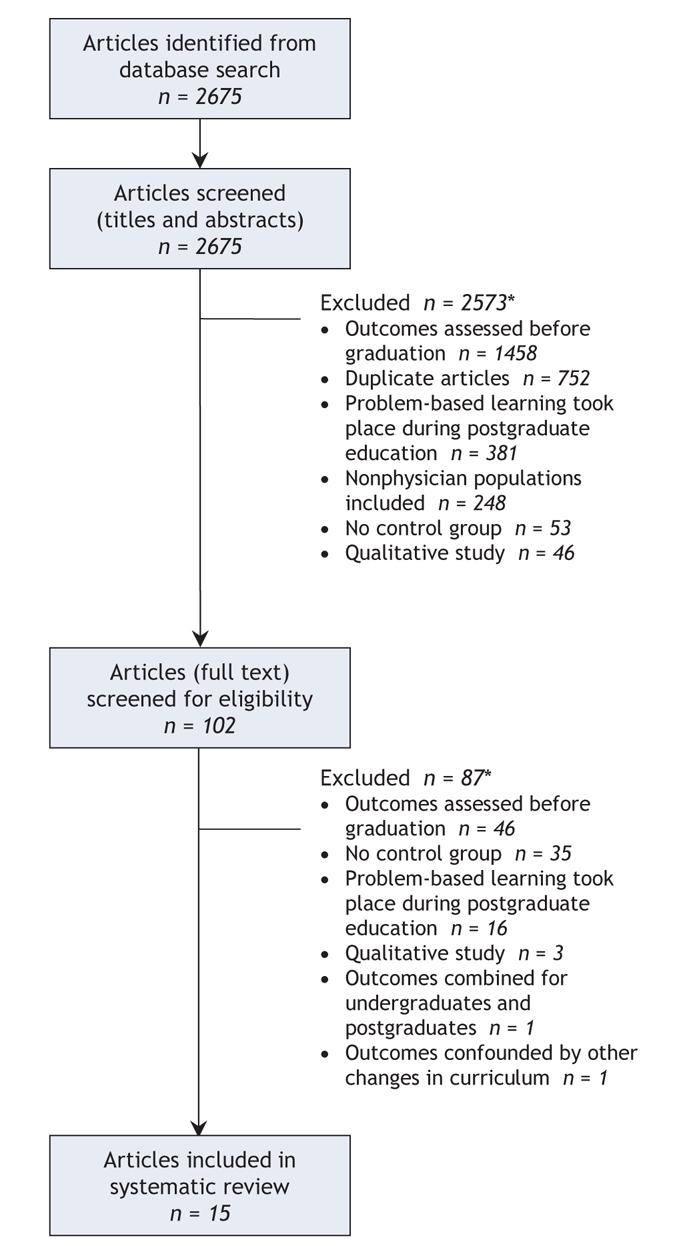
Results: Our search yielded 102 articles, of which 15 met inclusion criteria after full text review. Only 13 studies entered final systematic analysis because 2 studies reported their findings in 2 articles. According to self-assessments, 8 of 37 competencies had strong evidence in support of problem-based learning. Observed assessments had 7 competencies with strong evidence. In both groups, most of these competencies were in the social and cognitive dimensions. Only 4 competencies had moderate to strong levels of evidence in support of problem-based learning for both self-and observed assessments: coping with uncertainty (strong), appreciation of legal and ethical aspects of health care (strong), communication skills (moderate and strong respectively) and self-directed continuing learning (moderate).
Interpretation: Problem-based learning during medical school has positive effects on physician competency after graduation, mainly in social and cognitive dimensions.
Figures
Comment in
-
Is it time for another medical curriculum revolution?CMAJ. 2008 Jan 1;178(1):11, 13. doi: 10.1503/cmaj.071726. CMAJ. 2008. PMID: 18166716 Free PMC article. No abstract available.
-
Problem-based learning makes a difference. But why?CMAJ. 2008 Jan 1;178(1):61-2. doi: 10.1503/cmaj.071590. CMAJ. 2008. PMID: 18166733 Free PMC article. No abstract available.
References
-
- Christopher DF, Harte K, George CF. The implementation of tomorrow's doctors. Med Educ 2002;36:282-8. - PubMed
-
- Kinkade S. A snapshot of the status of problem-based learning in US medical schools, 2003–04. Acad Med 2005;80:300-1. - PubMed
-
- Donner RS, Bickley H. Problem-based learning: an assessment of its feasibility and cost. Hum Pathol 1990;21:881-5. - PubMed
-
- Harden RM. Developments in outcome-based education. Med Teach 2002;24:117-20. - PubMed
Publication types
MeSH terms
LinkOut - more resources
Full Text Sources
Miscellaneous