. 2008 Apr;197(2):339-50.
doi: 10.1007/s00213-007-1036-0. Epub 2008 Jan 3.

Effect of quinolinic acid-induced lesions of the nucleus accumbens core on performance on a progressive ratio schedule of reinforcement: implications for inter-temporal choice

Affiliations

Effect of quinolinic acid-induced lesions of the nucleus accumbens core on performance on a progressive ratio schedule of reinforcement: implications for inter-temporal choice

G Bezzina et al. Psychopharmacology (Berl). 2008 Apr.

Abstract

Rationale: The nucleus accumbens core (AcbC) is believed to contribute to the control of operant behaviour by reinforcers. Recent evidence suggests that it is not crucial for determining the incentive value of immediately available reinforcers, but is important for maintaining the values of delayed reinforcers.

Objective: This study aims to examine the effect of AcbC lesions on performance on a progressive-ratio schedule using a quantitative model that dissociates effects of interventions on motor and motivational processes (Killeen 1994 Mathematical principles of reinforcement. Behav Brain Sci 17:105-172).

Materials and methods: Rats with bilateral quinolinic acid-induced lesions of the AcbC (n = 15) or sham lesions (n = 14) were trained to lever-press for food-pellet reinforcers under a progressive-ratio schedule. In Phase 1 (90 sessions) the reinforcer was one pellet; in Phase 2 (30 sessions), it was two pellets; in Phase 3, (30 sessions) it was one pellet.

Results: The performance of both groups conformed to the model of progressive-ratio performance (group mean data: r2 > 0.92). The motor parameter, delta, was significantly higher in the AcbC-lesioned than the sham-lesioned group, reflecting lower overall response rates in the lesioned group. The motivational parameter, a, was sensitive to changes in reinforcer size, but did not differ significantly between the two groups. The AcbC-lesioned group showed longer post-reinforcement pauses and lower running response rates than the sham-lesioned group.

Conclusions: The results suggest that destruction of the AcbC impairs response capacity but does not alter the efficacy of food reinforcers. The results are consistent with recent findings that AcbC lesions do not alter sensitivity to reinforcer size in inter-temporal choice schedules.


Figures
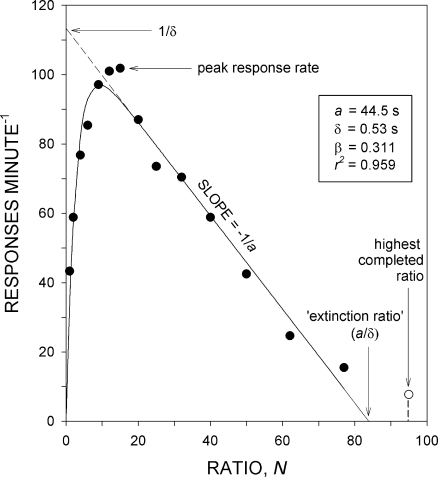
Fig. 1
Fig. 1
Fit of Equation 1 to data obtained from one rat responding on the progressive-ratio schedule, illustrating the derivation of the parameters. Ordinate: response rate; abscissa: response/reinforcer ratio (N). Points are mean overall response rates, averaged across ten sessions; the curve is defined by Equation 1 (parameter values: see inset). The (projected) point of intersection of the function with the ordinate is at R = 1/δ; the slope of the descending limb of the function is −1/a. Note that the data-point represented by the open symbol was excluded from the function-fitting (see text)
Fig. 2
Fig. 2
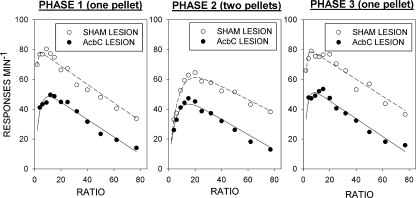
Overall response rates under the progressive-ratio schedule during the final 10 sessions of each phase of the experiment. Ordinate: response rate (responses minute−1); abscissa: response/reinforcer ratio. Points are group mean data from the sham-lesioned (open circles) and AcbC-lesioned (filled circles) groups. The curves are fits of Equation 1 to the data. See text for details of analysis
Fig. 3
Fig. 3
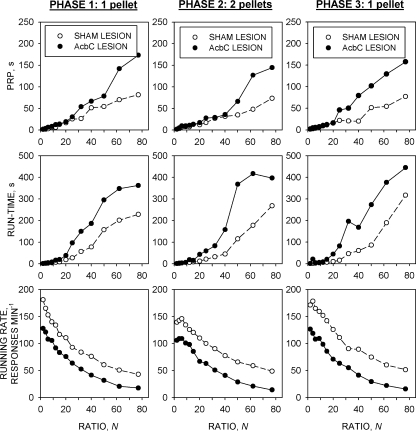
Performance in successive ratios of the progressive-ratio schedule during the final 10 sessions of each phase of the experiment. Upper panels. Post-reinforcement pause: ordinate, pause duration (s). Middle panels. Run-time (inter-reinforcement interval after subtraction of the post-reinforcement pause): ordinate, run-time (s). C. Lower panels. Running response rate (response rate during the ‘run-time’): ordinate: running rate (responses minute−1). Other conventions are as in Fig. 2
Fig. 4
Fig. 4
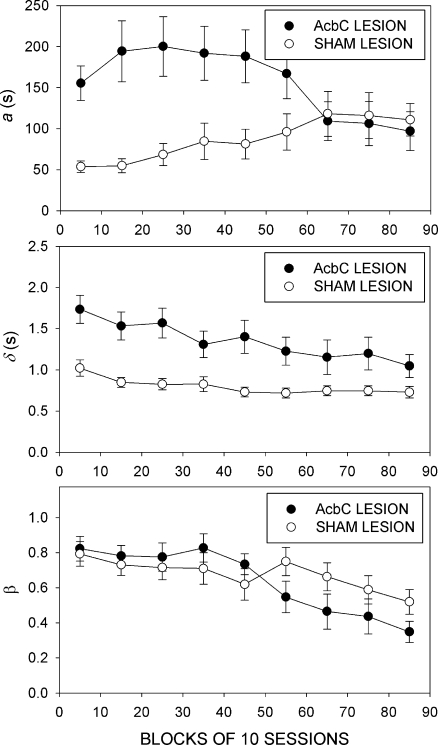
Parameters of Equation 1 obtained during successive 10-session blocks of Phase 1: Upper panel. ‘specific activation’ parameter, a (s). Middle panel. ‘response time’ parameter; δ (s). Lower panel. ‘currency’ parameter, β. Points are group mean data ±SEM. Other conventions as in Fig. 2
Fig. 5
Fig. 5
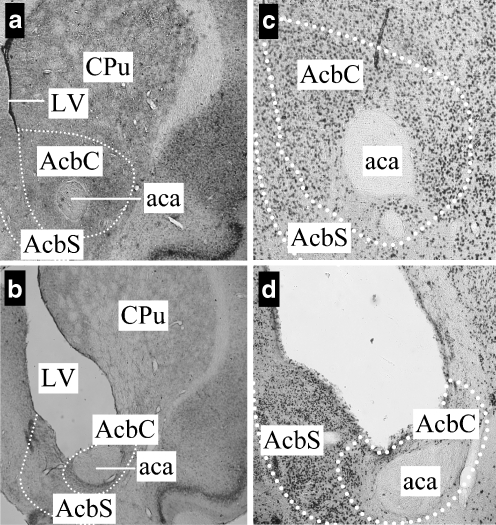
Sample photomicrographs showing coronal sections of the brains of a sham-lesioned rat (panels a nand c) and a AcbC-lesioned rat (panels b and d). Left-hand panels: sections stained with cresyl violet; right-hand panels: sections stained for NeuN. LV, lateral ventricle; CPu, caudate-putamen; AcbC, nucleus accumbens core; AcbS, nucleus accumbens shell; aca, anterior commisure. Note ventricular dilatation, neuronal loss and atrophy of the AcbC in the lesioned brain
Fig. 6
Fig. 6
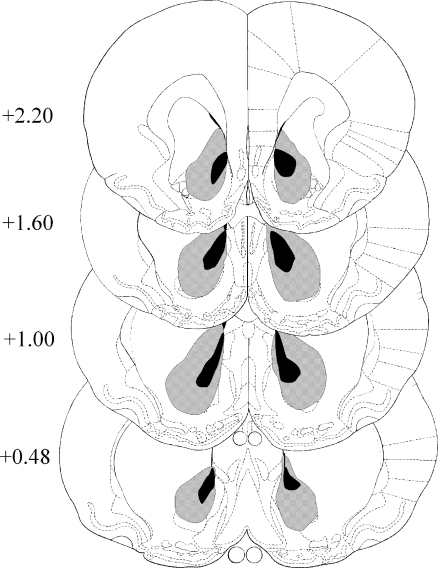
Diagram of the approximate area of destruction of the AcbC in the lesioned group. Drawings were made from the microscopic sections, and were superimposed on the relevant pages from Paxinos and Watson’s (1998) stereotaxic atlas. The black area represents the smallest, and the stippled area the largest extent of the lesion

References

    1. Aberman JE, Ward SJ, Salamone JD (1998) Effects of dopamine antagonists and accumbens dopamine depletions on time-constrained progressive-ratio performance. Pharmacol Biochem Behav 61:341–348 - DOI - PubMed
    1. Acheson A, Farrar AM, Patak M, Hausknecht KA, Kieres AK, Choi S, de Wit H, Richards JB (2006) Nucleus accumbens lesions decrease sensitivity to rapid changes in the delay to reinforcement. Behav Brain Res 173:217–228 - DOI - PMC - PubMed
    1. Ainslie GW (1975) Specious reward: a behavioral theory of impulsiveness and impulse control. Psychol Bull 82:463–492 - DOI - PubMed
    1. Baron A, Derenne A (2000) Progressive ratio schedules: effects of later schedule requirements on earlier performances. J Exp Anal Behav 73:291–304 - DOI - PMC - PubMed
    1. Baron A, Mikorski J, Schlund M (1992) Reinforcement magnitude and pausing on progressive-ratio schedules. J Exp Anal Behav 58:377–388 - DOI - PMC - PubMed

Publication types

Substances

LinkOut - more resources