


Low-level HIV-1 replication and the dynamics of the resting CD4+ T cell reservoir for HIV-1 in the setting of HAART
- PMID: 18171475
- PMCID: PMC2254415
- DOI: 10.1186/1471-2334-8-2
Low-level HIV-1 replication and the dynamics of the resting CD4+ T cell reservoir for HIV-1 in the setting of HAART
Abstract
Background: In the setting of highly active antiretroviral therapy (HAART), plasma levels of human immunodeficiency type-1 (HIV-1) rapidly decay to below the limit of detection of standard clinical assays. However, reactivation of remaining latently infected memory CD4+ T cells is a source of continued virus production, forcing patients to remain on HAART despite clinically undetectable viral loads. Unfortunately, the latent reservoir decays slowly, with a half-life of up to 44 months, making it the major known obstacle to the eradication of HIV-1 infection. However, the mechanism underlying the long half-life of the latent reservoir is unknown. The most likely potential mechanisms are low-level viral replication and the intrinsic stability of latently infected cells.
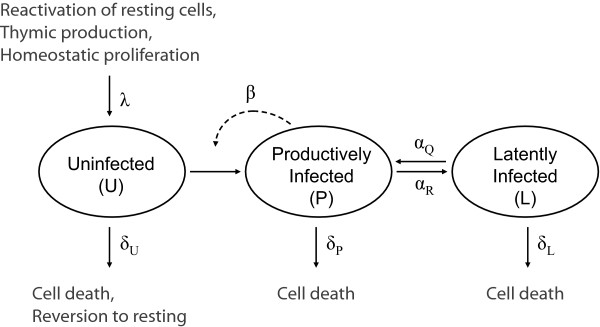
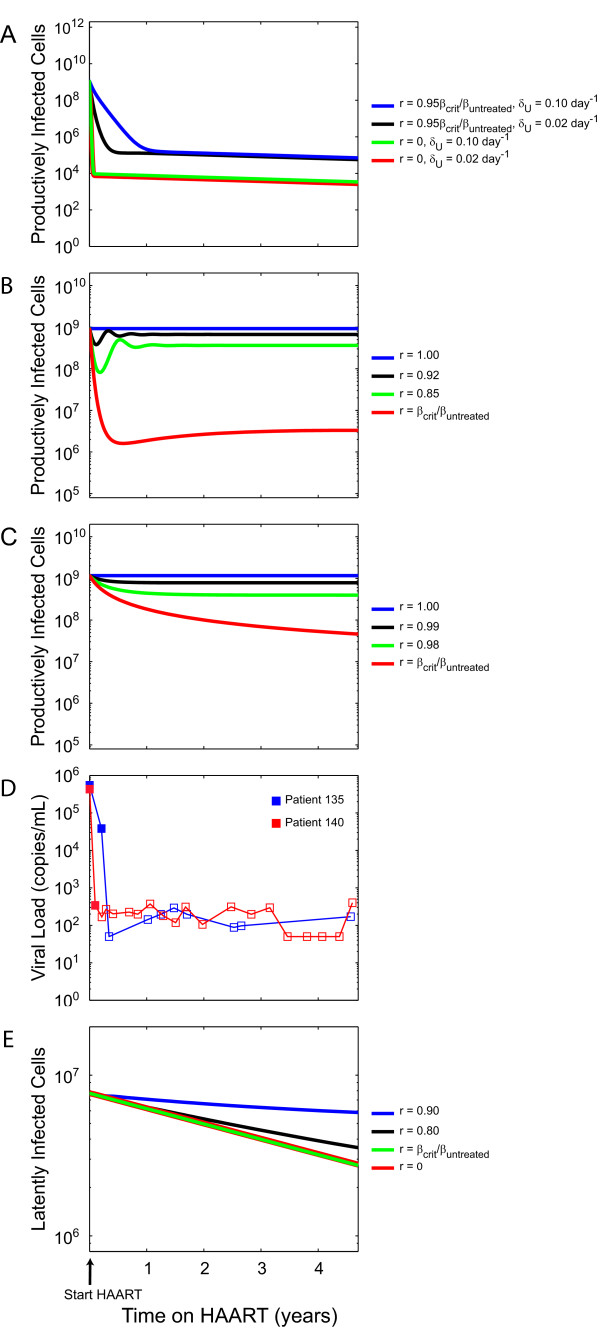
Methods: Here we use a mathematical model of T cell dynamics in the setting of HIV-1 infection to probe the decay characteristics of the latent reservoir upon initiation of HAART. We compare the behavior of this model to patient derived data in order to gain insight into the role of low-level viral replication in the setting of HAART.
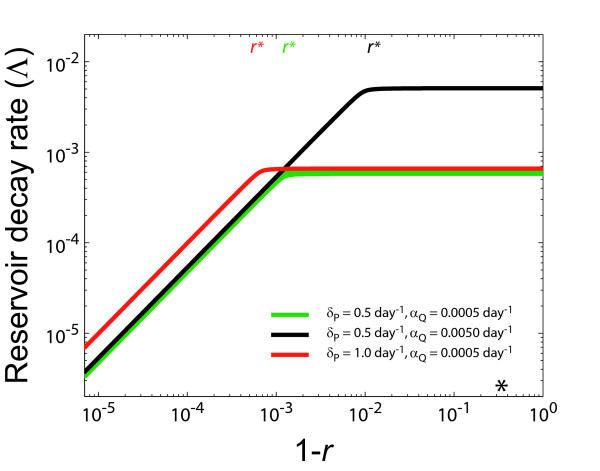
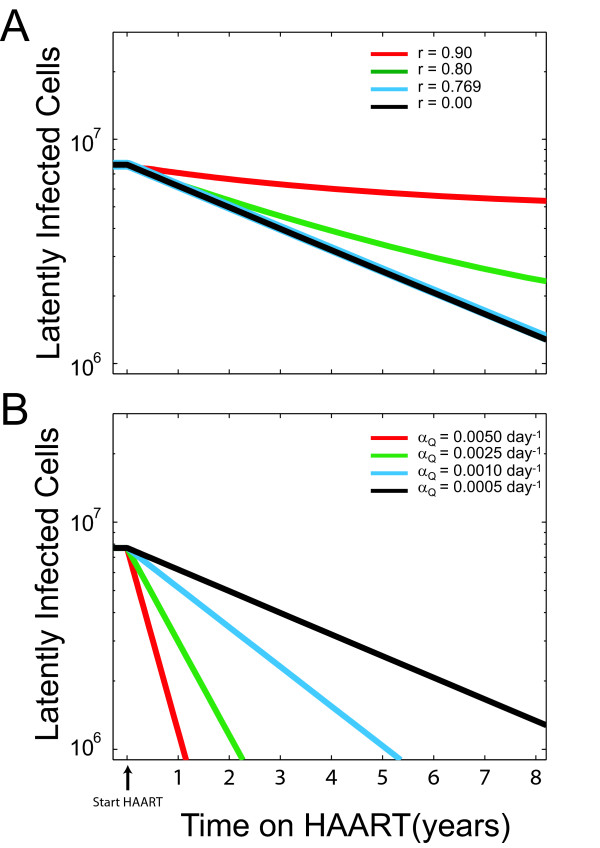
Results: By comparing the behavior of our model to patient derived data, we find that the viral dynamics observed in patients on HAART could be consistent with low-level viral replication but that this replication would not significantly affect the decay rate of the latent reservoir. Rather than low-level replication, the intrinsic stability of latently infected cells and the rate at which they are reactivated primarily determine the observed reservoir decay rate according to the predictions of our model.
Conclusion: The intrinsic stability of the latent reservoir has important implications for efforts to eradicate HIV-1 infection and suggests that intensified HAART would not accelerate the decay of the latent reservoir.
Figures
References
-
- Chun TW, Carruth L, Finzi D, Shen X, DiGiuseppe JA, Taylor H, Hermankova M, Chadwick K, Margolick J, Quinn TC, Kuo YH, Brookmeyer R, Zeiger MA, Barditch-Crovo P, Siliciano RF. Quantification of latent tissue reservoirs and total body viral load in HIV-1 infection. Nature. 1997;387:183–188. doi: 10.1038/387183a0. - DOI - PubMed
-
- Finzi D, Hermankova M, Pierson T, Carruth LM, Buck C, Chaisson RE, Quinn TC, Chadwick K, Margolick J, Brookmeyer R, Gallant J, Markowitz M, Ho DD, Richman DD, Siliciano RF. Identification of a reservoir for HIV-1 in patients on highly active antiretroviral therapy. Science. 1997;278:1295–1300. doi: 10.1126/science.278.5341.1295. - DOI - PubMed
-
- Hermankova M, Siliciano JD, Zhou Y, Monie D, Chadwick K, Margolick JB, Quinn TC, Siliciano RF. Analysis of human immunodeficiency virus type 1 gene expression in latently infected resting CD4+ T lymphocytes in vivo. J Virol. 2003;77:7383–7392. doi: 10.1128/JVI.77.13.7383-7392.2003. - DOI - PMC - PubMed
Publication types
MeSH terms
Grants and funding
LinkOut - more resources
Full Text Sources
Other Literature Sources
Medical
Research Materials
