. 2008 Mar;28(6):2023-34.
doi: 10.1128/MCB.02130-07. Epub 2008 Jan 2.

Multiple-myeloma-related WHSC1/MMSET isoform RE-IIBP is a histone methyltransferase with transcriptional repression activity

Affiliations

Multiple-myeloma-related WHSC1/MMSET isoform RE-IIBP is a histone methyltransferase with transcriptional repression activity

Ji-Young Kim et al. Mol Cell Biol. 2008 Mar.

Abstract

Histone methylation is crucial for transcriptional regulation and chromatin remodeling. It has been suggested that the SET domain containing protein RE-IIBP (interleukin-5 [IL-5] response element II binding protein) may perform a function in the carcinogenesis of certain tumor types, including myeloma. However, the pathogenic role of RE-IIBP in these diseases remains to be clearly elucidated. In this study, we have conducted an investigation into the relationship between the histone-methylating activity of RE-IIBP and transcriptional regulation. Here, we report that RE-IIBP is up-regulated in the blood cells of leukemia patients, and we characterized the histone H3 lysine 27 (H3-K27) methyltransferase activity of RE-IIBP. Point mutant analysis revealed that SET domain cysteine 483 and arginine 477 are critical residues for the histone methyltransferase (HMTase) activity of RE-IIBP. RE-IIBP also represses basal transcription via histone deacetylase (HDAC) recruitment, which may be mediated by H3-K27 methylation. In the chromatin immunoprecipitation assays, we showed that RE-IIBP overexpression induces histone H3-K27 methylation, HDAC recruitment, and histone H3 hypoacetylation on the IL-5 promoter and represses expression. Conversely, short hairpin RNA-mediated knockdown of RE-IIBP reduces histone H3-K27 methylation and HDAC occupancy around the IL-5 promoter. These data illustrate the important regulatory role of RE-IIBP in transcriptional regulation, thereby pointing to the important role of HMTase activity in carcinogenesis.


Figures
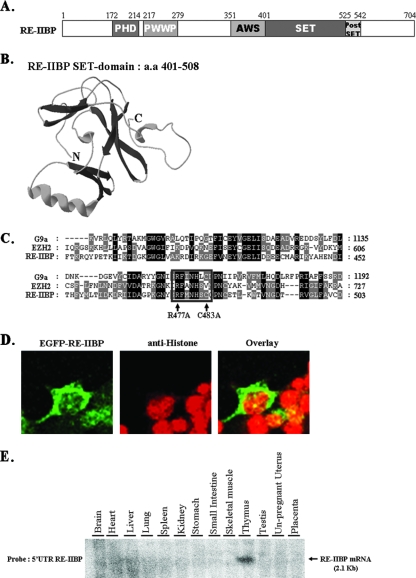
FIG. 1.
FIG. 1.
Structural features of the RE-IIBP. (A) Schematic view of RE-IIBP domains: amino acids 172 to 214 were predicted to be the PHD domain; amino acids 217 to 279 were predicted to be the PWWP (proline-tryptophan-tryptophan-proline) domain; amino acids 401 to 525 were predicted to be the SET domain; and amino acids 526 to 542 were predicted to be the postSET domain. (B) Three-dimensional modeling of RE-IIBP SET domain was performed by using the stand-alone Swiss-PdbViewer with an installed protein loop database. (C) Multiple alignments of the SET domains of G9a, EZH2, and RE-IIBP proteins. RE-IIBP protein harbors an RΦΦNHSC motif (where Φ indicates a hydrophobic residue; boxed). The arrows indicate the R477 and C483 residues of the RΦΦNHSC motif that are mutated for testing the HMTase activity of RE-IIBP protein. Conserved amino acid residues between three sequences are shown in black, and similar residues between these two sequences are shaded in gray. (D) HeLa cells were transfected with enhanced green fluorescent protein (EGFP)-RE-IIBP, stained with anti-histone antibodies, and detected with Cy3-conjugated secondary antibodies. (E) The adult human tissue blot was hybridized to a 32P-labeled 5′ UTR RE-IIBP DNA probe. The 2.1-kb RE-IIBP mRNA transcript is indicated by an arrow.
FIG. 2.
FIG. 2.
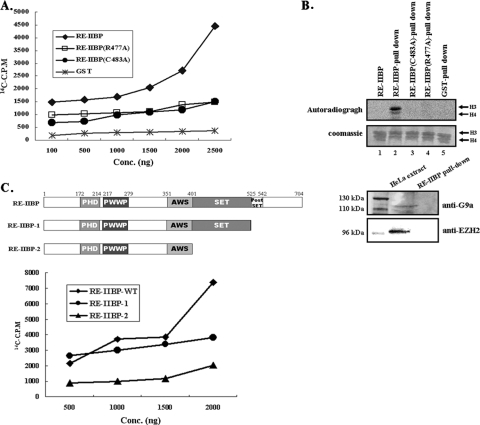
HMTase activity of RE-IIBP. (A) Core histones were used as substrates in the HMTase assay with GST-RE-IIBP and GST-RE-IIBP point mutants (C483A and R477A). Methylation levels were quantified via filter binding assay, and data are represented as raw counts per minute incorporated. (B) Purified GST-RE-IIBP, GST-RE-IIBP point mutants, and GST proteins were incubated with HeLa cell extracts and subjected to HMTase assays. GST-bound beads were used as the negative control. The lower panel represents GST-RE-IIBP pulled down and immunoblotted with anti-G9a and anti-EZH2 antibodies. HeLa cell extracts were used as the positive control. (C) A similar HMTase assay as that described in panel A was performed with RE-IIBP deletion mutants (GST-RE-IIBP-1 and GST-RE-IIBP-2). A schematic representation of the domain structure of the recombinant RE-IIBP deletion mutants is shown. Conc, concentration; WT, wild type.
FIG. 3.
FIG. 3.
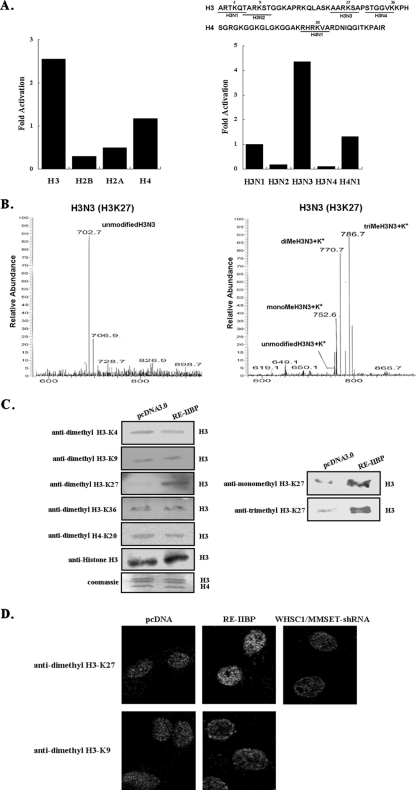
Histone H3-K27 methylation specificity of RE-IIBP. (A) HMTase assays were performed with individual histone subunits and five synthesized histone peptides, shown above as substrates. Reaction products were analyzed by the filter binding assay and scintillation counting. (B) Synthesized peptides (H3N3) were used as substrates in the HMTase assay with purified RE-IIBP. After 3 h, the proteins were precipitated with TCA buffer and removed by centrifugation. The methylated peptide samples were analyzed by LC-MS. (C) Transiently transfected cell extracts were immunoblotted against anti-dimethyl H3-K4, anti-dimethyl H3-K9, anti-monomethyl H3-K27, anti-dimethyl H3-K27, anti-trimethyl H3-K27, anti-dimethyl H3-K36, and anti-dimethyl H4-K20 antibodies. The equal amount of sample loading was confirmed by Western blotting with antibodies against histone H3. (D) Immunofluorescence staining of HeLa cells transfected with pcDNA3.1-HisTOPO-RE-IIBP and pSM2c-WHSC1/MMSET-shRNA using antihistone antibodies and anti-dimethyl H3-K9 and anti-dimethyl H3-K27 antibodies. Antibody staining was visualized using Cy3-conjugated antibodies. Me, methylated.
FIG. 4.
FIG. 4.
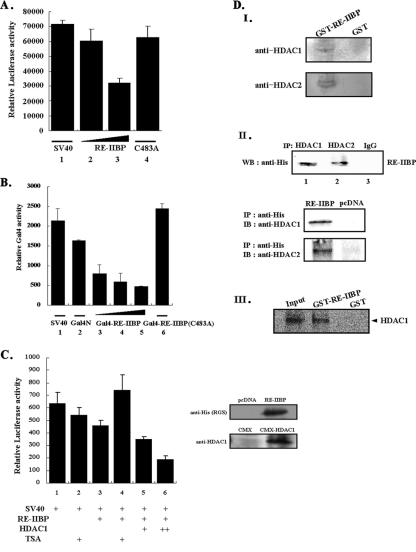
RE-IIBP represses transcription and associates with HDAC. (A) HeLa cells were transfected with Gal4-SV40 and increasing concentrations of RE-IIBP constructs, as indicated. Following transfection of the pcDNA3.1-HisTOPO-RE-IIBP and the point mutant (C483A), cell extracts were assayed for luciferase activity. (B) Cotransfections of a Gal4-SV40 luciferase reporter with the GAL4 DNA binding domain alone or Gal4-RE-IIBP and Gal4-RE-IIBP point mutant (C483A) are shown. (C) HeLa cells were transfected with Gal4-SV40 reporter vector, pcDNA3.1-HisTOPO-RE-IIBP, and CMX-HDAC1. TSA was added, as indicated, 24 h after transfection. Expression of RE-IIBP and HDAC1 used in transfection assays was confirmed by immunoblotting using anti-His and anti-HDAC1 antibodies. (D) GST-RE-IIBP and GST were incubated in HeLa cell extract and immunoblotted with anti-HDAC1 and anti-HDAC2 antibodies (I). HeLa cells were transfected with pcDNA3.1-HisTOPO-RE-IIBP (RE-IIBP) and pcDNA3.0 (pcDNA) constructs as indicated (II). After cell lysates were treated with DNase, immunoprecipitation was performed with anti-HDAC1, anti-HDAC2, anti-His, and anti-IgG antibodies; immunoblot analysis was then performed with anti-His (RE-IIBP) or anti-HDAC1 or anti-HDAC2 antibodies. (III) CMX-HDAC1 was in vitro transcribed and translated and incubated with purified GST-RE-IIBP and GST bound to beads. Pulled-down proteins were analyzed by SDS-PAGE and phosphorimager. IP, immunoprecipitation; IB, immunoblotting; WB, Western blotting.
FIG. 5.
FIG. 5.
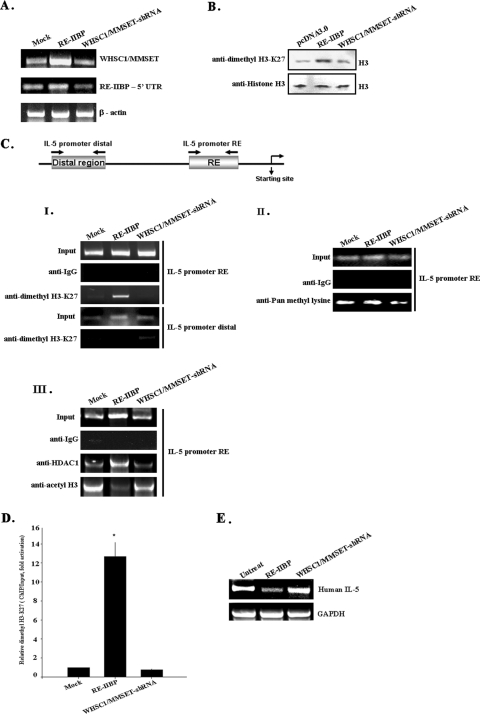
Effects of RE-IIBP transcript by RNA interference. (A) HeLa cells were mock transfected or transfected with pcDNA3.1-HisTOPO-RE-IIBP and pSM2c-WHSC1/MMSET-shRNA, and WHSC1/MMESET and RE-IIBP expression levels were confirmed by RT-PCR with specific primers. (B) The status of lysine methylation was determined using transiently transfected cells with RE-IIBP and WHSC1/MMSET-shRNA. Transfected cells were lysed and immunoblotted with anti-dimethyl H3-K27 antibodies. (C) HeLa cells were transfected with the pcDNA3.0, pcDNA3.1-HisTOPO-RE-IIBP, and pSM2c-WHSC1/MMSET-shRNA. Following transfection, ChIP assays were performed employing control IgG, anti-dimethyl H3-K27 (I), anti-pan methyl lysine antibodies (II), and anti-acetyl H3 and anti-HDAC1 antibodies (III). The immunoprecipitated DNA fragments were amplified by PCR from the proximal and distal promoter regions of the integrated IL-5. (D) ChIP analysis was performed with the indicated antibodies and examined by qPCR in the presence of proximal IL-5 promoter fragments. The dimethyl H3-K27 level was normalized by input. (E) Total RNA was isolated from HeLa cells. RT-PCR analysis was performed with primers for IL-5. Human glyceraldehyde-3-phosphate dehydrogenase (GAPDH) was used as an RNA loading control. The relative levels of gene expression of RE-IIBP mRNA in untreated cells and RE-IIBP- and WHSC1/MMSET-shRNA-transfected cells were compared by RT-PCR.
FIG. 6.
FIG. 6.
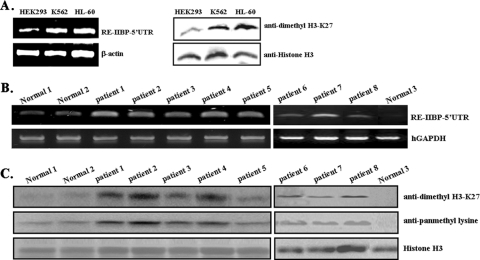
RE-IIBP expression and histone methylation levels are increased in leukemia patient samples. (A) Nuclear extracts from leukemic cell lines K562 and HL-60 amplified with primers for the 5′ UTR RE-IIBP region were immunoblotted with anti-dimethyl H3-K27 antibodies. (B) Semiquantitative RT-PCR analysis was performed with primers for the 5′ UTR RE-IIBP region. Human glyceraldehyde-3-phosphate dehydrogenase (hGAPDH) was used as an RNA loading control. (C) Histones extracted from blood cells of healthy individuals and from leukemia patients were separated by 18% SDS-PAGE and immunoblotted against anti-dimethyl H3-K27 and anti-pan methyl lysine antibodies. The loading of equal amounts of sample was confirmed by Western blotting with antibodies against histone H3.

References

    1. Ayton, P. M., and M. L. Cleary. 2001. Molecular mechanisms of leukemogenesis mediated by MLL fusion proteins. Oncogene 205695-5707. - PubMed
    1. Cao, R., L. Wang, H. Wang, L. Xia, H. Erdjument-Bromage, P. Tempst, R. S. Jones, and Y. Zhang. 2002. Role of histone H3 lysine 27 methylation in Polycomb-group silencing. Science 2981039-1043. - PubMed
    1. Daser, A., and T. H. Rabbitts. 2004. Extending the repertoire of the mixed-lineage leukemia gene MLL in leukemogenesis. Genes Dev. 18965-974. - PubMed
    1. Fischle, W., Y. Wang, and C. D. Allis. 2003. Binary switches and modification cassettes in histone biology and beyond. Nature 425475-479. - PubMed
    1. Garlisi, C. G., A. S. Uss, H. Xiao, F. Tian, K. E. Sheridan, L. Wang, M. Motasim Billah, R. W. Egan, K. S. Stranick, and S. P. Umland. 2001. A unique mRNA initiated within a middle intron of WHSC1/MMSET encodes a DNA binding protein that suppresses human IL-5 transcription. Am. J. Respir. Cell Mol. Biol. 2490-98. - PubMed

Publication types

MeSH terms