. 2008 Jan 3;451(7174):69-72.
doi: 10.1038/nature06414.

TRPC channel activation by extracellular thioredoxin

Affiliations

TRPC channel activation by extracellular thioredoxin

Shang-Zhong Xu et al. Nature. .

Abstract

Mammalian homologues of Drosophila melanogaster transient receptor potential (TRP) are a large family of multimeric cation channels that act, or putatively act, as sensors of one or more chemical factor. Major research objectives are the identification of endogenous activators and the determination of cellular and tissue functions of these channels. Here we show the activation of TRPC5 (canonical TRP 5) homomultimeric and TRPC5-TRPC1 heteromultimeric channels by extracellular reduced thioredoxin, which acts by breaking a disulphide bridge in the predicted extracellular loop adjacent to the ion-selectivity filter of TRPC5. Thioredoxin is an endogenous redox protein with established intracellular functions, but it is also secreted and its extracellular targets are largely unknown. Particularly high extracellular concentrations of thioredoxin are apparent in rheumatoid arthritis, an inflammatory joint disease that disables millions of people worldwide. We show that TRPC5 and TRPC1 are expressed in secretory fibroblast-like synoviocytes from patients with rheumatoid arthritis, that endogenous TRPC5-TRPC1 channels of the cells are activated by reduced thioredoxin, and that blockade of the channels enhances secretory activity and prevents the suppression of secretion by thioredoxin. The data indicate the presence of a previously unrecognized ion-channel activation mechanism that couples extracellular thioredoxin to cell function.


Figures
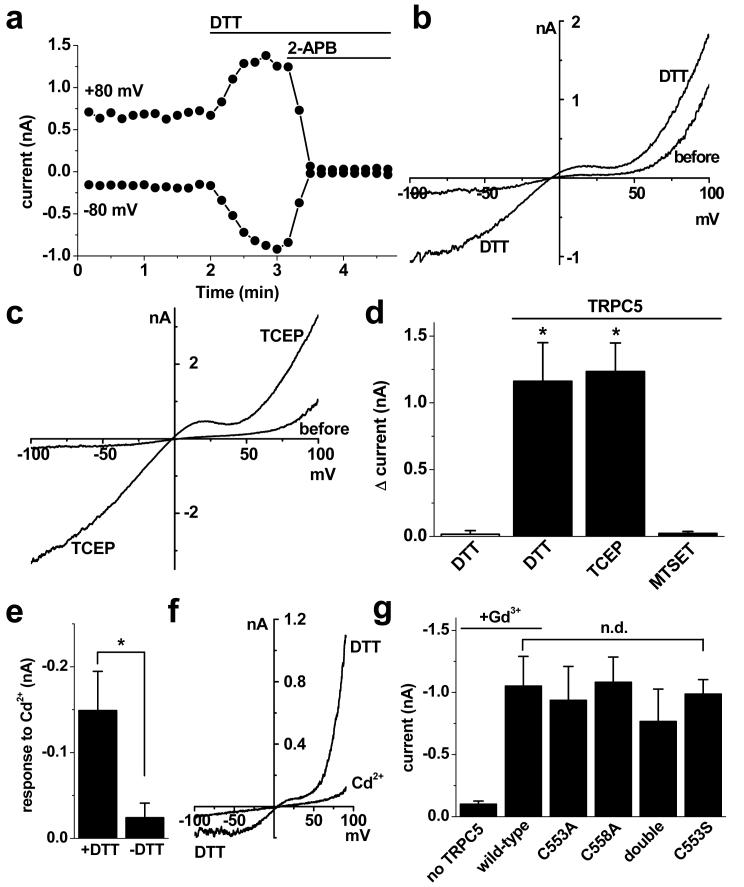
Figure 1
Figure 1. Functional disulphide-bridge in TRPC5
Whole-cell recordings from HEK 293 cells. a, In a cell expressing TRPC5, response to bath-applied 10 mM DTT and 75 μM 2-APB. b, I-Vs from a. c, As for b but for 1 mM TCEP. d, Currents at -80 mV evoked by 10 mM DTT (n=8), 1 mM TCEP (n=5) or 5 mM MTSET (n=6) in cells expressing TRPC5. DTT had no effect without TRPC5 (n=5). e, Inhibition of current at -80 mV by 0.1 mM Cd2+ in TRPC5-cells with and without DTT treatment. f, As for e but typical I-Vs. g, Currents at -80 mV after transfection with GFP alone (no TRPC5, n=8) or GFP plus wild-type TRPC5 (n=7) or the TRPC5 mutants C553A (n=11), C558A (n=6), C553A+C558A (double, n=3) or C553S (n=6). Gd3+ (100 μM) activated wild-type TRPC5 but had no effect on mutants. All currents were blocked by 2-APB (eg Supplementary Fig. 5).
Figure 2
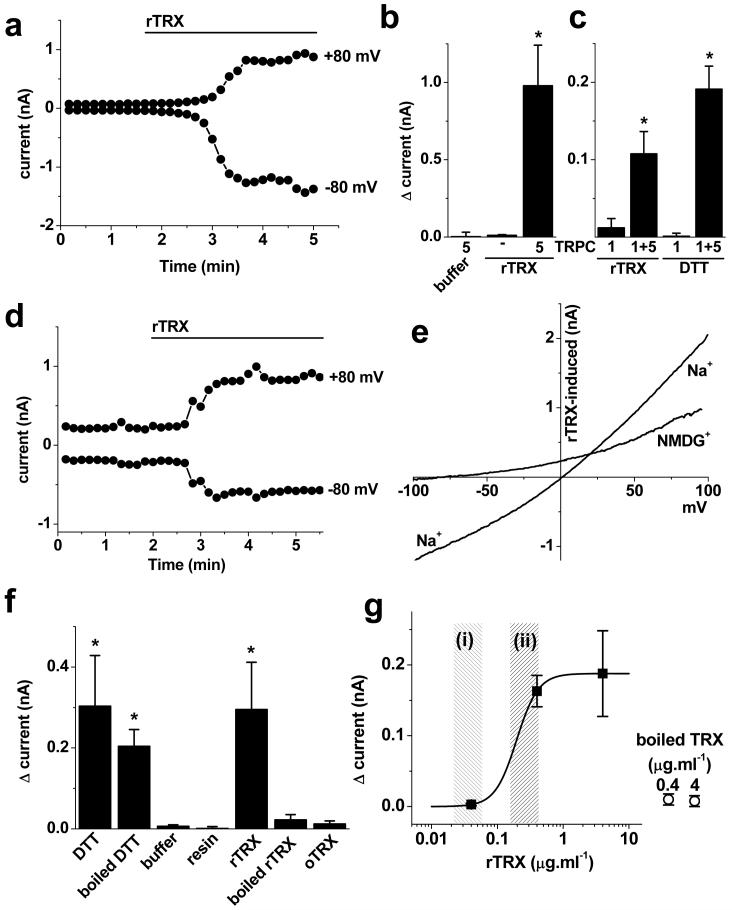
Figure 2. Ionic current induced by rTRX
a-c, Whole-cell recordings from HEK 293 cells expressing TRPC5 alone (a-b), TRPC1 alone, or TRPC5 plus TRPC1 (c). a, Effect of 4 μg.ml-1 rTRX. b, Current at -80 mV in response to 1:100 elution buffer (n=4) or rTRX with (n=8) and without (n=3) TRPC5 expression. c, Responses to rTRX or 10 mM DTT (n=5 each). d, Effect of rTRX on a human FLS cell. e-g, Data for rabbit FLS cells. e, rTRX induced I-Vs in standard bath (Na+) or N-methyl-D-glucamine (NMDG+) solution (see Supplementary Fig. 9). f, Currents evoked at -80 mV. g, Data for human rTRX with a fitted Hill equation (EC50 0.20 μg.ml-1, slope 2.64). Open symbols are control data and shaded areas concentrations of TRX in patients without arthritis (i) or with osteo (i) or rheumatoid arthritis (ii). f-g, n=5 per data point.
Figure 3
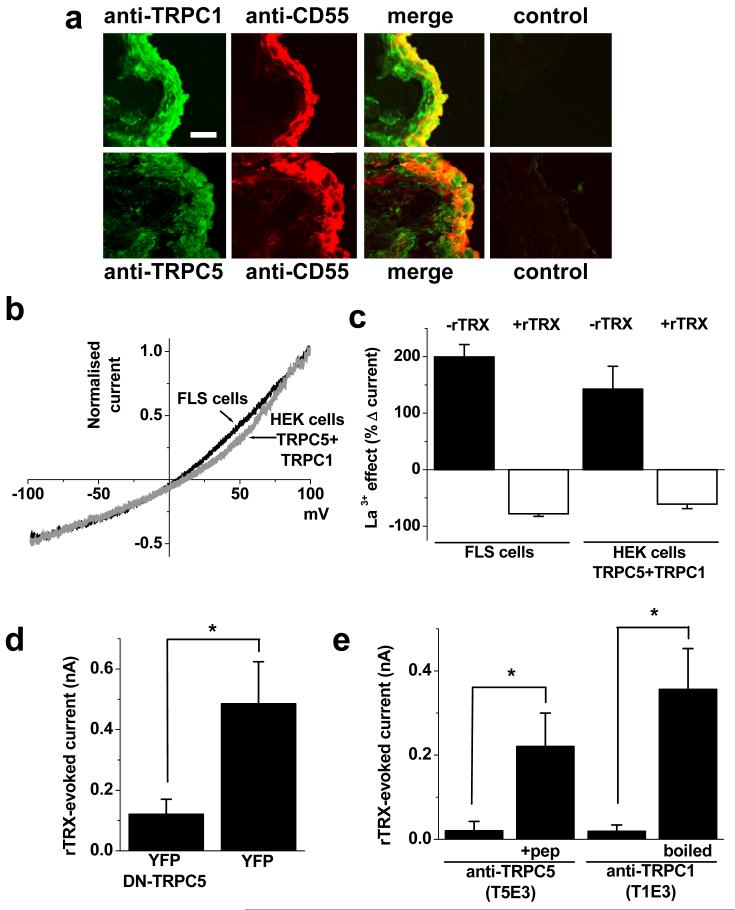
Figure 3. Endogenous TRPC expression and function
a, Tissue sections from joints of patients with rheumatoid arthritis stained with T1E3 or T5E3 (green) or anti-CD55 (red) antibodies. Controls were: omission of anti-CD55 antibody; T1E3 or T5E3 preadsorbed to its antigenic peptide. b, Normalised rTRX-evoked I-Vs for rabbit FLS cells (n=3) and HEK 293 cells expressing TRPC5 and TRPC1 (n=5). c, Changes in currents at -80 mV in response to 10 μM La3+ before or after 4 μg.ml-1 rTRX (n=6 FLS cells, n=4 HEK cells). d, Current at -80 mV in FLS cells transfected with DN-TRPC5 plus YFP or YFP alone (n=5 each). e, As in d but showing effects of anti-TRPC antibodies (n=5 each).
Figure 4
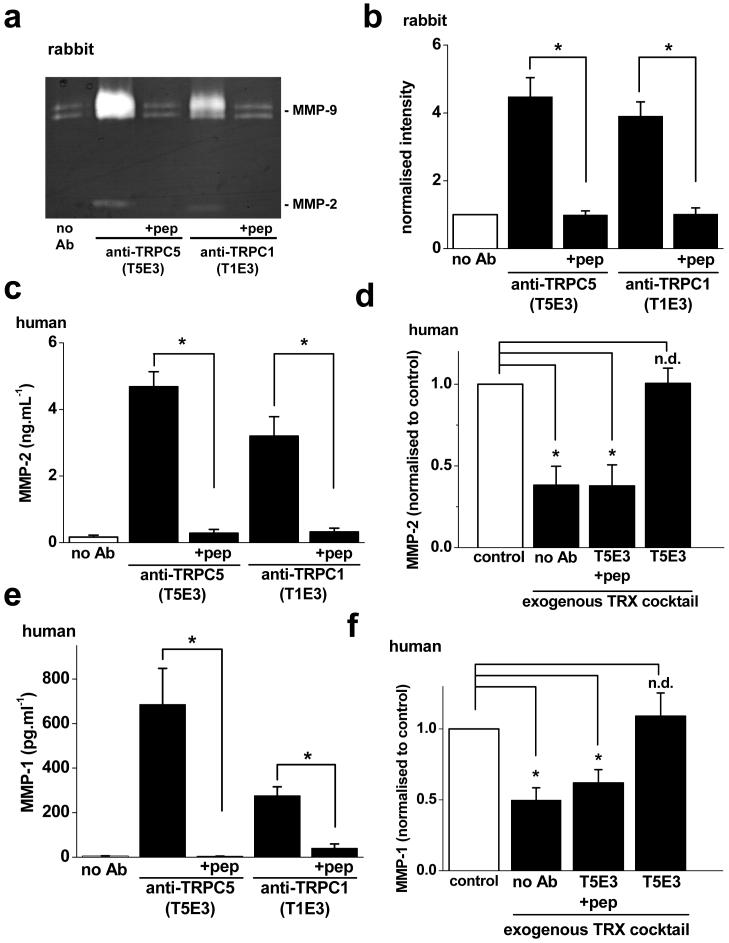
Figure 4. Relevance to secretion from FLS cells
a, Zymogram showing MMP-9 (pro and active) and MMP-2. b, As for a but mean data after normalisation of MMP-9 band intensity to the no antibody control group (n=3 each). c, ELISA data for MMP-2 (n=4). d, Effect of T5E3 (n=4) on inhibition of MMP-2 secretion by exogenous TRX cocktail. For each group secretion in TRX was normalised to that in its absence (control). e, f, As for c, d but for secretion of pro-MMP-1.

References

    1. Flockerzi V. An introduction on TRP channels. Handb Exp Pharmacol. 2007:1–19. - PubMed
    1. Nilius B, Owsianik G, Voets T, Peters JA. Transient receptor potential cation channels in disease. Physiol Rev. 2007;87:165–217. - PubMed
    1. Strubing C, Krapivinsky G, Krapivinsky L, Clapham DE. TRPC1 and TRPC5 form a novel cation channel in mammalian brain. Neuron. 2001;29:645–55. - PubMed
    1. Plant TD, Schaefer M. TRPC4 and TRPC5: receptor-operated Ca2+-permeable nonselective cation channels. Cell Calcium. 2003;33:441–50. - PubMed
    1. Beech DJ. TRPC5. Handb Exp Pharmacol. 2007:109–123. 2007. - PubMed

Publication types

Substances