Molecular characterization of Mycobacterium massiliense and Mycobacterium bolletii in isolates collected from outbreaks of infections after laparoscopic surgeries and cosmetic procedures
- PMID: 18174307
- PMCID: PMC2268380
- DOI: 10.1128/JCM.02052-07
Molecular characterization of Mycobacterium massiliense and Mycobacterium bolletii in isolates collected from outbreaks of infections after laparoscopic surgeries and cosmetic procedures
Abstract
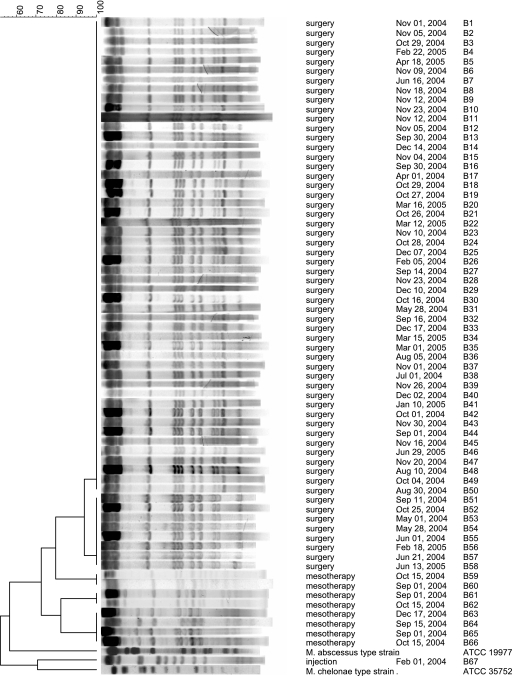
An outbreak of infections affecting 311 patients who had undergone different invasive procedures occurred in 2004 and 2005 in the city of Belém, in the northern region of Brazil. Sixty-seven isolates were studied; 58 were from patients who had undergone laparoscopic surgeries, 1 was from a patient with a postinjection abscess, and 8 were from patients who had undergone mesotherapy. All isolates were rapidly growing nonpigmented mycobacteria and presented a pattern by PCR-restriction enzyme analysis of the hsp65 gene with BstEII of bands of 235 and 210 bp and with HaeIII of bands of 200, 70, 60, and 50 bp, which is common to Mycobacterium abscessus type 2, Mycobacterium bolletii, and Mycobacterium massiliense. hsp65 and rpoB gene sequencing of a subset of 20 isolates was used to discriminate between these three species. hsp65 and rpoB sequences chosen at random from 11 of the 58 isolates from surgical patients and the postinjection abscess isolate presented the highest degrees of similarity with the corresponding sequences of M. massiliense. In the same way, the eight mesotherapy isolates were identified as M. bolletii. Molecular typing by pulsed-field gel electrophoresis (PFGE) grouped all 58 surgical isolates, while the mesotherapy isolates presented three different PFGE patterns and the postinjection abscess isolate showed a unique PFGE pattern. In conclusion, molecular techniques for identification and typing were essential for the discrimination of two concomitant outbreaks and one case, the postinjection abscess, not related to either outbreak, all of which were originally attributed to a single strain of M. abscessus.
Figures
References
-
- Adekambi, T., P. Berger, D. Raoult, and M. Drancourt. 2006. rpoB gene sequence-based characterization of emerging non-tuberculous mycobacteria with descriptions of Mycobacterium bolletii sp. nov., Mycobacterium phocaicum sp. nov. and Mycobacterium aubagnense sp. nov. Int. J. Syst. Evol. Microbiol. 56133-143. - PubMed
-
- Adekambi, T., and M. Drancourt. 2004. Dissection of phylogenetic relationships among 19 rapidly growing Mycobacterium species by 16S rRNA, hsp65, sodA, recA and rpoB gene sequencing. Int. J. Syst. Evol. Microbiol. 542095-2105. - PubMed
-
- Brown-Elliott, B. A., D. E. Griffith, and R. J. Wallace, Jr. 2002. Diagnosis of nontuberculous mycobacterial infections. Clin. Lab. Med. 22911-925, vi. - PubMed
Publication types
MeSH terms
Substances
Associated data
- Actions
- Actions
- Actions
- Actions
- Actions
- Actions
- Actions
- Actions
LinkOut - more resources
Full Text Sources
Medical
Molecular Biology Databases
Research Materials