


Review
doi: 10.1161/CIRCRESAHA.107.164186.
Forkhead transcription factors and cardiovascular biology
Affiliations
- PMID: 18174472
- PMCID: PMC2752022
- DOI: 10.1161/CIRCRESAHA.107.164186
Item in Clipboard
Review
Forkhead transcription factors and cardiovascular biology
Circ Res.
.
Abstract
The Forkhead family of transcription factors modulates a wide variety of cellular functions in cardiovascular tissues. In this review article, we discuss recent advances in our understanding of regulation provided by the forkhead factors in cardiac myocytes and vascular cells.
Figures
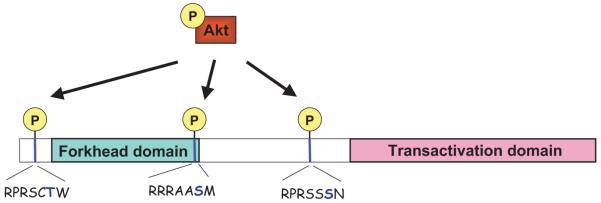
FoxO factors are regulated by the protein kinase Akt. Schematic representation of the generalized structure of FoxO forkhead factors and the conserved Akt-phosphorylation sites. Phosphorylation on these serine/threonine residues is considered to be inhibitory because it facilitates nuclear export and cytoplasmic retention/degradation of the FoxO factors. The forkhead/winged helix domain required for DNA binding and the transactivation domain necessary for interactions with other DNA-associated proteins are also illustrated.
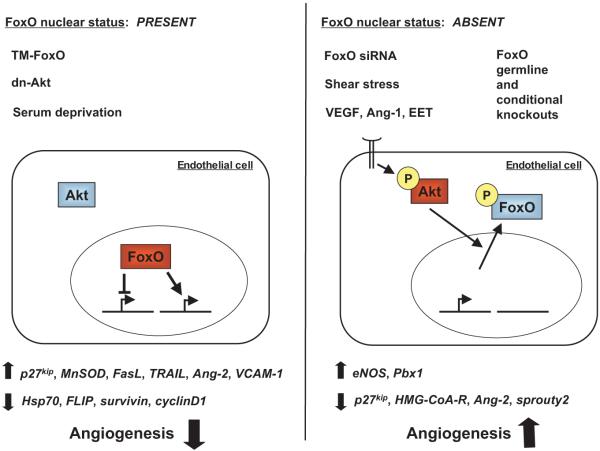
The role of FoxO factors in endothelial cells. Left panel, FoxO nuclear localization can be conferred by incubating ECs in low serum media or by inhibiting PI3K/Akt signaling. Nuclear localization of FoxO has been frequently recapitulated in cultured ECs by means of ectopic expression of a mutant FoxO isoform mutated at the 3 conserved Akt sites (FoxO-TM). On nuclear localization, FoxO can activate or repress the transcription of several target genes as illustrated at the bottom. The overall effect of FoxO activation in ECs is a suppression of angiogenesis. Right panel, The classical route for FoxO nuclear exclusion involves shear stress or the stimulation of the PI3K/Akt pathway by different agonists. FoxO gene-targeting in mice has been also used to dissect their functions in vivo. FoxO inhibition is generally associated with angiogenesis. The generic term FoxO is used to describe properties identified in 1 or more of FoxO1, FoxO3, and FoxO4. See the text for details on isoform specific properties of the FoxO factors or the paradoxical synergism between FoxO and VEGF signaling. TM-FoxO indicates triple mutant FoxO; dn-Akt, dominant negative Akt; MnSOD, manganese superoxide dismutase; TRAIL, TNF-α related apoptosis-inducing ligand; Ang-2, angiopoietin-2; VCAM-1, vascular cell adhesion molecule-1; Hsp70, heat shock protein-70; FLIP, FLICE inhibitory protein; siRNA, small interfering RNA; VEGF, vascular endothelial growth factor; Ang-1, angiopoietin-1, EET, 11, 12-epoxyeicosatrienoic acid; eNOS, endothelial nitric oxide synthase; Pbx, pre-B cell acute leukemia homeobox gene; HMG-CoA-R, 3-hydroxyl 3-methylglutaryl-coenzyme A reductase.
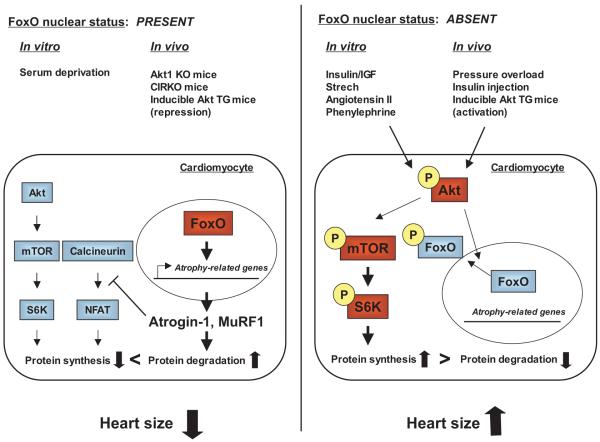
The role of Akt-FoxO pathway in regulation of heart size. Left, FoxO factor phosphorylation is decreased under conditions of Akt inactivation. Under these conditions, FoxO factors remain in the nucleus and activate atrophy-related genes, including the ubiquitin ligases atrogin-1 and MuRF-1, which promote protein degradation. Atrogin-1 also interacts with and represses calcineurin by targeting calcineurin for ubquintin-mediated proteolysis, leading to inhibition of cardiac growth. Right, Various physiological or pathological hypertrophic growth stimuli result in the activation of Akt through phosphorylation. Akt activiation leads to inactivation of FoxO factors through phosphorylation and nuclear exclusion, thereby limiting the expression of atrophy-related genes. Akt activation also increases protein synthesis through the mammalian target of rapamycin (mTOR)/S6 linase (S6K)-dependent signaling pathways.
References
-
- Kaestner KH, Knochel W, Martinez DE. Unified nomenclature for the winged helix/forkhead transcription factors. Genes Dev. 2000;14:142–146. - PubMed
-
- Lehmann OJ, Sowden JC, Carlsson P, Jordan T, Bhattacharya SS. Fox’s in development and disease. Trends Genet. 2003;19:339–344. - PubMed
-
- Carlsson P, Mahlapuu M. Forkhead transcription factors: key players in development and metabolism. Dev Biol. 2002;250:1–23. - PubMed
-
-
Delated in proof.
-
-
- Kops GJ, Dansen TB, Polderman PE, Saarloos I, Wirtz KW, Coffer PJ, Huang TT, Bos JL, Medema RH, Burgering BM. Forkhead transcription factor FOXO3a protects quiescent cells from oxidative stress. Nature. 2002;419:316–321. - PubMed
Publication types
MeSH terms
Substances
Grants and funding
LinkOut - more resources
Full Text Sources
Molecular Biology Databases
