


Abnormal regional cerebral blood flow in cognitively normal elderly subjects with hypertension
- PMID: 18174483
- PMCID: PMC2701215
- DOI: 10.1161/STROKEAHA.107.495457
Abnormal regional cerebral blood flow in cognitively normal elderly subjects with hypertension
Abstract
Background and purpose: The purpose of this study was to examine regional cerebral blood flow (rCBF) in normal cognitive-performing subjects with hypertension (HTN) using continuous arterial spin-labeled MRI. The most common explanation for the effect of blood pressure on cognition is that HTN increases the risk of cerebrovascular disease, and it may increase the risk for Alzheimer disease possibly through small vessel disease, ischemia, oxidative stress, and inflammation. However, few studies to date have examined the rCBF of cognitively normal subjects with HTN in population-based cohorts, and none have used continuous arterial spin-labeled MRI. This is a noninvasive technique that does not require either injections or ionizing radiation and can measure absolute rCBF rates over the entire brain.
Methods: rCBF was measured at 1.5 T using continuous arterial spin-labeled MRI in 41 cognitively normal subjects who were participating in the Cardiovascular Health Study Cognition Study. A deformable atrophy-corrected registration method was used to warp the rCBF maps to the standard colin27 brain space. Image and cluster-based statistical analyses were performed between subject groups.
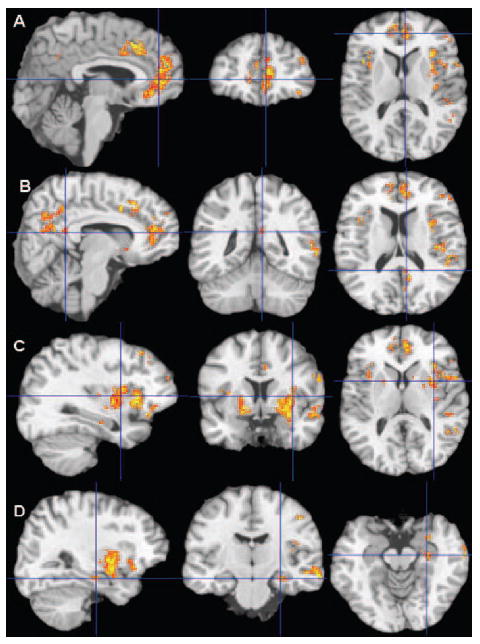
Results: Cognitively normal subjects with HTN (n=19) had decreased rCBF in the putamen, globus pallidus, bilaterally, and in the left hippocampus compared with normotensives (n=22). In addition, decreased rCBF was observed in the right and left anterior cingulate gyrus with extension to the subcallosal region, left posterior cingulate gyrus and medial precuneus, left lateral inferior and superior frontal, and inferior parietal, left orbitofrontal, and left superior temporal cortices.
Conclusions: rCBF is affected in normal subjects with HTN, not only in the subcortical regions, but also in limbic and paralimbic structures. We hypothesize that the HTN creates a vulnerability state for the development of neurodegenerative disorders, especially Alzheimer disease.
Figures
References
-
- Wolf-Maier K, Cooper RS, Banegas J, Giampaoli S, Hense HW, Joffres M, Kastarinen MPN, Primatesta P. Hypertension prevalence and blood pressure levels in 6 European countries, Canada, and the United States. JAMA. 2003;289:2362–2369. - PubMed
-
- Kilander L, Nyman H, Boberg M, Hansson L, Lithell H. Hypertension is related to cognitive impairment: a 20-year follow-up of 999 men. Hypertension. 1998;31:780–786. - PubMed
-
- Kivipelto M, Helkala E-L, Hanninen T, Laakso MP, Hallikainen M, Alhainen K, Soininen H, Tuomilehto J, Nissinen A. Midlife vascular risk factors and late-life mild cognitive impairment. Neurology. 2001;56:1683–1689. - PubMed
-
- Launer LJ, Masaki K, Petrovitch H, Foley D, Havlik R. The association between mid-life blood pressure levels and late life cognitive function: the Honolulu–Asia Aging Study. JAMA. 1995;274:1846–1851. - PubMed
-
- Struijs J, van Genugten LL, Evers SMAA, jr, Ament AJHA, Baan CA, van den Bos GAM. Modeling the future burden of stroke in The Netherlands: impact of aging, smoking, and hypertension. Stroke. 2005;36:1648–1655. - PubMed
Publication types
MeSH terms
Substances
Grants and funding
LinkOut - more resources
Full Text Sources
Other Literature Sources
Medical
