


Review
doi: 10.1621/nrs.05009.
The NR3B subgroup: an ovERRview
Affiliations
- PMID: 18174917
- PMCID: PMC2121319
- DOI: 10.1621/nrs.05009
Item in Clipboard
Review
The NR3B subgroup: an ovERRview
Nucl Recept Signal.
.
Abstract
Members of the NR3B group of the nuclear receptor superfamily, known as the estrogen-related receptors (ERRs), were the first orphan receptors to be identified two decades ago. Despite the fact that a natural ligand has yet to be associated with the ERRs, considerable knowledge about their mode of action and biological functions has emerged through extensive biochemical, genetic and functional genomics studies. This review describes our current understanding of how the ERRs work as transcription factors and as such, how they control diverse developmental and physiological programs.
Figures
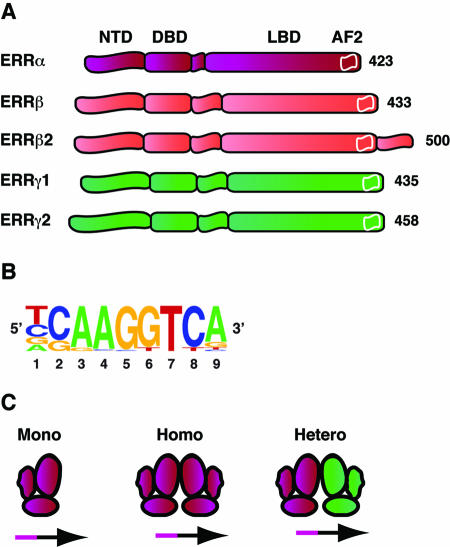
A) Schematic structure of the various ERR isoforms. Like most nuclear receptors, the ERRs possess three core domains, a regulatory amino-terminal domain (NTD), a DNA binding domain (DBD) and a ligand binding domain (LBD), in which the activation function 2 (AF-2, white box) is embedded at its carboxy terminal end. The AF-2 is required for ERR interaction with the coactivator PGC-1 and corepressor RIP140. B) Consensus ERR response element, as defined by motif-finding algorithms of ERR target gene promoters (Dufour et al., 2007). C) ERRs can bind to the ERRE as monomers, homodimers and heterodimers.
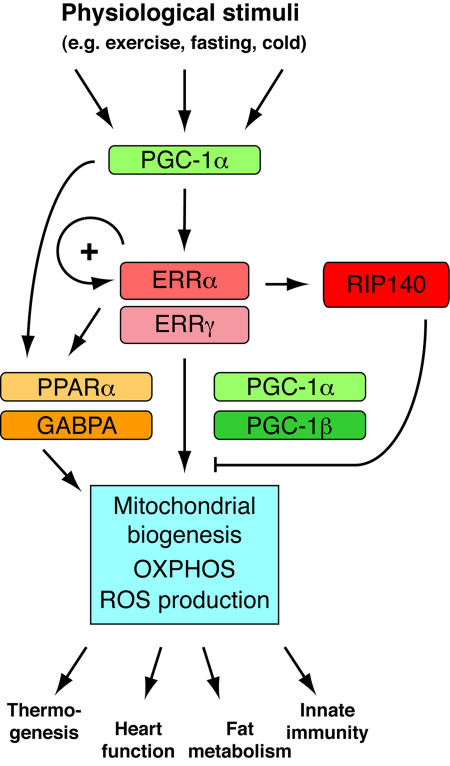
Induction of the expression of the coactivator PGC-1α upon diverse physiological stimuli leads to an augmentation in ERR transcriptional activity, as well as an increase in ERRα levels through an autoregulatory mechanism. The ERRs then upregulate the expression of other transcription factors, such as PPARα and GABPA, thus amplifying the original signal. These factors, working in concert with PGC1α and PGC-β, stimulate the expression of a vast genetic program controlling mitochondrial biogenesis, OXPHOS and ROS production. ERRα also stimulates the expression of RIP140, which provides an inhibitory feedback mechanism. Mitochondrial output is then used in a tissue-specific manner to modulate diverse biological responses.
References
-
- Alaynick W. A., Kondo R. P., Xie W., He W., Dufour C. R., Downes M., Jonker J. W., Giles W., Naviaux R. K., Giguere V., Evans R. M. ERRgamma directs and maintains the transition to oxidative metabolism in the postnatal heart. Cell Metab. 2007;6:13–24. - PubMed
-
- Araki M., Motojima K. Identification of ERRalpha as a specific partner of PGC-1alpha for the activation of PDK4 gene expression in muscle. Febs J. 2006;273:1669–80. - PubMed
-
- Ariazi E. A., Clark G. M., Mertz J. E. Estrogen-related receptor α and estrogen-related receptor γ associate with unfavorable and favorable biomarkers, respectively, in human breast cancer. Cancer Res. 2002;62:6510–8. - PubMed
-
- Ariazi E. A., Kraus R. J., Farrell M. L., Jordan V. C., Mertz J. E. Estrogen-related receptor alpha1 transcriptional activities are regulated in part via the ErbB2/HER2 signaling pathway. Mol Cancer Res. 2007;5:71–85. - PubMed
Publication types
MeSH terms
Substances
LinkOut - more resources
Full Text Sources
Other Literature Sources
