


On-field testing environment and balance error scoring system performance during preseason screening of healthy collegiate baseball players
- PMID: 18174931
- PMCID: PMC2140068
On-field testing environment and balance error scoring system performance during preseason screening of healthy collegiate baseball players
Abstract
Context: To determine if testing environment affects Balance Error Scoring System (BESS) scores in healthy collegiate baseball players.
Design: Experimental, randomized, repeated-measures design with a sample of convenience.
Setting: Uncontrolled sideline and controlled locker room baseball environments.
Patients or other participants: A total of 21 healthy collegiate baseball players (age = 20.1 +/- 1.4 years, height = 185.1 +/- 6.8 cm, mass = 86.3 +/- 9.5 kg) with no history of head injury within the last 12 months, no lower extremity injuries reported within the past 2 months that caused them to miss 1 or more days of practice or game time, and no history of otitis media, Parkinson disease, or Meniere disease.
Main outcome measure(s): Participants performed the BESS test in 2 environments, controlled locker room and uncontrolled sideline, in 2 testing sessions 1 week apart during the baseball preseason. The BESS scores were evaluated for each of the 6 conditions and total score across the testing sessions. Separate, paired-samples t tests with Bonferroni adjustment (P < .008) were used to examine differences between testing environments for each BESS subcategory and total score. Cohen d tests were calculated to evaluate effect sizes and relative change.
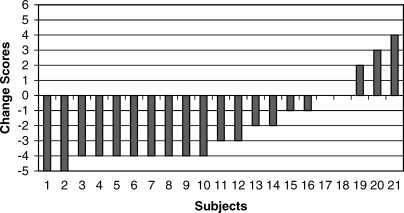
Results: Significant group mean differences were found between testing environments for single-leg foam stance (P = .001), with higher scores reported for the uncontrolled sideline environment (7.33 +/- 2.11 errors) compared with the controlled clinical environment (5.19 +/- 2.16 errors). Medium to large effect sizes (0.53 to 1.03) were also found for single-leg foam, tandem foam, and total BESS scores, with relative increases (worse scores) of 30% to 44% in the sideline environment compared with the clinical environment.
Conclusions: The BESS performance was impaired when participants were tested in a sideline environment compared with a clinical environment. Baseline testing for postural control using the BESS should be conducted in the setting or environment in which testing after injury will most likely be conducted.
Keywords: attention; concussion; environment; postural control.
Figures
References
-
- Bazarian JJ, McClung J, Shah MN, Cheng YT, Flesher W, Kraus J. Mild traumatic brain injury in the United States, 1998–2000. Brain Inj. 2005;19:85–91. - PubMed
-
- Guskiewicz KM, McCrea M, Marshall SW. Cumulative effects associated with recurrent concussion in collegiate football players: the NCAA Concussion Study. JAMA. 2003;290:2549–2555. et al. - PubMed
-
- Mori T, Katayama Y, Kawamata T. Acute hemispheric swelling associated with thin subdural hematomas: pathophysiology of repetitive head injury in sports. Acta Neurochir Suppl. 2006;96:40–43. - PubMed
-
- Belanger HG, Vanderploeg RD. The neuropsychological impact of sports-related concussion: a meta-analysis. J Int Neuropsychol Soc. 2005;11:345–357. - PubMed
Publication types
MeSH terms
LinkOut - more resources
Full Text Sources
Other Literature Sources
Medical
Miscellaneous