


Quantification of functional knee flexor to extensor moment ratio using isokinetics and electromyography
- PMID: 18174936
- PMCID: PMC2140073
Quantification of functional knee flexor to extensor moment ratio using isokinetics and electromyography
Abstract
Context: Evaluating moment balance around the knee helps athletic trainers set appropriate targets for injury prevention and rehabilitation programs.
Objective: To examine the knee flexor (KF) to knee extensor (KE) moment ratios using the moments when each muscle group acts as an agonist and using the moments when the KE acts as an agonist and the KF acts as an antagonist.
Design: Cross-sectional.
Setting: University research laboratory.
Patients or other participants: Seventeen pubertal males (age = 13.7 +/- 0.2 years, height = 1.61 +/- 0.04 m, mass = 51.3 +/- 2.7 kg).
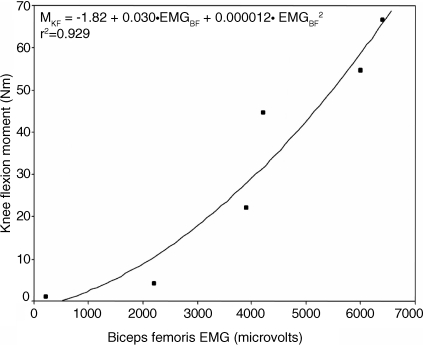
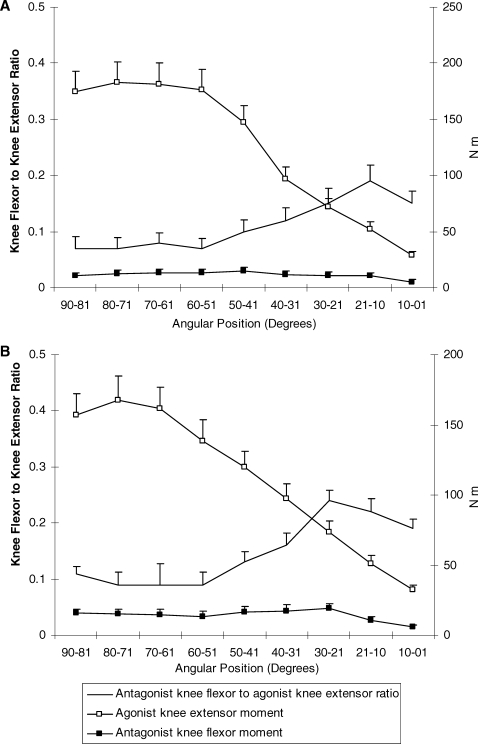
Intervention(s): The subjects performed maximal isokinetic concentric KE (KE(CON)) and eccentric KF (KF(ECC)) efforts and performed eccentric KE (KE(ECC)) and concentric KF efforts at 60 degrees /s and 180 degrees /s while we recorded the bipolar surface electromyographic (EMG) signal of the involved muscles. The KF antagonist moment was estimated from EMG-moment relationships determined during calibration KF efforts. Maximal moments were used to estimate the KF:KE ratios, and EMG-based moments were used to estimate the antagonist to agonist ratios.
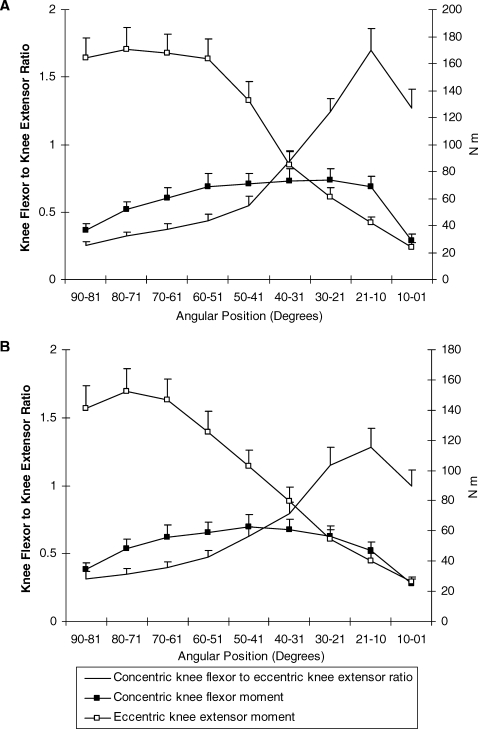
Main outcome measure(s): We calculated KF:KE ratios for various angular positions, velocities, and movement directions.
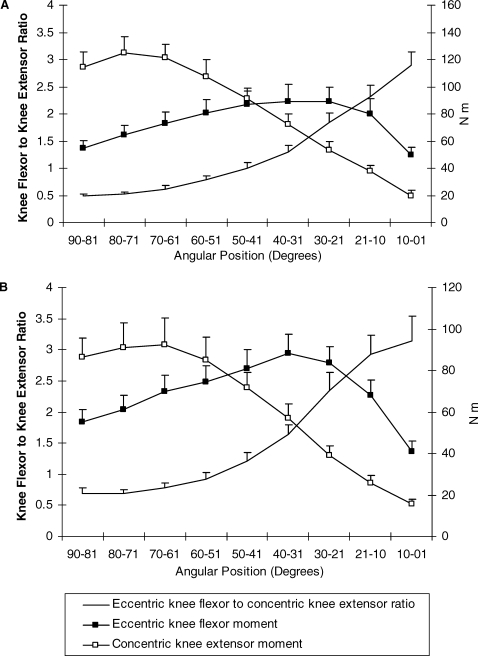
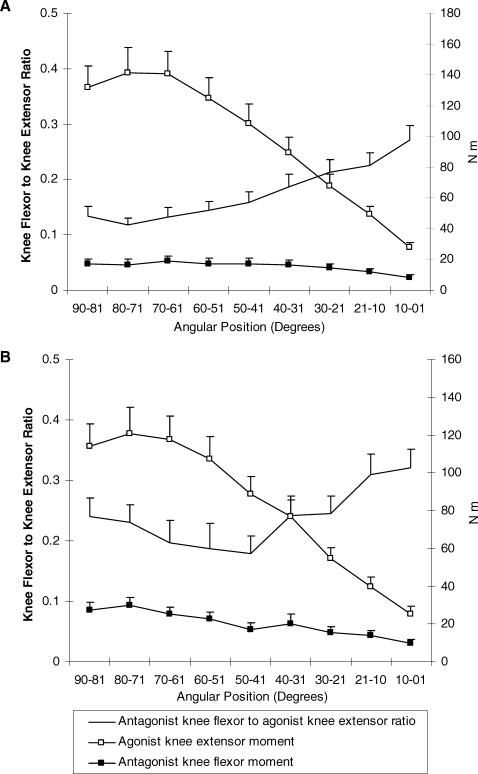
Results: The KF(ECC):KE(CON) ratio significantly increased as the knee extended (P < .05) at increased angular velocity (P < .05), reaching a value of 3.14 +/- 1.95 at full extension. The estimated knee flexor antagonist to knee extensor agonist ratio also increased near full extension (0.32 +/- 0.21).
Conclusions: Although the KFs have a higher capacity to produce maximal moment near knee extension and at increased angular velocities, knee joint movement is achieved through a balanced coactivation of the 2 antagonistic muscle groups to maintain joint stability and movement efficiency. The combined use of moment and EMG data can provide additional useful information regarding muscle balance around the knee.
Keywords: coactivation; injury index; muscle balance; rehabilitation; strength.
Figures
References
-
- Kellis E, Baltzopoulos V. Isokinetic eccentric exercise. Sports Med. 1995;19:202–222. - PubMed
-
- Osternig LR, Caster BL, James CR. Contralateral hamstring (biceps femoris) coactivation patterns and anterior cruciate ligament dysfunction. Med Sci Sports Exerc. 1995;27:805–808. - PubMed
-
- Solomonow M, Baratta R, D'Ambrosia R. The role of hamstrings in the rehabilitation of the anterior cruciate ligament-deficient knee in athletes. Sports Med. 1989;7:42–48. - PubMed
-
- Dvir Z, Eger G, Halperin N, Shklar A. Thigh muscle activity and anterior cruciate ligament insufficiency. Clin Biomech (Bristol, Avon) 1989;4:87–91. - PubMed
MeSH terms
LinkOut - more resources
Full Text Sources