


Clinical value of fecal calprotectin in determining disease activity of ulcerative colitis
- PMID: 18176961
- PMCID: PMC2673391
- DOI: 10.3748/wjg.14.53
Clinical value of fecal calprotectin in determining disease activity of ulcerative colitis
Abstract
Aim: To investigate possibility and clinical application of fecal calprotectin in determining disease activity of ulcerative colitis (UC).
Methods: The enzyme-linked immunosorbent assay (ELISA) was used to measure the concentrations of calprotectin in feces obtained from 66 patients with UC and 20 controls. C-reactive protein (CRP), erythrocyte sedimentation rate (ESR), acid glycoprotein (AGP) were also measured and were compared with calprotectin in determining disease activity of UC. The disease activity of UC was also determined by the Sutherland criteria.
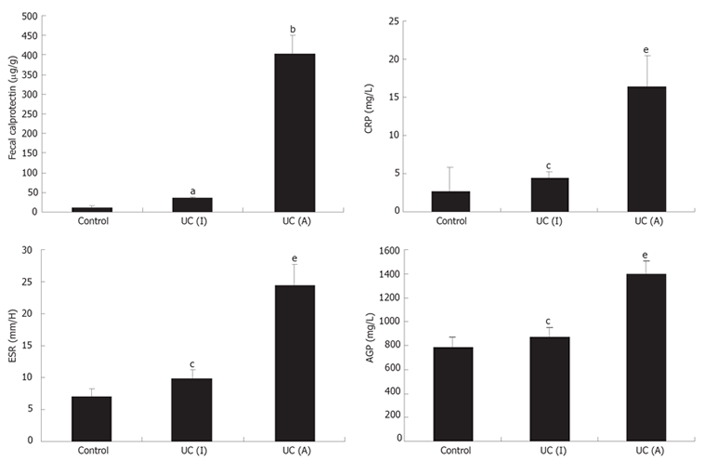
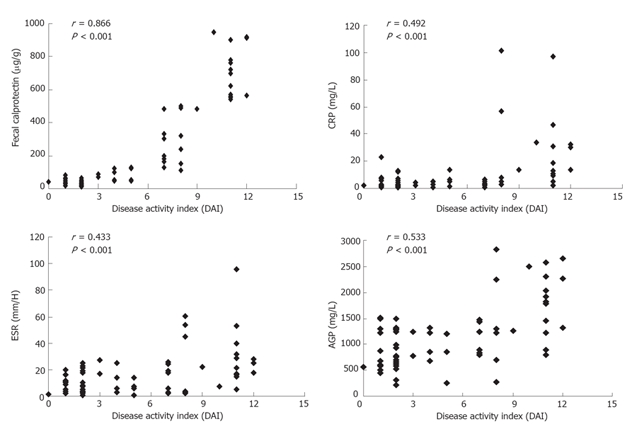
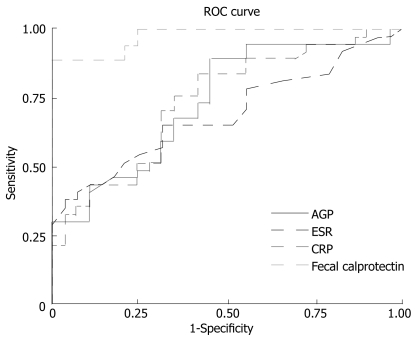
Results: The fecal calprotectin concentration in the patients with active UC was significantly higher than that in the inactive UC and in the controls (402.16 +/- 48.0 microg/g vs 35.93 +/- 3.39 microg/g, 11.5 +/- 3.42 microg/g, P < 0.01). The fecal calprotectin concentration in the inactive UC group was significantly higher than that in the control group (P < 0.05). A significant difference was also found in the patients with active UC of mild, moderate and severe degrees. The area under the curve of the receiver operating characteristics (AUCROC) was 0.975, 0.740, 0.692 and 0.737 for fecal calprotectin, CRP, ESR and AGP, respectively. There was a strong correlation between the fecal calprotectin concentration and the endoscopic gradings for UC (r = 0.866, P < 0.001).
Conclusion: Calprotectin in the patient's feces can reflect the disease activity of UC and can be used as a rational fecal marker for intestinal inflammation in clinical practice. This kind of marker is relatively precise, simple and noninvasive when compared with other commonly-used markers such as CRP, ESR and AGP.
Figures
References
-
- Carpenter HA, Talley NJ. The importance of clinicopathological correlation in the diagnosis of inflammatory conditions of the colon: histological patterns with clinical implications. Am J Gastroenterol. 2000;95:878–896. - PubMed
-
- Poullis AP, Zar S, Sundaram KK, Moodie SJ, Risley P, Theodossi A, Mendall MA. A new, highly sensitive assay for C-reactive protein can aid the differentiation of inflammatory bowel disorders from constipation- and diarrhoea-predominant functional bowel disorders. Eur J Gastroenterol Hepatol. 2002;14:409–412. - PubMed
-
- Dunker MS, Ten Hove T, Bemelman WA, Slors JF, Gouma DJ, Van Deventer SJ. Interleukin-6, C-reactive protein, and expression of human leukocyte antigen-DR on peripheral blood mononuclear cells in patients after laparoscopic vs conventional bowel resection: a randomized study. Dis Colon Rectum. 2003;46:1238–1244. - PubMed
MeSH terms
Substances
LinkOut - more resources
Full Text Sources
Medical
Research Materials
Miscellaneous
