


Climatic, temporal, and geographic characteristics of respiratory syncytial virus disease in a tropical island population
- PMID: 18177515
- PMCID: PMC2870725
- DOI: 10.1017/S0950268807000015
Climatic, temporal, and geographic characteristics of respiratory syncytial virus disease in a tropical island population
Abstract
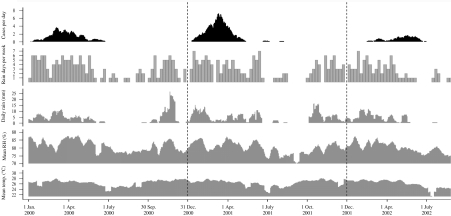
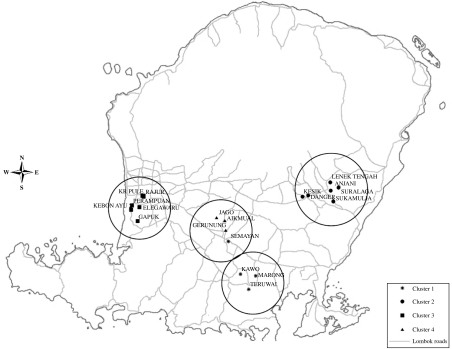
Respiratory syncytial virus (RSV) is an important cause of morbidity in children worldwide, although data from equatorial regions are limited. We analysed climatic, spatial, and temporal data for children presenting to hospitals in Lombok island, Indonesia with clinical pneumonia. During the study period, 2878 children presented and 741 RSV cases were identified. In multivariate analysis with an 8-day lag, occurrence of rain was associated with 64% higher incidence of RSV disease [incidence rate ratio (IRR) 1.64, 95% confidence interval (CI) 1.13-2.38]. A 1% rise in mean relative humidity and 1 degree C increase in mean air temperature was associated with a 6% (IRR 1.06, 95% CI 1.03-1.10) and 44% (IRR 1.44, 95% CI 1.24-1.66) increase in RSV cases, respectively. Four statistically significant local clusters of RSV pneumonia were identified within the annual island-wide epidemics. This study demonstrates statistical association of monsoon-associated weather in equatorial Indonesia with RSV. Moreover, within the island-wide epidemics, localized RSV outbreaks suggest local factors influence RSV disease.
Figures
References
-
- Law BJ, Carbonell-Estrany X, Simoes EA. An update on respiratory syncytial virus epidemiology: a developed country perspective. Respiratory Medicine. 2002;96:S1–S7. (Suppl. B): - PubMed
-
- Glezen P, Denny FW. Epidemiology of acute lower respiratory disease in children. New England Journal of Medicine. 1973;288:498–505. - PubMed
-
- Hall CB. Respiratory syncytial virus: A continuing culprit and conundrum. Journal of Pediatrics. 1999;135:2–7. - PubMed
-
- Djelantik IG et al. Incidence and clinical features of hospitalization because of respiratory syncytial virus lower respiratory illness among children less than two years of age in a rural Asian setting. Pediatric Infectious Disease Journal. 2003;22:150–157. - PubMed
Publication types
MeSH terms
LinkOut - more resources
Full Text Sources
Medical
