


Structural and functional characterization of a new recombinant histidine-tagged acyl coenzyme A binding protein (ACBP) from mouse
- PMID: 18178100
- PMCID: PMC2367699
- DOI: 10.1016/j.pep.2007.11.010
Structural and functional characterization of a new recombinant histidine-tagged acyl coenzyme A binding protein (ACBP) from mouse
Abstract
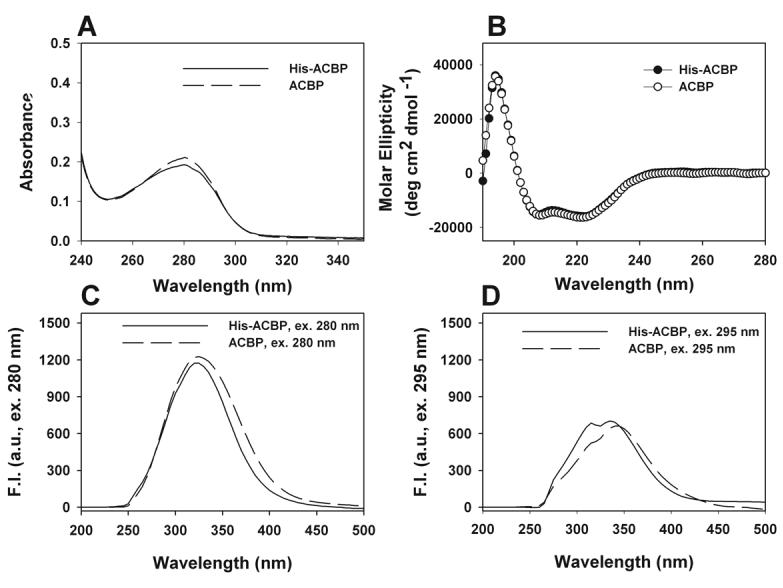
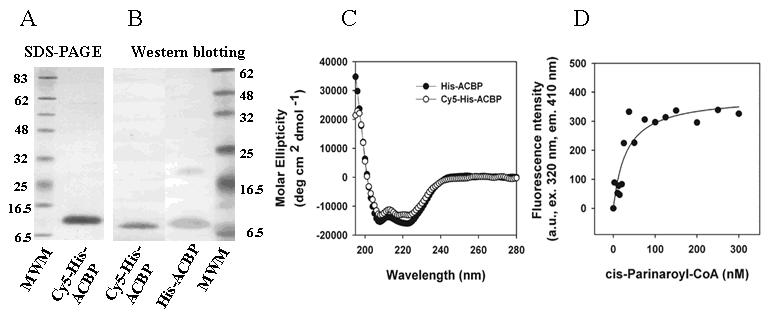
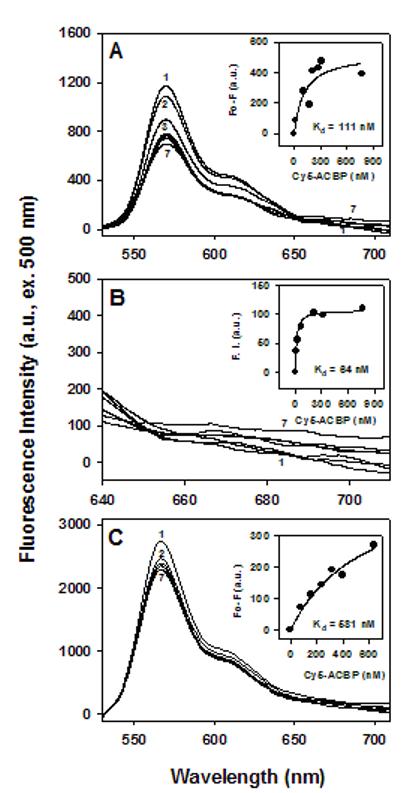
Acyl coenzyme A binding protein (ACBP) has been proposed to transport fatty acyl CoAs intracellularly, facilitating their metabolism. In this study, a new mouse recombinant ACBP was produced by insertion of a histidine (his) tag at the C-terminus to allow efficient purification by Ni-affinity chromatography. The his-tag was inserted at the C-terminus since ACBP is a small molecular size (10 kDa) protein whose structure and activity are sensitive to amino acid substitutions in the N-terminus. The his-tag had no or little effect on ACBP structure or ligand binding affinity and specificity. His-ACBP bound the naturally occurring fluorescent cis-parinaroyl-CoA with very high affinity (K(d)=2.15 nM), but exhibited no affinity for non-esterified cis-parinaric acid. To determine if the presence of the C-terminal his-tag altered ACBP interactions with other proteins, direct binding to hepatocyte nuclear factor-4alpha (HNF-4alpha), a nuclear receptor regulating transcription of genes involved in lipid metabolism, was examined. His-ACBP and HNF-4alpha were labeled with Cy5 and Cy3, respectively, and direct interaction was determined by a novel fluorescence resonance energy transfer (FRET) binding assay. FRET analysis showed that his-ACBP directly interacted with HNF-4alpha (intermolecular distance of 73 A) at high affinity (K(d)=64-111 nM) similar to native ACBP. The his-tag also had no effect on ACBPs ability to interact with and stimulate microsomal enzymes utilizing or forming fatty acyl CoA. Thus, C-terminal his-tagged-ACBP maintained very similar structural and functional features of the untagged native protein and can be used in further in vitro experiments that require pure recombinant ACBP.
Figures


References
-
- Abo-Hashema KAH, Cake MH, Lukas MA, Knudsen J. The interaction of acyl CoA with acyl CoA binding protein and carnitine palmitoyltransferase I. Int. J. Biochem. & Cell Biol. 2001;33:807–815. - PubMed
-
- Berde CB, Hudson BS, Simoni RD, Sklar LA. Human serum albumin. Spectroscopic studies of binding and proximity relationships for fatty acids adn bilirubin. J. Biol. Chem. 1979;254:391–400. - PubMed
-
- Bhuiyan AKMJ, Pande SV. Carnitine palmitoyltransferase activies: effects of serum albumin, ACBP, and FABP. Mol. Cell. Biochem. 1994;139:109–116. - PubMed
-
- Chao H, Martin G, Russell WK, Waghela SD, Russell DH, Schroeder F, Kier AB. Membrane charge and curvature determine interaction with acyl CoA binding protein (ACBP) and fatty acyl CoA targeting. Biochemistry. 2002;41:10540–10553. - PubMed
-
- Chao H, Zhou M, McIntosh A, Schroeder F, Kier AB. Acyl CoA binding protein and cholesterol differentially alter fatty acyl CoA utilization by microsomal acyl CoA: cholesterol transferase. J. Lipid Res. 2003;44:72–83. - PubMed
Publication types
MeSH terms
Substances
Grants and funding
LinkOut - more resources
Full Text Sources
Other Literature Sources
