


Physical maturation, peer environment, and the ontogenesis of substance use disorders
- PMID: 18178256
- PMCID: PMC2274910
- DOI: 10.1016/j.psychres.2007.02.017
Physical maturation, peer environment, and the ontogenesis of substance use disorders
Abstract
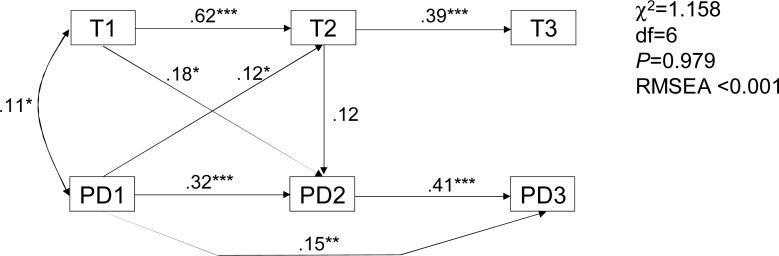
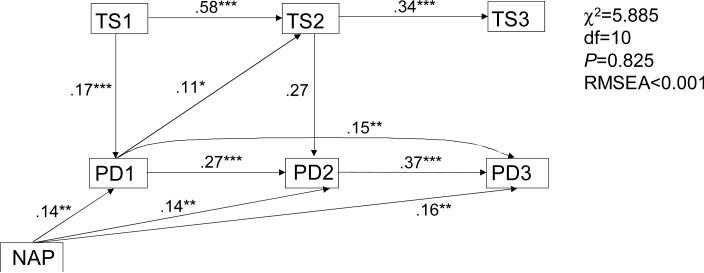
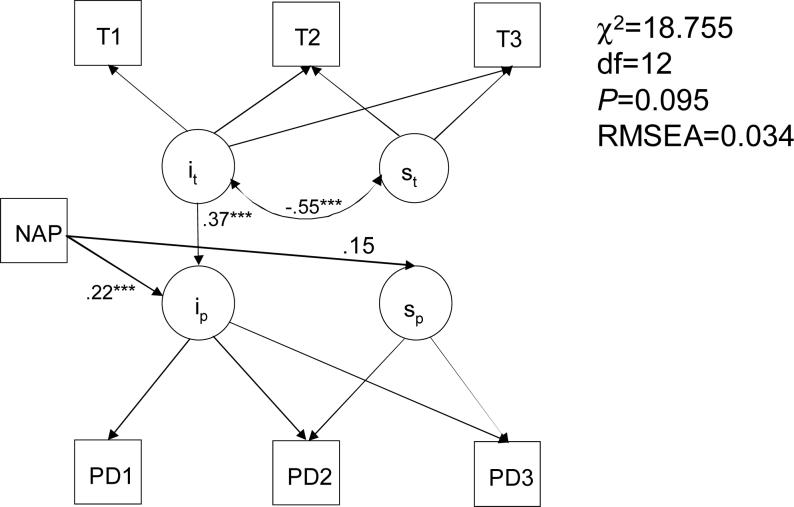
The risk for substance use disorders (SUD) is transmissible between generations via both genetic and environmental mechanisms. One path that is hypothesized to mediate this transmission and include both types of mechanisms is through faster physiological maturation, leading to suboptimal self-regulation, affiliation with deviant peers, and higher risk for conduct disorder (CD). Extending prior research, this hypothesis was tested in a longitudinal study. A sample of 478 males whose fathers were affected with SUD or psychiatrically normal was assessed prospectively at ages from 9-13 to 17-20. The DSM-III-R diagnoses were obtained using standard methodology. Blood testosterone was assayed by radioimmunoassay, and Tanner staging was used to evaluate sexual maturation. Peer deviance was evaluated by the Peer Delinquency Scale. Correlation and path analysis, Cox proportional hazard regression, and growth curve modeling were used to determine the relationships between the variables. The data support the hypothesis that parental SUD liability influences the rate of physiological maturation in offspring, which in turn is related to affiliation with deviant peers and an elevated rate of the development of CD and SUD.
Figures
References
-
- Afifi AA, Clark V. Computer-Aided Multivariate Analysis. Van Nostrand Reinhold Company; New York, NY: 1990.
-
- Archer J. Testosterone and human aggression: an evaluation of the challenge hypothesis. Neuroscience & Biobehavioral Reviews. 2006;30:319–345. - PubMed
-
- Aroian LA. The probability function of the product of two normally distributed variables. Annals of Mathematical Statistics. 1944;18:265–271.
-
- Baron RM, Kenny DA. The moderator-mediator variable distinction in social psychological research: Conceptual, strategic, and statistical considerations. Journal of Personality and Social Psychology. 1986;51:1173–1182. - PubMed
-
- Belsky J, Steinberg L, Draper P. Childhood experience, interpersonal development, and reproductive strategy: an evolutionary theory of socialization. Child Development. 1991;62:647–670. - PubMed
