


Physical activity is a predictor of all-cause mortality in patients with intermittent claudication
- PMID: 18178462
- PMCID: PMC2701190
- DOI: 10.1016/j.jvs.2007.09.033
Physical activity is a predictor of all-cause mortality in patients with intermittent claudication
Abstract
Objective: We examined whether all-cause mortality was predicted by physical activity level in peripheral arterial disease (PAD) patients limited by intermittent claudication.
Methods: This retrospective, natural history follow-up study determined survival status of each patient. Patients with stable symptoms of intermittent claudication were evaluated in the Geriatrics, Research, Education, and Clinical Center at the Maryland Veterans Affairs Health Care System (MVAHCS) at Baltimore between 1994 and 2002, and were classified into a physically sedentary group (n = 299) or a physically active group (n =135), and followed in 2004 using the Social Security Death Index.
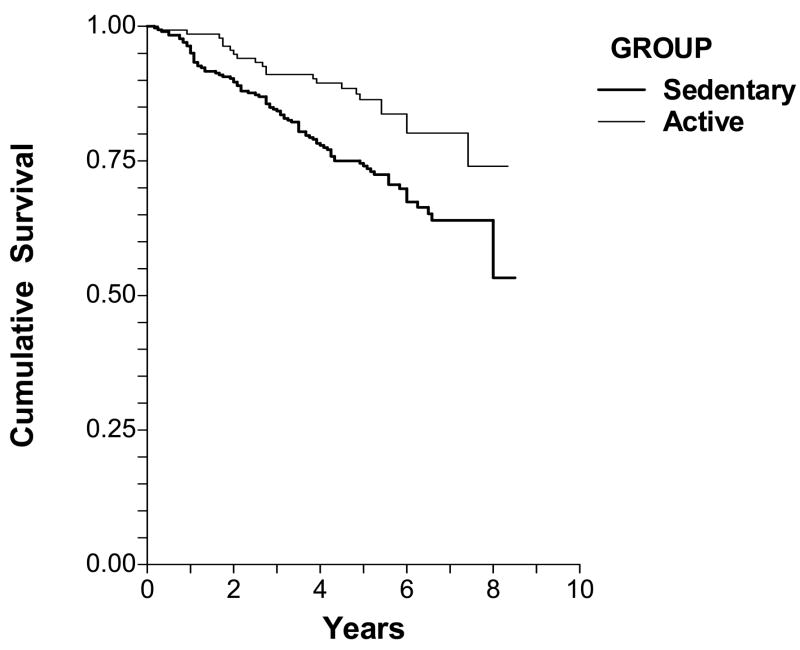
Results: Median follow-up was 5.33 years (range = 0.25 to 8.33 years) for the physically active group, and 5.0 years (range = 0.17 to 8.5 years) for the sedentary group. At follow-up, 108 patients (24.9%) had died, consisting of 86 (28.8%) in the sedentary group and 22 (16.3%) in the active group. Unadjusted risk of mortality was lower (P = .005) in the physically active group (hazard ratio [HR] = 0.510, 95% CI = 0.319 to 0.816). In multivariate Cox proportional hazards analysis, age (HR = 1.045, 95% CI = 1.019 to 1.072, P < 0.001), body mass index (BMI) (HR = 0.943, 95% CI = 0.902 to 0.986, P = 0.009), ankle-brachial index (ABI) (HR = 0.202, 95% CI = 0.064 to 0.632, p = 0.006), and physical activity status (HR = 0.595, 95% CI = 0.370 to 0.955, P = .031) were predictors of mortality.
Conclusion: Patients limited by intermittent claudication who engage in any amount of weekly physical activity beyond light intensity at baseline have a lower mortality rate than their sedentary counterparts who perform either no physical activity or only light-intensity activities. The protective effect of physical activity persists even after adjusting for other predictors of mortality, which include age, ABI, and BMI.
Figures
References
-
- Criqui MH, Langer RD, Fronek A, et al. Mortality over a period of 10 years in patients with peripheral arterial disease. N Engl J Med. 1992;326:381–386. - PubMed
-
- Feringa HHH, Bax JJJ, van Waning VH, et al. The long-term prognostic value of the resting and postexercise ankle-brachial index. Arch Int Med. 2006;166:529–535. - PubMed
-
- Howell MA, Colgan MP, Seeger RW, Ramsey DE, Sumner DS. Relationship of severity of lower limb peripheral vascular disease to mortality and morbidity: A six-year follow-up study. J Vasc Surg. 1989;9:691–697. - PubMed
-
- Lee AJ, Price JF, Russell MJ, Smith FB, van Wijk MCW, Fowkes FGR. Improved prediction of fatal myocardial infarction using the ankle brachial index in addition to conventional risk factors: the Edinburgh Artery Study. Circulation. 2004;110:3075–3080. - PubMed
