. 2008 Mar;146(3):1098-108.
doi: 10.1104/pp.107.113647. Epub 2008 Jan 4.

Myosin XI-K Is required for rapid trafficking of Golgi stacks, peroxisomes, and mitochondria in leaf cells of Nicotiana benthamiana

Affiliations

Myosin XI-K Is required for rapid trafficking of Golgi stacks, peroxisomes, and mitochondria in leaf cells of Nicotiana benthamiana

Dror Avisar et al. Plant Physiol. 2008 Mar.

Abstract

A prominent feature of plant cells is the rapid, incessant movement of the organelles traditionally defined as cytoplasmic streaming and attributed to actomyosin motility. We sequenced six complete Nicotiana benthamiana cDNAs that encode class XI and class VIII myosins. Phylogenetic analysis indicates that these two classes of myosins diverged prior to the radiation of green algae and land plants from a common ancestor and that the common ancestor of land plants likely possessed at least seven myosins. We further report here that movement of Golgi stacks, mitochondria, and peroxisomes in the leaf cells of N. benthamiana is mediated mainly by myosin XI-K. Suppression of myosin XI-K function using dominant negative inhibition or RNA interference dramatically reduced movement of each of these organelles. When similar approaches were used to inhibit functions of myosin XI-2 or XI-F, only moderate to marginal effects were observed. Organelle trafficking was virtually unaffected in response to inhibition of each of the three class VIII myosins. Interestingly, none of the tested six myosins appears to be involved in light-induced movements of chloroplasts. Taken together, these data strongly suggest that myosin XI-K has a major role in trafficking of Golgi stacks, mitochondria, and peroxisomes, whereas myosins XI-2 and XI-F might perform accessory functions in this process. In addition, our analysis of thousands of individual organelles revealed independent movement patterns for Golgi stacks, mitochondria, and peroxisomes, indicating that the notion of coordinated cytoplasmic streaming is not generally applicable to higher plants.


Figures
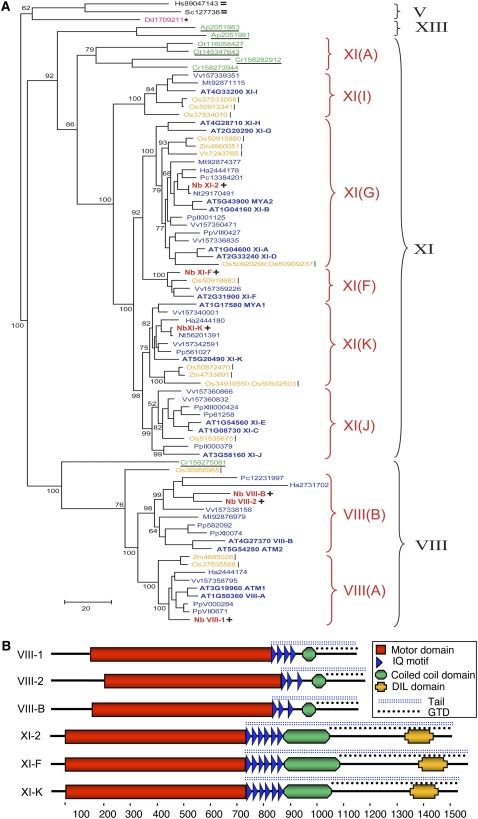
Figure 1.
Figure 1.
A, Phylogenetic tree for the motor domain of plant myosins. Each terminal node of the tree is labeled by the two-letter abbreviation of the corresponding species name and the numeric GenBank identifier (GI). For Arabidopsis, identifiers assigned previously (Reddy and Day, 2001) are also indicated. Identical sequences encoded in distinct loci in rice are separated by semicolon. Coding is as follows: dicots, dark blue (unmarked) except for Arabidopsis marked in bold and N. benthamiana marked in red and [+]; monocots, yellow and [ | ]; green algae, green and underlined; human and yeast, black and [=]; Dictyostelium discoideum, magenta and [*]. Abbreviations: Ap, A. peniculus; At, Arabidopsis; Cr, C. reinhardtii; Dd, D. discoideum; Ha, Helianthus annuus; Hs, Homo sapiens; Mt, Medicago truncatula; Nb, N. benthamiana; Nt, Nicotiana tabacum; Os, rice; Ot, O. lucimarinus; Pc, Petroselinum crispum; Sc, yeast; Vn, Vallisneria natans; Vv, grapevine; Zm, Zea mays. PpXIII000424, PpII001125, PpII000379, PpVII0671, PpVIII0427, PpXI0074, PpV000284, Pp582092, and Pp61258 are sequences from draft genome of Populus trichocarpa taken from the JGI Web site (http://genome.jgi-psf.org/Poptr1/Poptr1.home.html). For selected major branches, bootstrap probabilities (%) are shown. B, Domain structure of the N. benthamiana myosins. Dotted lines correspond to truncated myosin variants used for overexpression. The scale below the diagram shows the numbers of amino acid residues.
Figure 2.
Figure 2.
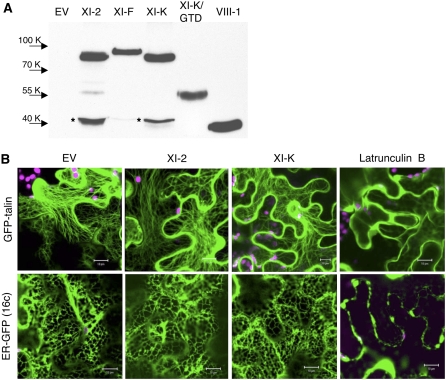
A, Immunoblot analysis of myosin tail accumulation using HA-specific monoclonal antibody. Asterisks mark degradation products (Pashkova et al., 2006). B, Myosin tail overexpression does not affect actin microfilaments or the ER network in the leaf epidermal cells of N. benthamiana. Top row, Actin microfilaments are labeled by expression of GFP-talin. The actin cytoskeleton in the cells that express tails of myosin XI-2 or XI-K appears similar to control cells treated with the empty vector (EV), while treatment with the microfilament-disassembling drug latrunculin B results in disintegration of the actin cytoskeleton. Bottom row, The ER is labeled by ER-GFP in transgenic plant line 16c. The ER network whose structure is maintained by the actin microfilaments is intact in cells that express tails of myosin XI-2 or XI-K, but is collapsed in the presence of latrunculin B. Bars = 10 μm.
Figure 3.
Figure 3.
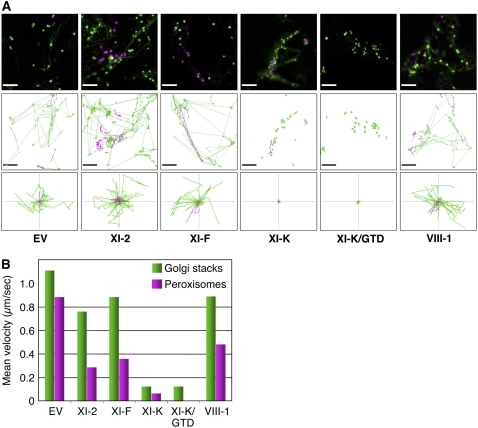
Effects of myosin tail overexpression on trafficking of Golgi stacks (green) and peroxisomes (magenta) in the leaf epidermal cells of N. benthamiana. A, Each column corresponds to expression of the myosin tail variant marked at the bottom; EV, empty vector control. Top row, Representative confocal images. Middle row, Dots and connecting lines show paths of individual organelles recorded in a time series. Bottom row, Movement of individual organelles plotted relative to a common origin. Bars = 7 μm. B, Mean velocity of the Golgi stacks and peroxisomes in the presence of overexpressed myosin tails as indicated below the diagram.
Figure 4.
Figure 4.
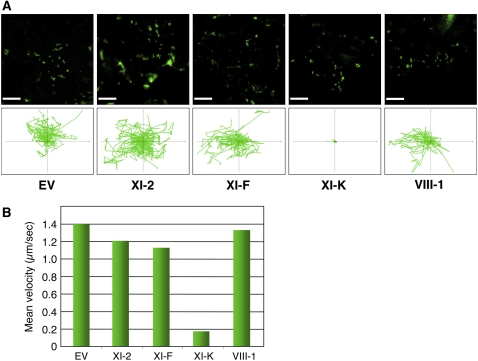
Effects of myosin tail overexpression on trafficking of mitochondria (green) in the leaf epidermal cells of N. benthamiana. A, Images and trafficking patterns of mitochondria. Bars = 14 μm. B, Mean velocity of the mitochondria in the presence of overexpressed myosin tails. The designations are the same as in Figure 3.
Figure 5.
Figure 5.
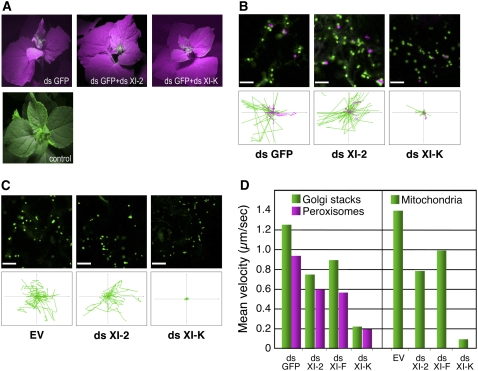
Transient RNAi of myosin XI-K mRNA in N. benthamiana inhibits trafficking of Golgi stacks, peroxisomes, and mitochondria. A, Images of the GFP-transgenic, systemically silenced plants used in the experiments shown in B, taken under UV (top row). The nonsilenced, empty vector control is shown at the bottom. B, Images and trafficking patterns of Golgi stacks (green) and peroxisomes (magenta) in plants systemically silenced for GFP only (ds GFP), GFP and myosin XI-2 (ds XI-2), or GFP and myosin XI-K (ds XI-K). Bars = 7 μm. C, Images and trafficking patterns of mitochondria (green) in plants locally silenced for myosin XI-2 (dsXI-2) or XI-K (dsXI-K). EV, Empty vector control. Bars = 14 μm. D, Mean velocity of the organelles in transiently silenced plants.
Figure 6.
Figure 6.
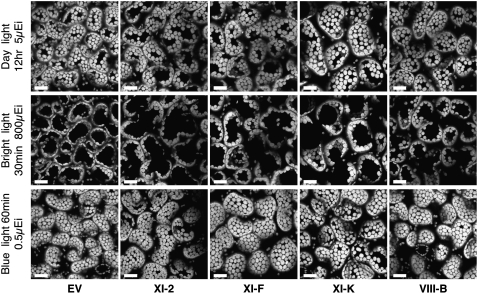
Bright light-avoidance and blue light-attraction movements of chloroplasts in N. benthamiana leaf epidermal cells are unaffected by ectopic expression of the myosin tails. Irradiation time and light intensity is shown at the left of each row; the identities of the overexpressed myosin tails are shown below each column. Bars = 20 μm.

References

    1. Adachi J, Waddell PJ, Martin W, Hasegawa M (2000) Plastid genome phylogeny and a model of amino acid substitution for proteins encoded by chloroplast DNA. J Mol Evol 50 348–358 - PubMed
    1. Bezanilla M, Horton AC, Sevener HC, Quatrano RS (2003) Phylogenetic analysis of new plant myosin sequences. J Mol Evol 57 229–239 - PubMed
    1. Boevink P, Oparka KJ (2005) Virus-host interactions during movement process. Plant Physiol 138 1815–1821 - PMC - PubMed
    1. Boevink P, Oparka KJ, Santa Cruz S, Martin B, Betteridge A, Hawes C (1998) Stacks on tracks: the plant Golgi apparatus traffics on an actin/ER network. Plant J 15 441–447 - PubMed
    1. Boldogh IR, Pon LA (2006) Interactions of mitochondria with the actin cytoskeleton. Biochim Biophys Acta 1763 450–462 - PubMed

Publication types