. 2008 Jul;190(13):4408-15.
doi: 10.1128/JB.01444-07. Epub 2008 Jan 4.

Peroxisome proliferator-activated receptors mediate host cell proinflammatory responses to Pseudomonas aeruginosa autoinducer

Affiliations

Peroxisome proliferator-activated receptors mediate host cell proinflammatory responses to Pseudomonas aeruginosa autoinducer

Aruna Jahoor et al. J Bacteriol. 2008 Jul.

Abstract

The pathogenic bacterium Pseudomonas aeruginosa utilizes the 3-oxododecanoyl homoserine lactone (3OC(12)-HSL) autoinducer as a signaling molecule to coordinate the expression of virulence genes through quorum sensing. 3OC(12)-HSL also affects responses in host cells, including the upregulation of genes encoding inflammatory cytokines. This proinflammatory response may exacerbate underlying disease during P. aeruginosa infections. The specific mechanism(s) through which 3OC(12)-HSL influences host responses is unclear, and no mammalian receptors for 3OC(12)-HSL have been identified to date. Here, we report that 3OC(12)-HSL increases mRNA levels for a common panel of proinflammatory genes in murine fibroblasts and human lung epithelial cells. To identify putative 3OC(12)-HSL receptors, we examined the expression patterns of a panel of nuclear hormone receptors in these two cell lines and determined that both peroxisome proliferator-activated receptor beta/delta (PPARbeta/delta) and PPARgamma were expressed. 3OC(12)-HSL functioned as an agonist of PPARbeta/delta transcriptional activity and an antagonist of PPARgamma transcriptional activity and inhibited the DNA binding ability of PPARgamma. The proinflammatory effect of 3OC(12)-HSL in lung epithelial cells was blocked by the PPARgamma agonist rosiglitazone, suggesting that 3OC(12)-HSL and rosiglitazone are mutually antagonistic negative and positive regulators of PPARgamma activity, respectively. These data identify PPARbeta/delta and PPARgamma as putative mammalian 3OC(12)-HSL receptors and suggest that PPARgamma agonists may be employed as anti-inflammatory therapeutics for P. aeruginosa infections.


Figures
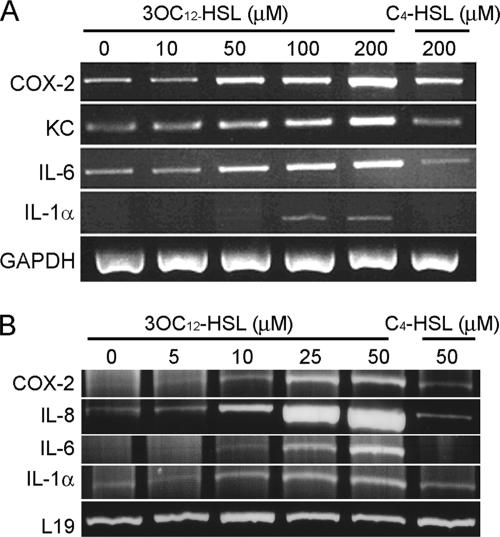
FIG. 1.
FIG. 1.
3OC12-HSL modulates proinflammatory gene expression in vitro. NIH 3T3 (A) and A549 (B) cells were incubated in the absence or presence of increasing concentrations of 3OC12-HSL or C4-HSL for 6 h, and RNA was extracted and converted into cDNA. mRNA levels for genes encoding the inflammatory mediators COX-2, IL-8, IL-6, and IL-1α were assessed by RT-PCR. GAPDH and L19 mRNAs were used as loading controls.
FIG. 2.
FIG. 2.
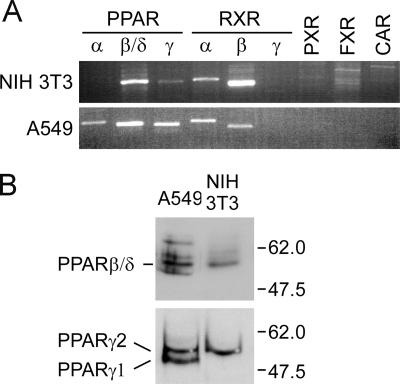
NHRs are expressed in 3OC12-HSL-responsive cell lines. RNA from cell lines that exhibit 3OC12-HSL-dependent changes in proinflammatory mRNAs was extracted and converted into cDNA. (A) RT-PCR was used to screen for a panel of NHRs in A549 cells. (B) Western blot analysis revealed PPARγ and PPARβ/δ proteins in the nuclear extracts of A549 and NIH 3T3 cells.
FIG. 3.
FIG. 3.
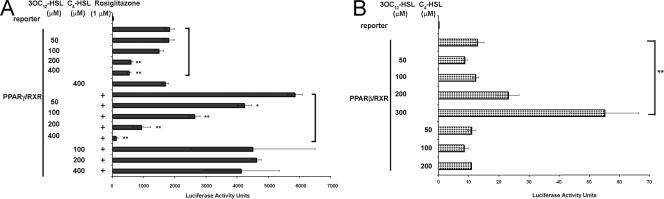
3OC12-HSL modulates the transcriptional activities of NHRs. NIH 3T3 cells were transfected with expression vectors for either PPARγ and RXRα (A) or PPARβ/δ and RXRα (B), along with the appropriate PPAR-responsive luciferase reporter plasmid and the TK-Renilla luciferase control plasmid. Twenty-four hours after transfection with the expression vectors, cells were stimulated with 3OC12-HSL or C4-HSL in the presence (+) or absence of rosiglitazone as indicated and incubated for 6 h. Cell lysates were prepared and assayed for luciferase activity. Each bar represents the average of results obtained from three transfections, and each experiment was performed at least three times. Statistical analysis was performed using a one-way analysis of variance with the Tukey-Kramer multiple-comparisons test. The error bars represent standard errors of the means. *, P < 0.01; **, P < 0.001.
FIG. 4.
FIG. 4.
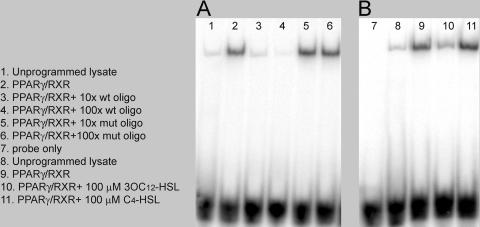
3OC12-HSL affects the DNA binding activity of PPARγ. Recombinant PPARγ and RXRα proteins were synthesized in vitro utilizing the TNT in vitro transcription-translation kit. Equal amounts of programmed or unprogrammed lysates were incubated with a radioactively labeled wild-type oligonucleotide carrying a consensus PPARγ-responsive element. (A) Competition assays were performed using 10× or 100× molar excesses of unlabeled wild-type (wt) or mutated (mut) oligonucleotides (oligo; lanes 3 to 6). (B) The effects of autoinducers on PPARγ DNA binding activity were assessed by adding 100 μM 3OC12-HSL or C4-HSL to the binding reaction mixtures in lanes 10 and 11.
FIG. 5.
FIG. 5.
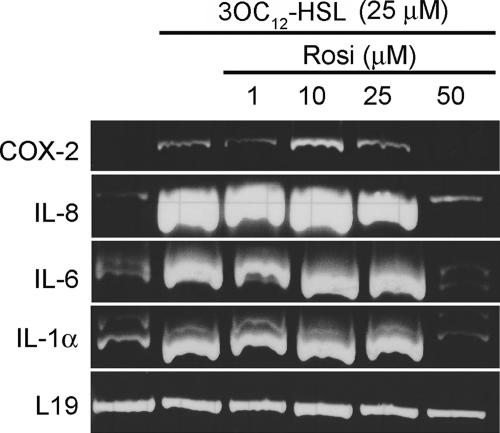
Antagonistic effects of 3OC12-HSL and rosiglitazone on mRNA levels for proinflammatory genes. A549 cells were incubated in the absence or presence of 25 μm 3OC12-HSL, either alone or in the presence of various concentrations of rosiglitazone (Rosi) for 6 h. RNA was extracted and converted into cDNA, and mRNA levels for a panel of proinflammatory genes were assessed by RT-PCR. The mRNA encoding the ribosomal protein L19 was analyzed as a loading control.
FIG. 6.
FIG. 6.
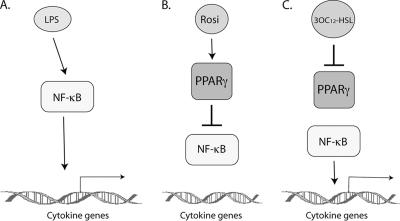
Hypothetical model of mutual antagonism between 3OC12-HSL and rosiglitazone in the regulation of NF-κB-dependent genes. (A) Proinflammatory stimuli such as lipopolysaccharide (LPS) activate NF-κB and stimulate the transcription of several inflammatory mediators. (B) Ligand-bound PPARγ transrepresses NF-κB by stabilizing corepressor complexes bound at promoters of NF-κB-dependent genes. (C) 3OC12-HSL inhibits PPARγ activity, possibly by competing with rosiglitazone for binding within the PPARγ ligand binding domain, and relieves the transrepression of NF-κB activity.

References

    1. Abbas, A. K. 2003. Cellular and molecular immunology, 5th ed. Saunders, Philadelphia, PA.
    1. Adachi, M., R. Kurotani, K. Morimura, Y. Shah, M. Sanford, B. B. Madison, D. L. Gumucio, H. E. Marin, J. M. Peters, H. A. Young, and F. J. Gonzalez. 2006. Peroxisome proliferator activated receptor gamma in colonic epithelial cells protects against experimental inflammatory bowel disease. Gut 551104-13. - PMC - PubMed
    1. Aranda, A., and A. Pascual. 2001. Nuclear hormone receptors and gene expression. Physiol. Rev. 811269-304. - PubMed
    1. Bals, R., and B. Jany. 2001. Identification of disease genes by expression profiling. Eur. Respir. J. 18882-9. - PubMed
    1. Bastie, C., D. Holst, D. Gaillard, C. Jehl-Pietri, and P. A. Grimaldi. 1999. Expression of peroxisome proliferator-activated receptor PPARδ promotes induction of PPARγ and adipocyte differentiation in 3T3C2 fibroblasts. J. Biol. Chem. 27421920-5. - PubMed

Publication types

MeSH terms

LinkOut - more resources