


Distribution and correlates of serum 25-hydroxyvitamin D levels in a sample of patients with hip fracture
- PMID: 18179991
- PMCID: PMC2387201
- DOI: 10.1016/j.amjopharm.2007.12.004
Distribution and correlates of serum 25-hydroxyvitamin D levels in a sample of patients with hip fracture
Abstract
Background: Vitamin D deficiency is common in older populations, particularly during the winter months due to low levels of ultraviolet light exposure, and in nursing home residents.
Objective: The main objective of the current study was to assess the distribution of serum 25-hydroxyvitamin D and its correlates in a sample of men and women with recent hip fractures who were part of a large clinical trial.
Methods: This was a cross-sectional exploratory study of screened and ultimately randomized patients with hip fractures. They were part of a multinational (115 clinical centers in 20 countries), randomized, placebo-controlled, double-blind study testing the efficacy of a yearly IV bisphosphonate (zoledronic acid) in the prevention of new clinical fractures in patients with recent hip fracture repair. Levels of 25-hydroxyvitamin D, calcium, alkaline phosphatase, creatinine clearance, and albumin were measured at a screening visit using blood serum. Demographic variables were assessed by patient self-report. Bone mineral density (BMD) was assessed by dual-energy x-ray absorptiometry of the nonfractured hip.
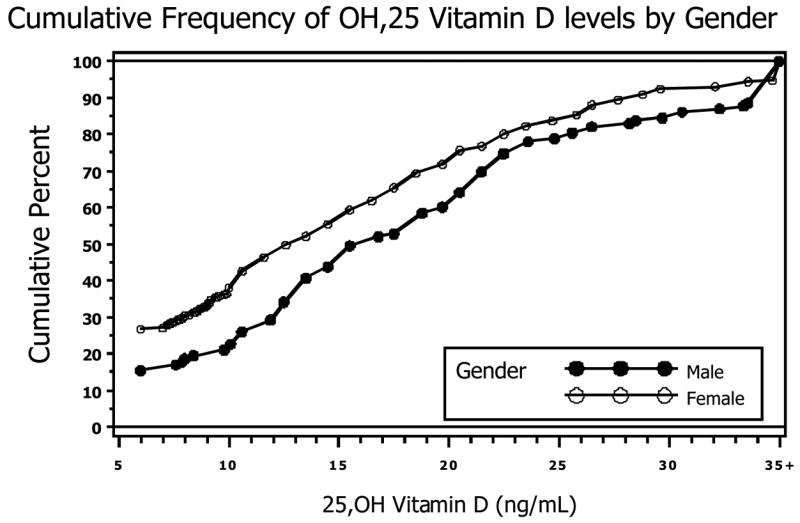
Results: This report included 1174 screened patients (526 with vitamin D measured) and 655 (385 with vitamin D measured) patients randomized before the protocol amendment. In screened patients, levels of 25-hydroxyvitamin D were low (median, 14.7 ng/mL; interquartilc range, 7.6, 21.65). Overall, 51% were at or below the clinically meaningful threshold of 15 ng/mL. Among those patients randomized, the level of 25-hydroxyvitamin D was significantly positively related to male sex (rho, 0.13; P < 0.05), serum calcium (rho, 0.16; P < 0.01), and BMD at the femoral neck (rho, 0.22; P < 0.01) in bivariate analyses. Low serum 25-hydroxyvitamin D (<15 ng/mL) was related only to low serum calcium (odds ratio, 0.16; 95% CI, 0.05-0.52) in multivariable logistic models controlling for sex, age, race, body mass index, living at home, alkaline phosphatase, and creatinine clearance.
Conclusions: We concluded that vitamin D insufficiency was a common problem in this population of elderly patients who had recently suffered a hip fracture. This insufficiency was related only to serum calcium in multivariable controlled models but cannot be reliably identified or excluded by measuring serum calcium alone. Physicians should be encouraged to check and monitor patients' serum levels of 25-hydroxyvitamin D.
Conflict of interest statement
CONFLICT OF INTEREST
Author Name: Carl F. Pieper None Author Name: Cathleen Colon-Emeric None Author Name: John Caminis None Author Name: Kathleen Betchyk None Author Name: Jie Zhang None Author Name: Cheri Janning None Author Name: John Shostak None Author Name: Meryl S. LeBoff None Author Name: Robert Heaney None Author Name: Kenneth W. Lyles None
Figures
References
-
- Simonelli C, Weiss T, Morancey J, Swanson L, Chen Y-T. Prevalence of vitamin D inadequacy in a minimal trauma fracture population. Current Medical Research and Opinions. 2005;21(7):1069–1074. - PubMed
-
- Bishcoff-Ferrari H, Dietrich T, Orav EJ, Dawson-Hughes B. Positive association between 25-Hydorxy vitamin D levels and bone mineral density: A population-based study of younger and older adults. American Journal of Medicine. 2004;116:634–639. - PubMed
-
- Heany R, Weaver CM. Calcium and Vitamin D. Endocrinology and Metabolism Clinics of North America. 2003;32(1):181–194. - PubMed
-
- Semba R, Garrett E, Johnson BA, Guralnik JM, Fried LP. Vitamin D deficiency among older women with and without disability. American Journal of Clinical Nutrition. 2000;72(6):1529–1534. - PubMed
-
- Elliot M, Binkley NC, Carnes M, Zimmerman DR, et al. Fracture risks for women in long-term care: high prevalence of calcaneal osteoporosis and hypovitaminosis. Pharmacotherapy. 2003;23(6):702–710. - PubMed
Publication types
MeSH terms
Substances
Grants and funding
LinkOut - more resources
Full Text Sources
Medical
