


Review
doi: 10.1038/sj.bjc.6604098.
Epub 2008 Jan 8.
Updates on p53: modulation of p53 degradation as a therapeutic approach
Affiliations
- PMID: 18182973
- PMCID: PMC2359710
- DOI: 10.1038/sj.bjc.6604098
Item in Clipboard
Review
Updates on p53: modulation of p53 degradation as a therapeutic approach
Br J Cancer.
.
Abstract
The p53 pathway is aberrant in most human tumours with over 50% expressing mutant p53 proteins. The pathway is critically controlled by protein degradation. Here, we discuss the latest developments in the search for small molecules that can modulate p53 pathway protein stability and restore p53 activity for cancer therapy.
Figures
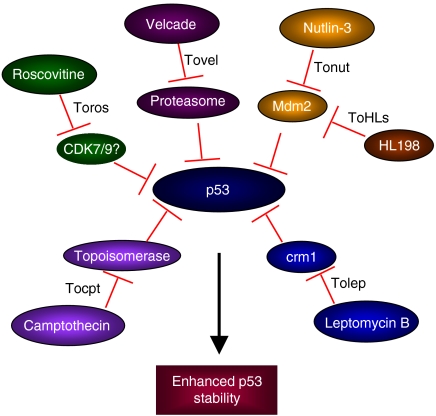
Small molecules that modulate p53 degradation and stability.
References
-
- Bertheau P, Plassa F, Espie M, Turpin E, de Roquancourt A, Marty M, Lerebours F, Beuzard Y, Janin A, de The H (2002) Effect of mutated TP53 on response of advanced breast cancers to high-dose chemotherapy. Lancet 360: 852–854 - PubMed
-
- Bond GL, Hu W, Levine AJ (2005) MDM2 is a central node in the p53 pathway: 12 years and counting. Curr Cancer Drug Targets 5: 3–8 - PubMed
-
- Brummelkamp TR, Fabius AW, Mullenders J, Madiredjo M, Velds A, Kerkhoven RM, Bernards R, Beijersbergen RL (2006) An shRNA barcode screen provides insight into cancer cell vulnerability to MDM2 inhibitors. Nat Chem Biol 2: 202–206 - PubMed
-
- Chen D, Zhang Z, Li M, Wang W, Li Y, Rayburn ER, Hill DL, Wang H, Zhang R (2007) Ribosomal protein S7 as a novel modulator of p53–MDM2 interaction: binding to MDM2, stabilization of p53 protein, and activation of p53 function. Oncogene 26: 5029–5037 - PubMed
-
- Chene P (2003) Inhibiting the p53–MDM2 interaction: an important target for cancer therapy. Nat Rev Cancer 3: 102–109 - PubMed
Publication types
MeSH terms
Substances
LinkOut - more resources
Full Text Sources
Research Materials
Miscellaneous
