


Friends or relatives? Phylogenetics and species delimitation in the controversial European orchid genus Ophrys
- PMID: 18184645
- PMCID: PMC2701817
- DOI: 10.1093/aob/mcm299
Friends or relatives? Phylogenetics and species delimitation in the controversial European orchid genus Ophrys
Abstract
Background and aims: Highly variable, yet possibly convergent, morphology and lack of sequence variation have severely hindered production of a robust phylogenetic framework for the genus Ophrys. The aim of this study is to produce this framework as a basis for more rigorous species delimitation and conservation recommendations.
Methods: Nuclear and plastid DNA sequencing and amplified fragment length polymorphism (AFLP) were performed on 85 accessions of Ophrys, spanning the full range of species aggregates currently recognized. Data were analysed using a combination of parsimony and Bayesian tree-building techniques and by principal co-ordinates analysis.
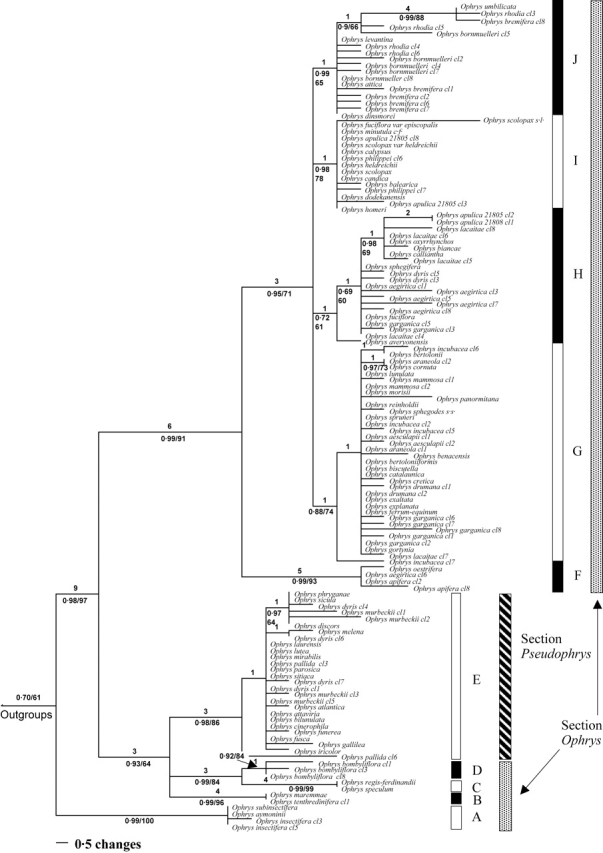
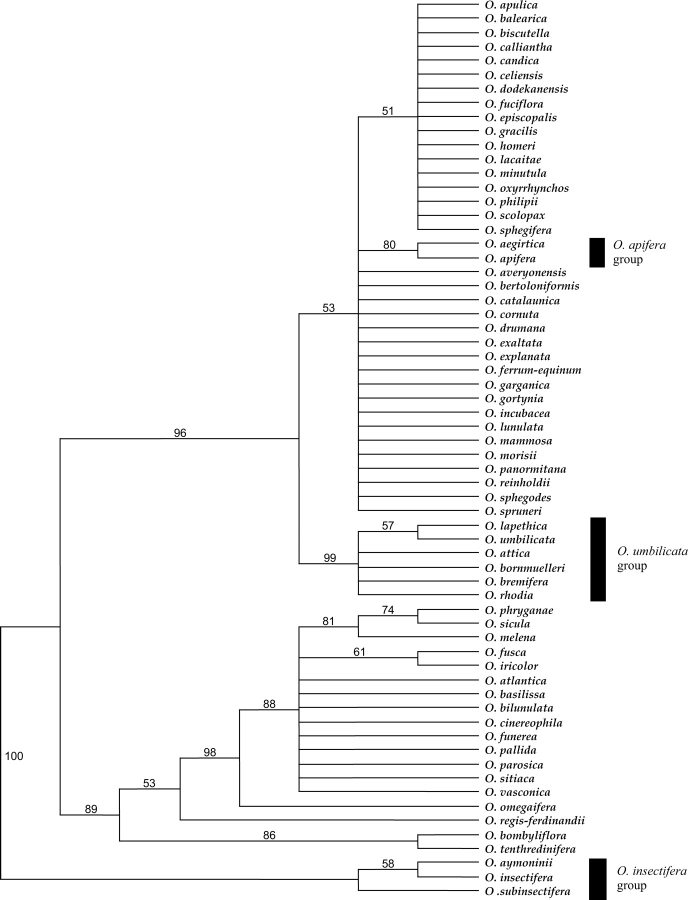
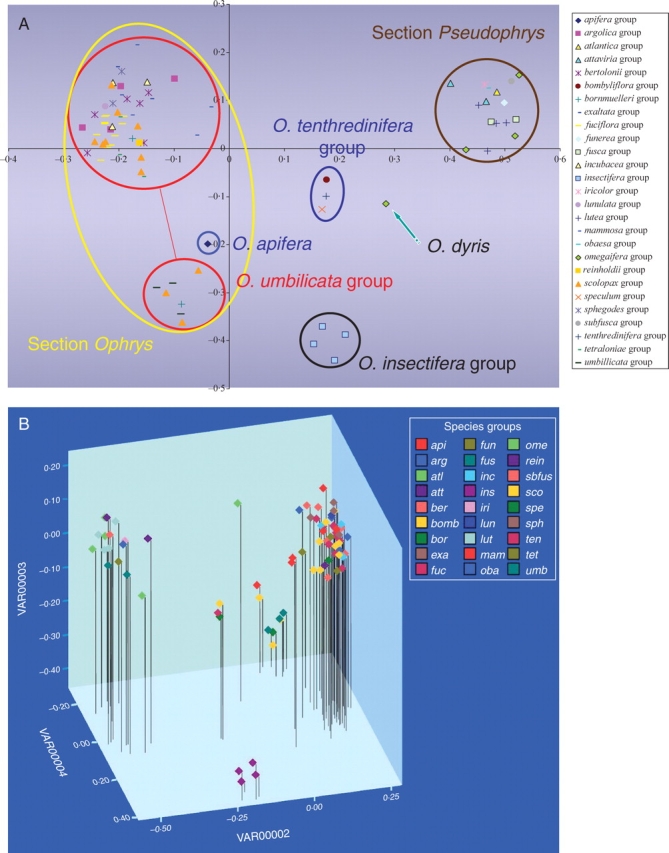
Key results: Complementary phylogenetic analyses and ordinations using nuclear, plastid and AFLP datasets identify ten genetically distinct groups (six robust) within the genus that may in turn be grouped into three sections (treated as subgenera by some authors). Additionally, genetic evidence is provided for a close relationship between the O. tenthredinifera, O. bombyliflora and O. speculum groups. The combination of these analytical techniques provides new insights into Ophrys systematics, notably recognition of the novel O. umbilicata group.
Conclusions: Heterogeneous copies of the nuclear ITS region show that some putative Ophrys species arose through hybridization rather than divergent speciation. The supposedly highly specific pseudocopulatory pollination syndrome of Ophrys is demonstrably 'leaky', suggesting that the genus has been substantially over-divided at the species level.
Figures
References
-
- Bernardos S, Amich F, Gallego F. Karyological and taxonomic notes on Ophrys (Orchidoideae, Orchidaceae) from the Iberian Peninsula. Botanical Journal of the Linnean Society London. 2003;142:395–406.
-
- Bateman RM. Integrating molecular and morphological evidence of evolutionary radiations. In: Hollingsworth PM, Bateman RM, Gornall RJ, editors. Molecular systematics and plant evolution. London: Taylor and Francis; 1999.
-
- Bateman RM. Evolution and classification of European orchids: insights from molecular and morphological characters. Journal Europäischer Orchideen. 2001;33:33–119.
-
- Bateman RM, Devey DS. When orchids challenge an island race. Orchid Review. 2006;114:98–102.
-
- Bateman RM, Hollingsworth PM, Preston J, Yi-Bo L, Pridgeon AM, Chase MW. Molecular phylogenetics and evolution of Orchidinae and selected Habenariinae (Orchidaceae) Botanical Journal of the Linnean Society. 2003;142:1–40.
