. 2008 Jan 9;28(2):446-55.
doi: 10.1523/JNEUROSCI.1775-07.2007.

The consequences of response nonlinearities for interpretation of spectrotemporal receptive fields

Affiliations

The consequences of response nonlinearities for interpretation of spectrotemporal receptive fields

G Björn Christianson et al. J Neurosci. .

Abstract

Neurons in the central auditory system are often described by the spectrotemporal receptive field (STRF), conventionally defined as the best linear fit between the spectrogram of a sound and the spike rate it evokes. An STRF is often assumed to provide an estimate of the receptive field of a neuron, i.e., the spectral and temporal range of stimuli that affect the response. However, when the true stimulus-response function is nonlinear, the STRF will be stimulus dependent, and changes in the stimulus properties can alter estimates of the sign and spectrotemporal extent of receptive field components. We demonstrate analytically and in simulations that, even when uncorrelated stimuli are used, interactions between simple neuronal nonlinearities and higher-order structure in the stimulus can produce STRFs that show contributions from time-frequency combinations to which the neuron is actually insensitive. Only when spectrotemporally independent stimuli are used does the STRF reliably indicate features of the underlying receptive field, and even then it provides only a conservative estimate. One consequence of these observations, illustrated using natural stimuli, is that a stimulus-induced change in an STRF could arise from a consistent but nonlinear neuronal response to stimulus ensembles with differing higher-order dependencies. Thus, although the responses of higher auditory neurons may well involve adaptation to the statistics of different stimulus ensembles, stimulus dependence of STRFs alone, or indeed of any overly constrained stimulus-response mapping, cannot demonstrate the nature or magnitude of such effects.


Figures
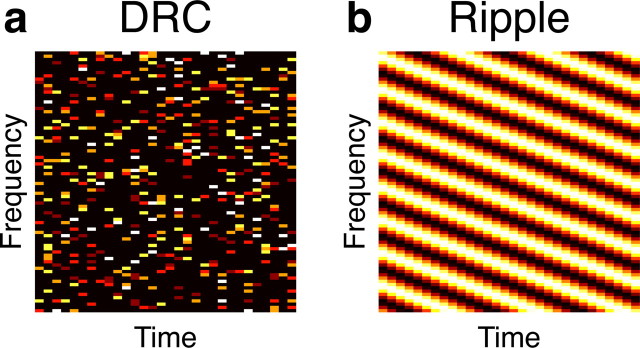
Figure 1.
Figure 1.
a, b, Examples of single frames of both the DRC stimulus (a) and the ripple stimulus (b). For STRF estimations, 75,000 frames of each stimulus were used. In the case of the DRC stimulus, each of these frames was randomly generated; in the case of the ripple stimulus, each frame had different modulation patterns along the time and frequency axes.
Figure 2.
Figure 2.
a–c, A linear RF formed by the addition of two Gaussian receptive fields (a) is correctly estimated using DRC (b) and ripple (c) stimuli. d, e, However, for a multiplicative RF (d), only the DRC estimate provides the expected STRF consisting of an approximation of the sum of the RF components (e). f, The ripple STRF includes prominent sidebands that have no basis in the true RF.
Figure 3.
Figure 3.
The effects of Figure 2 can influence STRF interpretation in a number of different ways. a–c, For this model sweep-sensitive neuron, with multiplicative RF components that are temporally offset and spectrally adjacent (a), the STRF estimated using an ensemble of ripples greatly overestimates the extent of spectrotemporal tuning (b vs c).
Figure 4.
Figure 4.
Divisive inhibition can cause overestimation of support. a, In this model RF, the maximum spectral extents of the regions of inhibition (dashed red line) and excitation (solid blue line) were identical, although the profiles had different shapes; in the temporal dimension, both extents and profile shapes were the same. b, Inhibitory sidebands are clearly apparent when an STRF is estimated using the DRC stimulus c. In the STRF estimated with the ensemble of ripples, an alternating pattern extends beyond the simple sidebands and outside the support of the model.
Figure 5.
Figure 5.
a, b, A rectifying nonlinearity (a) applied after a simple bimodal linear RF does not have any impact on the estimation of an STRF using the independent DRC stimulus (b). However, with the ripple stimulus, the receptive field of the neuron is overestimated, and sidebands appear.
Figure 6.
Figure 6.
The best-fit linear regression (red line) to parabolic data (black dashed line) depends on the subset of the data used in the fit (black solid line).
Figure 7.
Figure 7.
a, b, The periodic structure of a ripple stimulus in spectrotemporal space (a) simplifies to a single point in modulation transfer function space (b), up to a symmetry about the origin imposed by a real-valued signal. ccc–f, The true support of the nonlinear RF (c) from Figure 2c is overestimated in spectrotemporal space when using an ensemble of ripple stimuli (e), but when transformed into modulation transfer function space, the estimate is conservative (d, f). (Note that c and d show the spectrotemporal and modulation transfer function representations of the true support of the multiplicative RF, not the DRC estimate of this support.)
Figure 8.
Figure 8.
a, An RF with an inhibitory linear component and an excitatory multiplicative component, in which spectrotemporal extents of the two components are the same. b, At low stimulus powers, the linear component dominates, and the peak is inhibitory. c, d, As the stimulus power is increased, the influence of the multiplicative term begins to dominate; the peak diminishes (c) and becomes strongly excitatory (d). For this example, background firing was simulated by adding a constant to r⃗ (see Materials and Methods); orange represents this baseline response, with black being drops below this rate and white denoting increases in rate.
Figure 9.
Figure 9.
a–t, The STRF of a model neuron varies with the stimulus used to estimate it. Although the STRF estimated for a linear model (a–e) is invariant with the stimulus used, STRF estimates are stimulus dependent for the multiplicative RF (f–j), the threshold RF (k–o), and the divisive inhibition RF (p–t). a, f, k, p, Support of the models. All time–frequency combinations that can contribute to the response are shown in white. b, g, l, q, STRFs estimated using ambient environmental sounds. c, h, m, r, STRFs estimated using Bengalese finch song. d, i, n, s, STRFs estimated using cotton-top tamarin vocalizations. e, j, o, t, STRFs estimated using speech.
Figure 10.
Figure 10.
Minor changes in the model parameters can influence interactions with stimulus statistics. a, b, The multiplicative RF used in this paper (a; only model support shown, as in Fig. 9) leads to spectral elongation in the STRF estimated using Bengalese finch song (b; same as in Fig. 9). c, d, However, changing the locations of the RF components (c) leads to both more pronounced spectral elongation and the appearance of a clear third peak in the STRF (d).

References

    1. Aertsen AM, Johannesma PI. A comparison of the spectro-temporal sensitivity of auditory neurons to tonal and natural stimuli. Biol Cybern. 1981;42:145–156. - PubMed
    1. Aertsen AM, Olders JH, Johannesma PI. Spectro-temporal receptive fields of auditory neurons in the grassfrog. III. Analysis of the stimulus-event relation for natural stimuli. Biol Cybern. 1981;39:195–209. - PubMed
    1. Ahrens M, Linden JF, Sahani M. Nonlinearities and contextual influences in auditory cortical responses modeled with multilinear spectrotemporal methods. J Neurosci. 2008 in press. - PMC - PubMed
    1. Bar-Yosef O, Rotman Y, Nelken I. Responses of neurons in cat primary auditory cortex to bird chirps: effects of temporal and spectral context. J Neurosci. 2002;22:8619–8632. - PMC - PubMed
    1. Barbour DL, Wang X. Auditory cortical responses elicited in awake primates by random spectrum stimuli. J Neurosci. 2003;23:7194–7206. - PMC - PubMed

Publication types

LinkOut - more resources
