Endovascular treatment of experimental aneurysms with use of fibroblast transfected with replication-deficient adenovirus containing bone morphogenetic protein-13 gene
- PMID: 18184848
- PMCID: PMC2605703
- DOI: 10.3174/ajnr.A0892
Endovascular treatment of experimental aneurysms with use of fibroblast transfected with replication-deficient adenovirus containing bone morphogenetic protein-13 gene
Abstract
Background and purpose: Modified coils have failed to improve long-term recanalization of aneurysms. This study examined whether ex vivo transduction of replication-deficient adenovirus containing the bone morphogenetic protein-13 gene (Ad-BMP-13) in fibroblast allografts would improve angiographic results via increased collagen synthesis, compared with fibroblast-coated platinum coils (FBC) and bare platinum coils (PA).
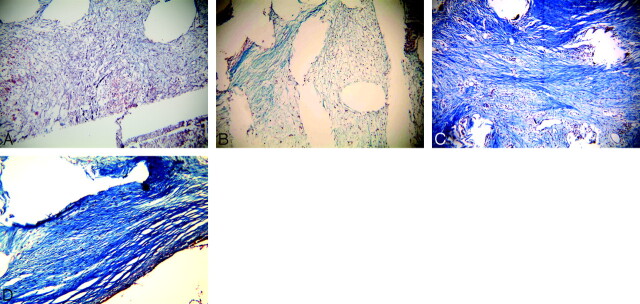
Materials and methods: Aneurysms were embolized with Ad-BMP-13-coated coils (n = 20). Rabbits were sacrificed at 14 days and at 1, 3, and 6 months after implantation. Digital subtraction angiography (DSA) evaluated stability after embolization. Histologic specimens were examined with a qualitative grading system. Masson trichrome evaluated collagen deposition. Findings were compared with previously reported controls for PA and FBC in the same model and time points.
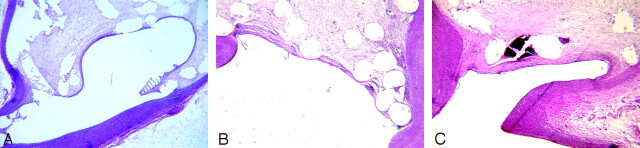
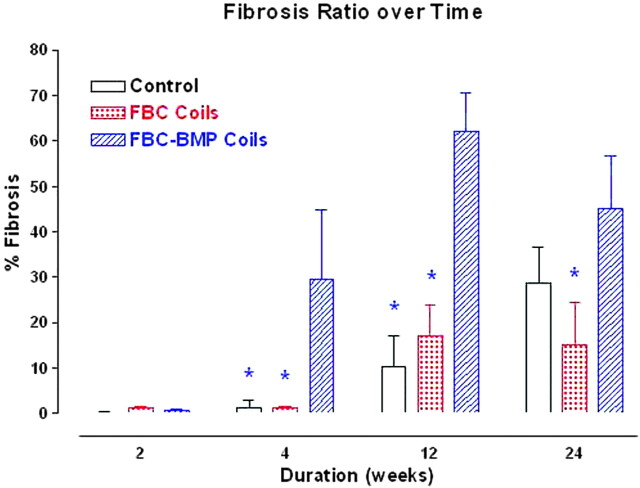
Results: The grading system showed a greater total score (P = .0002) in Ad-BMP-13 (6.8 +/- 1.6) and FBC (6.3 +/- 2.4) compared with PA (4.7 +/- 2.4). A group main effects test showed that aneurysm neck tissue coverage in Ad-BMP-13 (2.5 +/- 1.1) was higher (P = .0007) than both FBC (1.6 +/- 1.4) and PA (0.9 +/- 1.1). Ad-BMP-13 had more (P < .0001) collagen deposition than the FBC and PA. One- and 3-month Ad-BMP-13 collagen depositions increased (P < .05) over the FBC and PA. Finally, Ad-BMP-13 showed radiographic stability in 15 (75%) cases, coil compaction in 4 (20%) cases, and progressive occlusion in 1 (5%) case. There were no differences in angiographic results (P = .6522).
Conclusion: The Ad-BMP-13-coated coils can improve neck coverage and dome fibrosis in the rabbit model, even in the absence of observed differences in angiographic outcome.
Figures

References
-
- Molyneux A, Kerr RS, Yu LM, et al. International subarachnoid aneurysm trial (ISAT) of neurosurgical clipping versus endovascular coiling in 2143 patients with ruptured intracranial aneurysms: a randomised comparison of effects on survival, dependency, seizures, rebleeding, subgroups, and aneurysm occlusion. Lancet 2005;366:809–17 - PubMed
-
- Gruber A, Killer M, Bavinzski G, et al. Clinical and angiographic results of endosaccular coiling treatment of giant and very large intracranial aneurysms: a 7-year, single-center experience. Neurosurgery 1999;45:793–803; discussion 803–04 - PubMed
-
- Abrahams JM, Forman MS, Grady MS, et al. Biodegradable polyglycolide endovascular coils promote wall thickening and drug delivery in a rat aneurysm model. Neurosurgery 2001;49:1187–93; discussion 1193–95 - PubMed
-
- Dawson RC, Krisht AF, Barrow DL, et al. Treatment of experimental aneurysms using collagen-coated microcoils. Neurosurgery 1995;36:133–39; discussion 139–40 - PubMed
Publication types
MeSH terms
Substances
Grants and funding
LinkOut - more resources
Full Text Sources
Medical