. 2008 May;149(5):2667-77.
doi: 10.1210/en.2007-1527. Epub 2008 Jan 10.

Pathways leading to phosphorylation of p450c17 and to the posttranslational regulation of androgen biosynthesis

Affiliations

Pathways leading to phosphorylation of p450c17 and to the posttranslational regulation of androgen biosynthesis

Meng Kian Tee et al. Endocrinology. 2008 May.

Abstract

Cytochrome P450c17 (P450c17) is the single enzyme that catalyzes steroid 17alpha-hydroxylase and 17,20 lyase activities and hence is the crucial decision-making step that determines the class of steroid made in a steroidogenic cell. Although both activities are catalyzed on a single active site, the ratio of these activities is regulated by posttranslational events. Serine phosphorylation of P450c17 increases 17,20 lyase activity by increasing the enzyme's affinity for its redox partner, P450 oxidoreductase. We searched for the relevant kinase(s) that phosphorylates P450c17 by microarray studies and by testing of kinase inhibitors. Microarrays show that 145 of the 278 known serine/threonine kinases are expressed in human adrenal NCI-H295A cells, only six of which were induced more than 2-fold by treatment with 8-Br-cAMP. Key components of the ERK1/2 and MAPK/ERK kinase (MEK)1/2 pathways, which have been implicated in the insulin resistance of PCOS, were not found in NCI-H295A cells, implying that these pathways do not participate in P450c17 phosphorylation. Treatment with various kinase inhibitors that probe the protein kinase A/phosphatidylinositol 3-kinase/Akt pathway and the calcium/calmodulin/MAPK kinase pathway had no effect on the ratio of 17,20 lyase activity to 17alpha-hydroxylase activity, appearing to eliminate these pathways as candidates leading to the phosphorylation of P450c17. Two inhibitors that target the Rho-associated, coiled-coil containing protein kinase (ROCK)/Rho pathway suppressed 17,20 lyase activity and P450c17 phosphorylation, both in NCI-H295A cells and in COS-1 cells transfected with a P450c17 expression vector. ROCK1 phosphorylated P450c17 in vitro, but that phosphorylation did not affect 17,20 lyase activity. We conclude that members of the ROCK/Rho pathway act upstream from the kinase that phosphorylates P450c17 in a fashion that augments 17,20 lyase activity, possibly acting to catalyze a priming phosphorylation.


Figures

Figure 1
Figure 1
Serum suppresses P450c17 phosphorylation. A, NCI-H295A cells were labeled with [32P]orthophosphate in the presence (lanes 2 and 4) or absence (lanes 1 and 3) of serum, followed by immunoprecipitation (lanes 1 and 2) or immunoblotting (IB) with P450c17 antibody (lanes 3 and 4). B, NCI-H295A cells (left panel) and COS1 cells transfected with P450c17 (right panel) were assayed for 17α-hydroxylase and 17,20 lyase activities in the presence or absence of serum and 100 nm insulin for 4 h. The samples in lanes 4 and 7 received insulin without serum. The controls received the complete medium with serum. C, The above experiment was done in triplicate to determine the ratio of 17,20 lyase to 17α-hydroxylase activity in NCI-H295A cells. Asterisks indicate significant differences from controls: P = 0.00070 and P = 0.00060 for the treatments minus serum/minus insulin and minus serum/plus insulin, respectively. 17-OH preg, 17-Hydroxypregnenolone; 17-OH prog, 17-hydroxyprogesterone.
Figure 2
Figure 2
ROCK1 overexpression induces 17,20 lyase activity. COS-1 cells transfected with P450c17 alone or with the indicated ROCK1 constructs were incubated with [14C]progesterone (prog) (top panel) or [3H]17-hydroxypregnenolone (17-OH preg) (bottom panel) for 1 h. Steroids were extracted and analyzed by TLC and autoradiography. The data (mean ± sd) from three separate experiments are summarized on the right. Asterisks indicate significant differences from controls: P = 0.043, P = 0.0062, P = 0.0037, and P = 0.0022 for cells transfected with P450c17 and treated with cAMP, cotransfected with P450c17 and p160ROCK1-wt, p160ROCK1-Δ1 and p160ROCK1-Δ3, respectively.
Figure 3
Figure 3
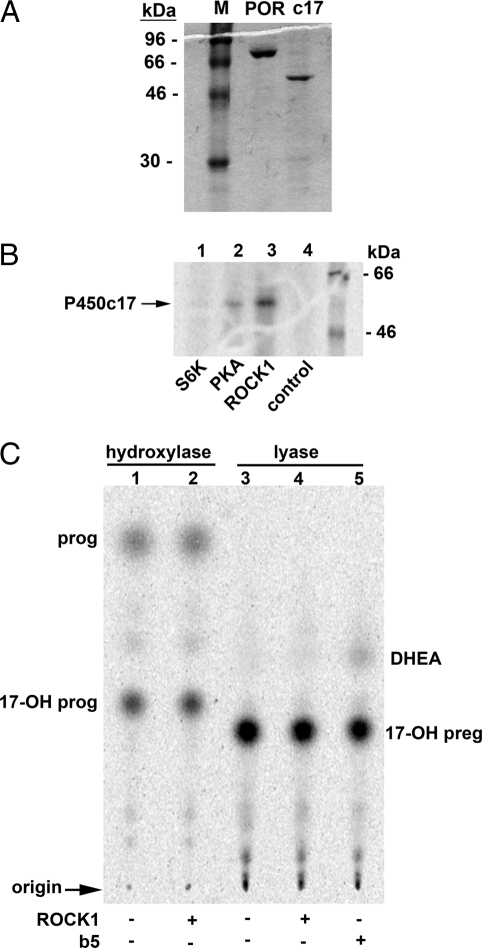
Recombinant ROCK1 alone can phosphorylate P450c17 in vitro but is not sufficient to induce 17,20 lyase activity. A, POR and His-tagged P450c17 (c17) were expressed in bacteria, purified, and analyzed by SDS-PAGE. B, Purified P450c17 (1 μg) was incubated with catalytically active recombinant p70S6K (S6K), PKA, or ROCK1 in 200 μm [γ-32P]ATP for 20 min at 30 C. P450c17 was captured onto Ni-NTA beads, washed and eluted in SDS-gel loading buffer, and analyzed by SDS-PAGE. C, P450c17 was preincubated with recombinant ROCK1 in 20 mm HEPES, 20 mm MgCl2, 200 μm ATP for 20 min at 30 C. POR (60 pmol), cytochrome b5 (10 pmol), and substrates [14C]progesterone (prog) or [3H]17-hydroxypregnenolone (17-OH preg) were added, and the mixtures were incubated at 37 C for 3 h. Steroids were extracted and analyzed by TLC and autoradiography.
Figure 4
Figure 4
Serum deprivation increases ROCK1-P450c17 interaction, P450c17 phosphorylation, and 17,20 lyase activity. A, COS-1 cells were transfected with P450c17 alone (lane 3) or with ROCK1-Δ3 (lane 2) and ROCK1-wt (lane 1). Cell lysates were immunoprecipitated (IP) with P450c17 antibody (lanes 1–3), and Western blot was done using ROCK1 antibody. B, NCI-H295A cells were incubated with and without serum for 4 h (lanes 1 and 3 vs. 2 and 4, respectively), immunoprecipitated with P450c17 antibody (lanes 1 and 2), and probed with ROCK1 antibody. C, GST-tagged catalytically active recombinant ROCK1 was incubated with a purified His-tagged P450c17 in 20 mm HEPES, 20 mm MgCl2, 200 μm ATP for 20 min at 30 C. Preformed complexes in lanes 1–2 and 3–4 were captured onto GST and Ni-NTA beads, respectively, washed, and eluted, and the gel was stained by Coomassie Blue R250. In lanes 5–6 and 7–8, ROCK1 and P450c17 were prebound to GST and Ni-NTA beads, respectively. The prebound input ROCK1-GST (lane 5) was incubated with P450c17 (lane 6), whereas prebound P450c17-Ni-NTA (lane 7) was incubated with ROCK1 (lane 8).
Figure 5
Figure 5
Suppression of ROCK1 by RNA interference inhibits 17,20 lyase activity. A, To confirm the silencing of ROCK1 and ROCK2 by RNA interference, 40 cycles of RT-PCR were done using cDNAs from lentivirus-infected NCI-H295A cells; β-glucuronidase (GUS) was used as an internal control. Subconfluent cells were infected for 2 d with lentiviruses expressing siRNAs for ROCK1 (lanes 3, 7, and 11) and ROCK2 (lanes 4, 8, and 12), or with lentiviruses prepared from the vector alone (lanes 1, 5, and 9) or a construct expressing a scrambled sequence (lanes 2, 6, and 10). B, NCI-H295A cells infected with lentiviral constructs of vector alone (lanes 1 and 5), a scrambled sequence (lanes 2 and 6), ROCK1 siRNA (lanes 3 and 7), and ROCK2 siRNA (lanes 4 and 8) were subjected to hydroxylase (lanes 1–4) and lyase (lane 5–8) assays with substrates [14C]progesterone or [3H]17-hydroxypregnenolone respectively. C, The above experiment was done in triplicate to determine the effects of ROCK1 and ROCK2 siRNAs on the ratio of 17,20 lyase to 17α-hydroxylase activities in NCI-H295A cells. *, Significant difference from controls; P = 0.00070 for ROCK1 siRNA.

References

    1. Azziz R, Woods KS, Reyna R, Key TJ, Knochenhauer ES, Yildiz BO 2004 The prevalence and features of the polycystic ovary syndrome in an unselected population. J Clin Endocrinol Metab 89:2745–2749 - PubMed
    1. Dunaif A, Thomas A 2001 Current concepts in the polycystic ovary syndrome. Annu Rev Med 52:401–419 - PubMed
    1. Lachelin GC, Judd HL, Swanson SC, Hauck ME, Parker DC, Yen SS 1982 Long term effects of nightly dexamethasone administration in patients with polycystic ovarian disease. J Clin Endocrinol Metab 55:768–773 - PubMed
    1. Rittmaster RS, Thompson DL 1990 Effect of leuprolide and dexamethasone on hair growth and hormone levels in hirsute women: the relative importance of the ovary and the adrenal in the pathogenesis of hirsutism. J Clin Endocrinol Metab 70:1096–1102 - PubMed
    1. Hoffman DI, Klove K, Lobo RA 1984 The prevalence and significance of elevated dehydroepiandrosterone sulfate levels in anovulatory women. Fertil Steril 42:76–81 - PubMed

Publication types

MeSH terms