


Trends in antibacterial resistance among Streptococcus pneumoniae isolated in the USA: update from PROTEKT US Years 1-4
- PMID: 18190701
- PMCID: PMC2262084
- DOI: 10.1186/1476-0711-7-1
Trends in antibacterial resistance among Streptococcus pneumoniae isolated in the USA: update from PROTEKT US Years 1-4
Abstract
Background: The increasing prevalence of resistance to established antibiotics among key bacterial respiratory tract pathogens, such as Streptococcus pneumoniae, is a major healthcare problem in the USA. The PROTEKT US study is a longitudinal surveillance study designed to monitor the susceptibility of key respiratory tract pathogens in the USA to a range of commonly used antimicrobials. Here, we assess the geographic and temporal trends in antibacterial resistance of S. pneumoniae isolates from patients with community-acquired respiratory tract infections collected between Year 1 (2000-2001) and Year 4 (2003-2004) of PROTEKT US.
Methods: Antibacterial minimum inhibitory concentrations were determined centrally using the Clinical and Laboratory Standards Institute (CLSI) broth microdilution method; susceptibility was defined according to CLSI interpretive criteria. Macrolide resistance genotypes were determined by polymerase chain reaction.
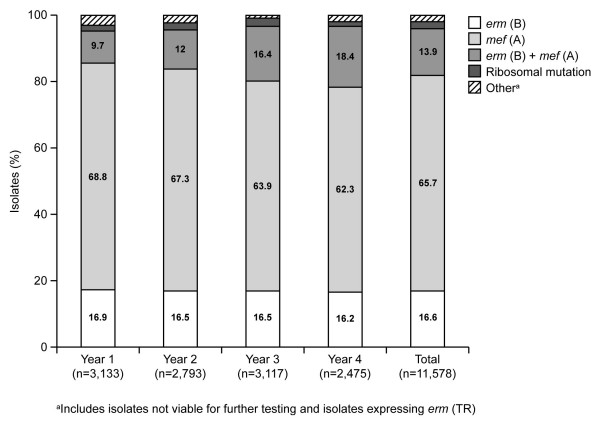
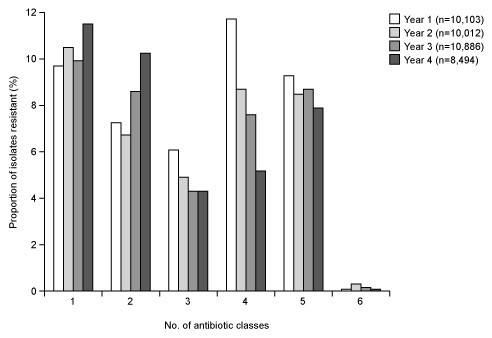
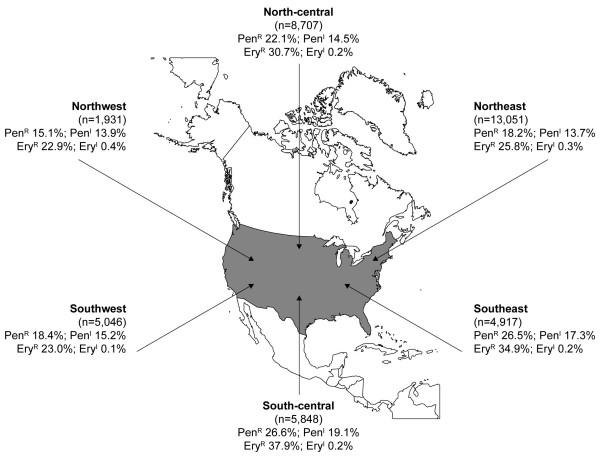
Results: A total of 39,495 S. pneumoniae isolates were collected during 2000-2004. The percentage of isolates resistant to erythromycin, penicillin, levofloxacin, and telithromycin were 29.3%, 21.2%, 0.9%, and 0.02%, respectively, over the 4 years, with marked regional variability. The proportion of isolates exhibiting multidrug resistance (includes isolates known as penicillin-resistant S. pneumoniae and isolates resistant to > or = 2 of the following antibiotics: penicillin; second-generation cephalosporins, e.g. cefuroxime; macrolides; tetracyclines; and trimethoprim-sulfamethoxazole) remained stable at approximately 30% over the study period. Overall mef(A) was the most common macrolide resistance mechanism. The proportion of mef(A) isolates decreased from 68.8% to 62.3% between Year 1 and Year 4, while the percentage of isolates carrying both erm(B) and mef(A) increased from 9.7% to 18.4%. Over 99% of the erm(B)+mef(A)-positive isolates collected over Years 1-4 exhibited multidrug resistance. Higher than previously reported levels of macrolide resistance were found for mef(A)-positive isolates.
Conclusion: Over the first 4 years of PROTEKT US, penicillin and erythromycin resistance among pneumococcal isolates has remained high. Although macrolide resistance rates have stabilized, the prevalence of clonal isolates, with a combined erm(B) and mef(A) genotype together with high-level macrolide and multidrug resistance, is increasing, and their spread may have serious health implications. Telithromycin and levofloxacin both showed potent in vitro activity against S. pneumoniae isolates irrespective of macrolide resistance genotype.
Figures
References
-
- Niederman MS, Mandell LA, Anzueto A, Bass JB, Broughton WA, Campbell GD, Dean N, File T, Fine MJ, Gross PA, Martinez F, Marrie TJ, Plouffe JF, Ramirez J, Sarosi GA, Torres A, Wilson R, Yu VL, American Thoracic Society Guidelines for the management of adults with community-acquired pneumonia. Diagnosis, assessment of severity, antimicrobial therapy, and prevention. Am J Respir Crit Care Med. 2001;163:1730–1754. - PubMed
-
- Pfaller MA, Jones RN, Doern GV, Kugler K. Bacterial pathogens isolated from patients with bloodstream infections: frequencies of occurrence and antimicrobial susceptibility patterns from the SENTRY antimicrobial surveillance program (United States and Canada, 1997) Antimicrob Agents Chemother. 1998;42:1762–1770. - PMC - PubMed
Publication types
MeSH terms
Substances
LinkOut - more resources
Full Text Sources
Medical
