. 2008 Jan 22;105(3):991-6.
doi: 10.1073/pnas.0711401105. Epub 2008 Jan 11.

Impaired cytoadherence of Plasmodium falciparum-infected erythrocytes containing sickle hemoglobin

Affiliations

Impaired cytoadherence of Plasmodium falciparum-infected erythrocytes containing sickle hemoglobin

Rushina Cholera et al. Proc Natl Acad Sci U S A. .

Abstract

Sickle trait, the heterozygous state of normal hemoglobin A (HbA) and sickle hemoglobin S (HbS), confers protection against malaria in Africa. AS children infected with Plasmodium falciparum are less likely than AA children to suffer the symptoms or severe manifestations of malaria, and they often carry lower parasite densities than AA children. The mechanisms by which sickle trait might confer such malaria protection remain unclear. We have compared the cytoadherence properties of parasitized AS and AA erythrocytes, because it is by these properties that parasitized erythrocytes can sequester in postcapillary microvessels of critical tissues such as the brain and cause the life-threatening complications of malaria. Our results show that the binding of parasitized AS erythrocytes to microvascular endothelial cells and blood monocytes is significantly reduced relative to the binding of parasitized AA erythrocytes. Reduced binding correlates with the altered display of P. falciparum erythrocyte membrane protein-1 (PfEMP-1), the parasite's major cytoadherence ligand and virulence factor on the erythrocyte surface. These findings identify a mechanism of protection for HbS that has features in common with that of hemoglobin C (HbC). Coinherited hemoglobin polymorphisms and naturally acquired antibodies to PfEMP-1 may influence the degree of malaria protection in AS children by further weakening cytoadherence interactions.


Conflict of interest statement

The authors declare no conflict of interest.

Figures
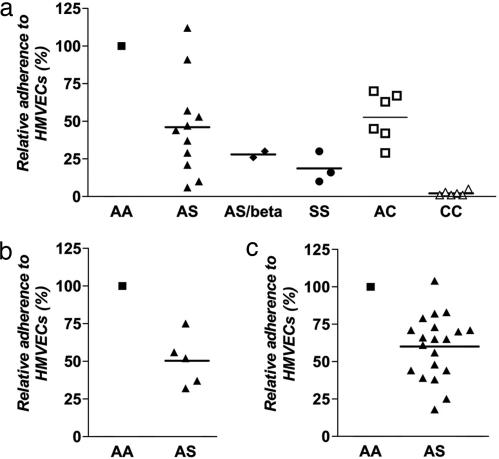
Fig. 1.
Fig. 1.
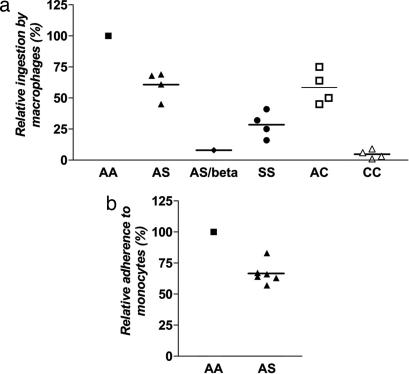
Adherence of parasitized HbS and HbC erythrocytes to HMVECs. (a) Adherence of parasitized erythrocytes to HMVECs under semistatic conditions. Results from AS, SS, AC, and CC erythrocytes were normalized to those from AA erythrocytes run in parallel. Mean percentages are indicated by horizontal bars. Results were obtained from three parasite lines (3D7, FVO, and 7G8) and multiple blood donors (17AA, 9AS, 1AS/β-thalassemia, 3SS, 2AC, and 2CC) (not all combinations tested). The mean (± SEM) number of parasitized AA erythrocytes per HMVEC was 3.7 ± 0.5. (b) Adherence of P. falciparum 7G8-infected erythrocytes to HMVECs under physiologic flow conditions. Results from three AS erythrocyte donors were normalized to those from five AA erythrocyte donors run in parallel and are expressed as mean percentages (not all combinations tested). The mean (± SEM) number of parasitized AA erythrocytes at 5% parasitemia was 179 ± 48/mm2. (c) Adherence of erythrocytes infected with naturally occurring P. falciparum isolates to HMVECs under semistatic conditions. Results from four AS erythrocyte donors were normalized to those from four AA erythrocyte donors run in parallel and are expressed as mean percentages. Data are from 13 parasite isolates (not all combinations tested). The mean (± SEM) number of parasitized AA erythrocytes per HMVEC was 3.7 ± 0.5.
Fig. 2.
Fig. 2.
Adherence of parasitized HbS and HbC erythrocytes to blood monocytes. (a) Phagocytosis of trophozoite-infected erythrocytes by blood monocyte-derived macrophages. Results from AS, AS/β-thal (AS/beta), SS, AC, and CC erythrocytes were normalized to those from AA erythrocytes run in parallel. Mean percentages are indicated by horizontal bars. Results were obtained from two parasite lines (3D7 and FVO) and multiple blood donors (7AA, 4AS, 1AS/β-thal, 4SS, 4AC, and 4CC) (not all combinations tested). (b) Adherence of trophozoite-infected erythrocytes to blood monocytes. Results from AS erythrocytes were normalized to those from AA erythrocytes run in parallel. Tests included two parasite lines (3D7 and 7G8) and multiple blood donors (3AA and 3AS) (not all combinations tested). The mean (± SEM) number of parasitized AA erythrocytes per monocyte was 1.6 ± 0.2.
Fig. 3.
Fig. 3.
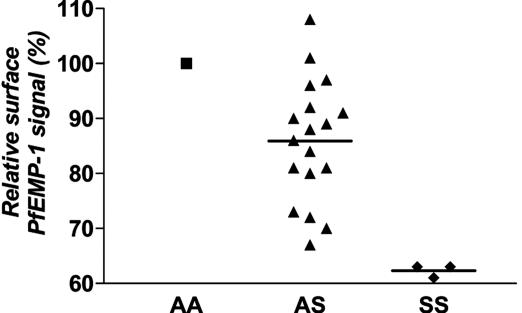
PfEMP-1 expression levels on the surface of unfixed parasitized erythrocytes. Flow-cytometry results from AS and SS erythrocytes were normalized to those from parasitized AA erythrocytes run in parallel. Mean percentages are indicated by horizontal bars. Assays included three parasite lines (3D7.41, FVO, and MCR+) and multiple blood donors (9AA, 18AS, and 3SS) (not all combinations tested).
Fig. 4.
Fig. 4.
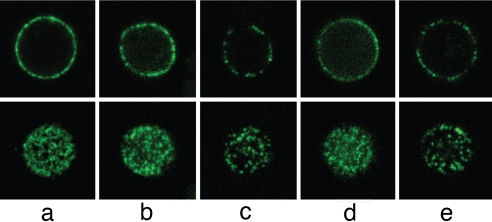
Distribution of PfEMP-1 signal on the surface of unfixed parasitized AA, AS, and SS erythrocytes. Confocal cross-sections through the midplane (Upper) or maximum projections of z stacks through the upper cell surface (Lower) of trophozoite-infected erythrocytes probed with a polyclonal antiserum against PfEMP-1 (FVO line). (a) PfEMP-1 fluorescence patterns typical of a parasitized AA erythrocyte. (b) Fluorescence patterns from a parasitized AS erythrocyte, similar to those of parasitized AA erythrocytes. (c) Irregular, patchy PfEMP-1 distribution on a parasitized AS erythrocyte. (d) Fluorescence patterns from a parasitized SS erythrocyte, similar to those of parasitized AA erythrocytes. (e) Irregular, patchy fluorescence signals from abnormally displayed PfEMP-1 on an SS erythrocyte.
Fig. 5.
Fig. 5.
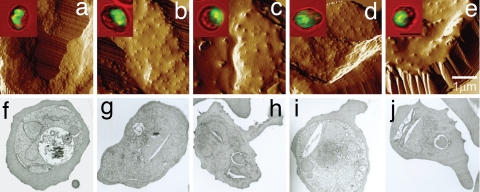
Knob morphology and distribution on the surface of parasitized AS and SS erythrocytes. (a–e) AFM images of parasitized AA (a), AS (b and c), and SS (d and e) erythrocytes in continuous culture showing normal AA-like (a, b, and d) or abnormal CC-like (c and e) appearances (38). (f–j) TEM images of parasitized AA (f), AS (g and h), and SS (i and j) erythrocytes from children with malaria showing normal AA-like (f, g, and i) or abnormal CC-like (h and j) knob appearances.

References

    1. Allison AC. Protection afforded by sickle-cell trait against subtertian malareal infection. Br Med J. 1954;4857:290–294. - PMC - PubMed
    1. Allison AC. Polymorphism and Natural Selection in Human Populations. Cold Spring Harb Symp Quant Biol. 1964;29:137–149. - PubMed
    1. Williams TN, et al. Sickle cell trait and the risk of Plasmodium falciparum malaria and other childhood diseases. J Infect Dis. 2005;192:178–186. - PMC - PubMed
    1. Hill AV, et al. Common west African HLA antigens are associated with protection from severe malaria. Nature. 1991;352:595–600. - PubMed
    1. Aidoo M, et al. Protective effects of the sickle cell gene against malaria morbidity and mortality. Lancet. 2002;359:1311–1312. - PubMed

Publication types

MeSH terms

Substances