


Concordance of the circadian clock with the environment is necessary to maximize fitness in natural populations
- PMID: 18194469
- PMCID: PMC4288752
- DOI: 10.1111/j.1558-5646.2008.00324.x
Concordance of the circadian clock with the environment is necessary to maximize fitness in natural populations
Abstract
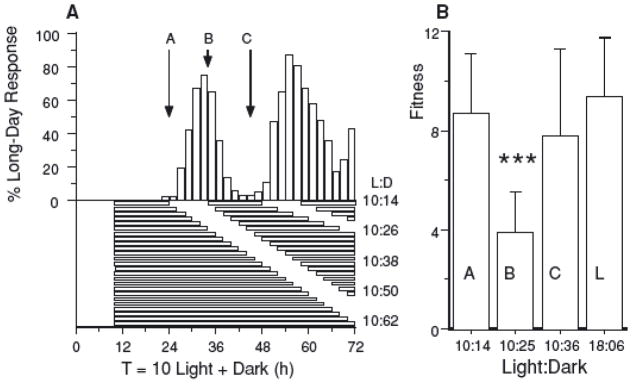
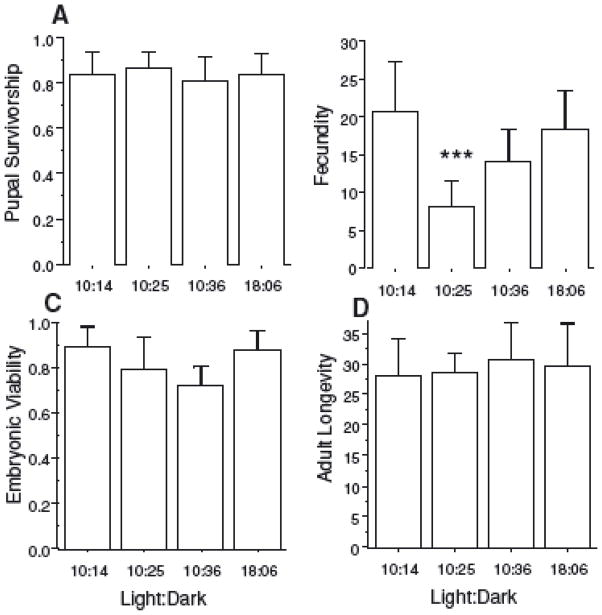
The ubiquity of endogenous, circadian (daily) clocks among eukaryotes has long been held as evidence that they serve an adaptive function, usually cited as the ability to properly time biological events in concordance with the daily cycling of the environment. Herein we test directly whether fitness is a function of the matching of the period of an organism's circadian clock with that of its environment. We find that fitness, measured as the per capita expectation of future offspring, a composite measure of fitness incorporating both survivorship and reproduction, is maximized in environments that are integral multiples of the period of the organism's circadian clock. Hence, we show that organisms require temporal concordance between their internal circadian clocks and their external environment to maximize fitness and thus the long-held assumption is true that, having evolved in a 24-h world, circadian clocks are adaptive.
Figures
References
-
- Aschoff J. Survival value of diurnal rhythms. In: Edholm O, editor. Biology of survival; Symposium of the Zoological Society of London; London. 1964. pp. 79–98.
-
- Beaver LM, Rush BL, Gvakharia BO, Giebultowicz JM. Noncircadian regulation and function of clock genes period and timeless in oogenesis of Drosophila melanogaster. J Biol Rhythms. 2003;18:463–472. - PubMed
-
- Bell G. Measuring the cost of reproduction. 1. The correlation structure of the life table of a plankton rotifer. Evolution. 1984;38:300–313. - PubMed
-
- Bradshaw WE, Lounibos LP. Evolution of dormancy and its photoperiodic control in pitcher-plant mosquitoes. Evolution. 1977;31:546–567. - PubMed
Publication types
MeSH terms
Grants and funding
LinkOut - more resources
Full Text Sources
Medical