. 2008 Jan;36(Database issue):D449-54.
doi: 10.1093/nar/gkm908.

The Plant Ontology Database: a community resource for plant structure and developmental stages controlled vocabulary and annotations

Affiliations

The Plant Ontology Database: a community resource for plant structure and developmental stages controlled vocabulary and annotations

Shulamit Avraham et al. Nucleic Acids Res. 2008 Jan.

Abstract

The Plant Ontology Consortium (POC, http://www.plantontology.org) is a collaborative effort among model plant genome databases and plant researchers that aims to create, maintain and facilitate the use of a controlled vocabulary (ontology) for plants. The ontology allows users to ascribe attributes of plant structure (anatomy and morphology) and developmental stages to data types, such as genes and phenotypes, to provide a semantic framework to make meaningful cross-species and database comparisons. The POC builds upon groundbreaking work by the Gene Ontology Consortium (GOC) by adopting and extending the GOC's principles, existing software and database structure. Over the past year, POC has added hundreds of ontology terms to associate with thousands of genes and gene products from Arabidopsis, rice and maize, which are available through a newly updated web-based browser (http://www.plantontology.org/amigo/go.cgi) for viewing, searching and querying. The Consortium has also implemented new functionalities to facilitate the application of PO in genomic research and updated the website to keep the contents current. In this report, we present a brief description of resources available from the website, changes to the interfaces, data updates, community activities and future enhancement.


Figures
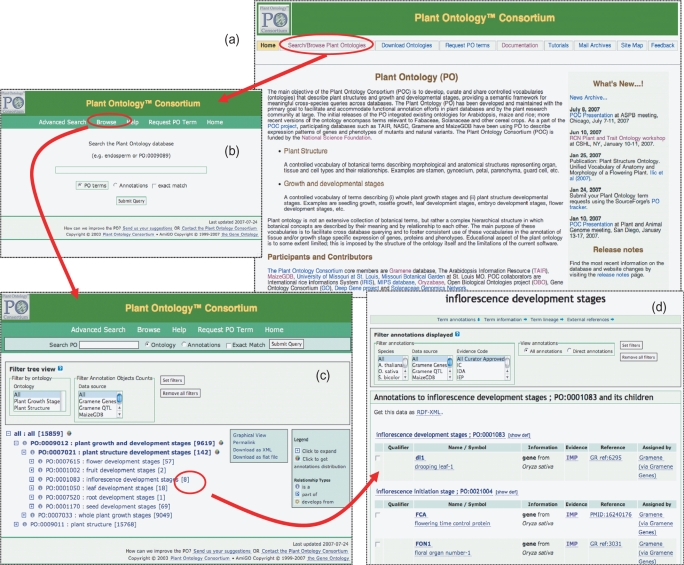
Figure 1.
Figure 1.
Stepwise guide to search and browse the PO and annotations. (a) The view of Plant Ontology project website (http://www.plantontology.org). Display features a navigation menu, ‘what's new’ section and the project description. The ‘Search/Browse Plant Ontologies’ links to the front page of PO ontology browser. (b) The simple search page for Ontology database with several options. All ontology browser pages have the same header, which allows users to search for PO terms or annotations, request PO term if it is not available in the database and provides direct access to a ‘Help’ page that describes details of how to use the ontology browser. The ‘Advanced Search’ link allows users to search for more than one term or annotations in different fields of the database and the search results can be filtered by ontology type, the evidence code, source species and data source. The ‘Browse’ link opens up a browsable ontology tree. (c) Browsable tree view of ontology. It can be browsed by expanding (click on + sign) or contracting (click on − sign) on the left side of the term name. The circular icons with characters I/P/D to the left of the term represent the relationship types, IS_A, PART_OF and DEVELOPS_FROM, respectively. More options on pie chart of annotations, links to download in XML or GO flat file formats, Permalink for book marking and summary of the number of annotations next to term names is provided. To view the annotations e.g. associated with PO:0001083: inflorescence development stages, click the number ‘8’ in curved brackets. (d) A list of annotations associated to a term (e.g. PO:0001083). The annotation table provides information on object type (gene, QTL, stock), name of the object, synonyms, link to the same entry in source database, evidence and evidence code used for associating the ontology term to the object.

References

    1. Jaiswal P, Avraham S, Ilic K, Kellogg E, McCouch S, Pujar A, Reiser L, Seung RY, Sachs MM, Schaeffer M, et al. Plant Ontology (PO): a controlled vocabulary of plant structures and growth stages. Comp. Funct. Genomics. 2005;6:388–397. - PMC - PubMed
    1. Ilic K, Kellogg E, Jaiswal P, Zapata F, Stevens PF, Vincent LP, Avraham S, Reiser L, Pujar A, et al. Plant Structure Ontology. Unified vocabulary of anatomy and morphology of a flowering plant. Plant Physiol. 2007;143:587–599. - PMC - PubMed
    1. Pujar A, Jaiswal P, Kellogg E, Ilic K, Vincent L, Avraham S, Stevens P, Zapata F, Reiser L, et al. Whole Plant Growth Stage Ontology for angiosperms and its application in plant biology. Plant Physiol. 2006;142:414–428. - PMC - PubMed
    1. Berardini T, Mundodi S, Reiser L, Huala E, Garcia-Hernandez M, Zhang P, Mueller LA, Yoon J, Doyle A, et al. Functional annotation of the Arabidopsis genome using controlled vocabularies. Plant Physiol. 2004;135:745–755. - PMC - PubMed
    1. Jaiswal P, Ni J, Yap I, Ware D, Spooner W, Youens-Clark K, Ren L, Liang C, Zhao W, et al. Gramene, a bird's eye view of cereal genomes. Nucleic Acids Res. 2006;34:D717–D723. - PMC - PubMed

Publication types
