


Patient-oncologist communication in advanced cancer: predictors of patient perception of prognosis
- PMID: 18196288
- PMCID: PMC2864029
- DOI: 10.1007/s00520-007-0372-2
Patient-oncologist communication in advanced cancer: predictors of patient perception of prognosis
Abstract
Goals of work: Advanced cancer patients' perceptions of prognosis, which are often overly optimistic compared to oncologist estimates, influence treatment preferences. The predictors of patients' perceptions and the effect of oncologist communication on patient understanding are unclear. This study was designed to identify the communication factors that influence patient-oncologist concordance about chance of cure.
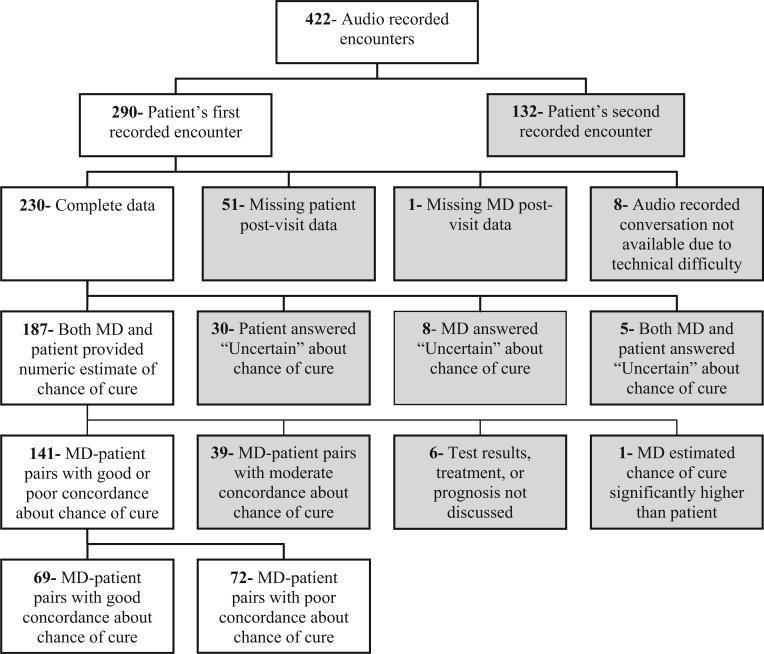
Materials and methods: We analyzed audiorecorded encounters between 51 oncologists and 141 advanced cancer patients with good (n = 69) or poor (n = 72) concordance about chance of cure. Encounters were coded for communication factors that might influence oncologist-patient concordance, including oncologist statements of optimism and pessimism.
Main results: Oncologists made more statements of optimism (mean = 3.3 per encounter) than statements of pessimism (mean = 1.2 per encounter). When oncologists made at least one statement of pessimism, patients were more likely to agree with their oncologist's estimated chance of cure (OR = 2.59, 95%CI = 1.31-5.12). Statements of optimism and uncertainty were not associated with an increased likelihood that patients would agree or disagree with their oncologists about chance of cure.
Conclusions: Communication of pessimistic information to patients with advanced cancer increases the likelihood that patients will report concordant prognostic estimates. Communication of optimistic information does not have any direct effect. The best communication strategy to maximize patient knowledge for informed decision making while remaining sensitive to patients' emotional needs may be to emphasize optimistic aspects of prognosis while also consciously and clearly communicating pessimistic aspects of prognosis.
Figures
References
-
- Bradley EH, Hallemeier AG, Fried TR, Johnson-Hurzeler R, Cherlin EJ, Kasl SV, et al. Documentation of discussions about prognosis with terminally ill patients. Am J Med. 2001;111:218–23. - PubMed
-
- Butow PN, Maclean M, Dunn SM, Tattersall MH, Boyer MJ. The dynamics of change: cancer patients’ preferences for information, involvement and support. Ann Oncol. 1997;8:857–863. - PubMed
-
- Butow PN, Dowsett S, Hagerty R, Tattersall MH. Communicating prognosis to patients with metastatic disease: what do they really want to know? Support Care Cancer. 2002;10:161–168. - PubMed
-
- Carver CS. You want to measure coping but your protocol's too long: consider the brief COPE. Int J Behav Med. 1997;4:92–100. - PubMed
Publication types
MeSH terms
Grants and funding
LinkOut - more resources
Full Text Sources
Medical
Research Materials
