


Visual processing of social context during mental state perception in schizophrenia
- PMID: 18197270
- PMCID: PMC2186367
Visual processing of social context during mental state perception in schizophrenia
Abstract
Objective: To examine schizophrenia patients' visual attention to social contextual information during a novel mental state perception task.
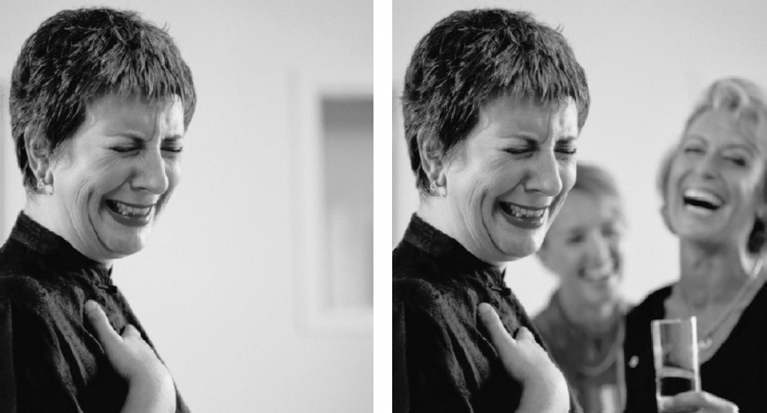
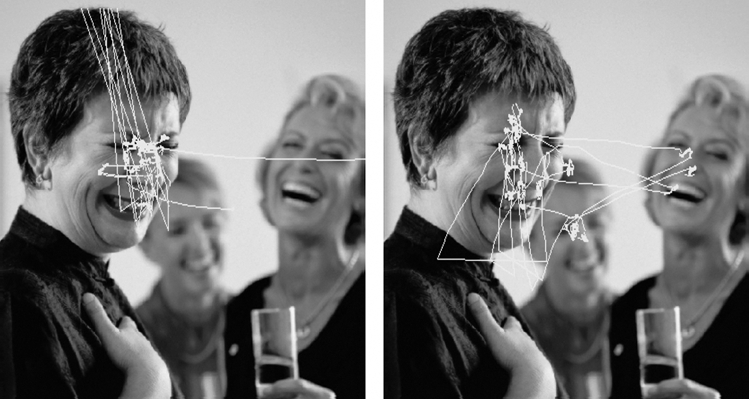
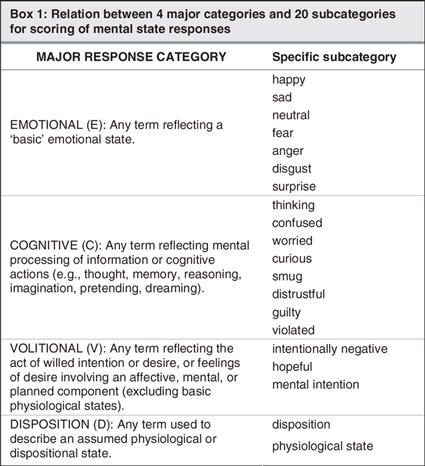
Method: Groups of healthy participants (n = 26) and schizophrenia patients (n = 24) viewed 7 image pairs depicting target characters presented context-free and context-embedded (i.e., within an emotion-congruent social context). Gaze position was recorded with the EyeLink I Gaze Tracker while participants performed a mental state inference task. Mean eye movement variables were calculated for each image series (context-embedded v. context-free) to examine group differences in social context processing.
Results: The schizophrenia patients demonstrated significantly fewer saccadic eye movements when viewing context-free images and significantly longer eye-fixation durations when viewing context-embedded images. Healthy individuals significantly shortened eye-fixation durations when viewing context-embedded images, compared with context-free images, to enable rapid scanning and uptake of social contextual information; however, this pattern of visual attention was not pronounced in schizophrenia patients. In association with limited scanning and reduced visual attention to contextual information, schizophrenia patients' assessment of the mental state of characters embedded in social contexts was less accurate.
Conclusion: In people with schizophrenia, inefficient integration of social contextual information in real-world situations may negatively affect the ability to infer mental and emotional states from facial expressions.
Objectif: Examiner l'attention visuelle que les patients atteints de schizophrénie accordent à l'information contextuelle sociale au cours d'une nouvelle tâche portant sur la perception de l'état mental.
Méthode: Des groupes de participants en bonne santé (n = 26) et de patients atteints de schizophrénie (n = 24) ont visualisé sept paires d'images décrivant des personnages cibles présentés sans contexte et en contexte (c.-à-d. dans un contexte social congruent aux émotions). On a consigné la position du regard au moyen du système de poursuite oculaire EyeLink I pendant que les participants exécutaient une tâche d'inférence liée à l'état mental. On a calculé les variables moyennes du mouvement de l'œil pour chaque série d'images (en contexte c. sans contexte) afin d'examiner les différences entre les groupes au niveau du traitement du contexte social.
Résultats: Les patients atteints de schizophrénie ont eu des mouvements oculaires saccadés beaucoup moins nombreux pendant qu'ils visualisaient des images sans contexte et une fixation beaucoup plus longue lorsqu'ils visualisaient des images en contexte. Les sujets en bonne santé ont raccourci considérablement la durée de la fixation oculaire lorsqu'ils visionnaient des images en contexte comparativement aux images sans contexte, ce qui leur a permis d'analyser et d'absorber rapidement de l'information contextuelle sociale, mais cette tendance de l'attention visuelle n'était pas prononcée chez les patients atteints de schizophrénie. Conjuguée à une limitation du balayage et à une réduction de l'attention visuelle portée à l'information contextuelle, l'évaluation effectuée par les patients atteints de schizophrénie de l'état mental des personnages intégrés dans des contextes sociaux était moins précise.
Conclusion: Chez les personnes atteintes de schizophrénie, l'intégration inefficiente de l'information contextuelle sociale dans des situations réelles peut avoir une incidence négative sur leur capacité de déduire des états mentaux et émotionnels à partir d'expressions faciales.
Keywords: attention; eye movements; facial expression; schizophrenia; social perception; visual perception.
Figures
References
-
- Frommann N, Streit M, Wolwer W. Remediation of facial affect recognition impairments in patients with schizophrenia: a new training program. Psychiatry Res 2003;117:281-4. - PubMed
-
- Penn DL, Combs D. Modification of affect perception deficits in schizophrenia. Schizophr Res 2000;46:217-29. - PubMed
-
- Silver M, Oakes P. Evaluation of a new computer intervention to teach people with autism or asperger syndrome to recognize and predict emotions in others. Autism 2001;5:299-316. - PubMed
-
- Wolwer W, Frommann N, Halfmann S, et al. Remediation of impairments in facial affect recognition in schizophrenia: Efficacy and specificity of a new training program. Schizophr Res 2005;80: 295-303. - PubMed
Publication types
MeSH terms
LinkOut - more resources
Full Text Sources
Medical