


Exogenous and endogenous determinants of blood trihalomethane levels after showering
- PMID: 18197300
- PMCID: PMC2199304
- DOI: 10.1289/ehp.10049
Exogenous and endogenous determinants of blood trihalomethane levels after showering
Abstract
Background: We previously conducted a study to assess whether household exposures to tap water increased an individual's internal dose of trihalomethanes (THMs). Increases in blood THM levels among subjects who showered or bathed were variable, with increased levels tending to cluster in two groups.
Objectives: Our goal was to assess the importance of personal characteristics, previous exposures, genetic polymorphisms, and environmental exposures in determining THM concentrations in blood after showering.
Methods: One hundred study participants completed a health symptom questionnaire, a 48-hr food and water consumption diary, and took a 10-min shower in a controlled setting. We examined THM levels in blood samples collected at baseline and 10 and 30 min after the shower. We assessed the significance of personal characteristics, previous exposures to THMs, and specific gene polymorphisms in predicting postshower blood THM concentrations.
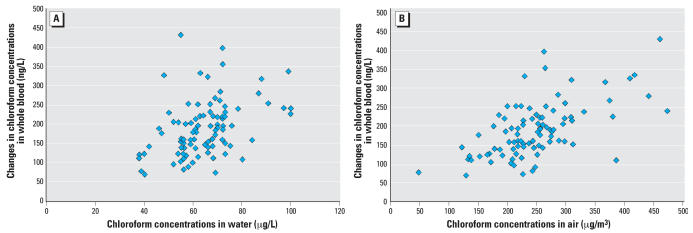
Results: We did not observe the clustering of blood THM concentrations observed in our earlier study. We found that environmental THM concentrations were important predictors of blood THM concentrations immediately after showering. For example, the chloroform concentration in the shower stall air was the most important predictor of blood chloroform levels 10 min after the shower (p < 0.001). Personal characteristics, previous exposures to THMs, and specific polymorphisms in CYP2D6 and GSTT1 genes were significant predictors of both baseline and postshowering blood THM concentrations as well as of changes in THM concentrations associated with showering.
Conclusion: The inclusion of information about individual physiologic characteristics and environmental measurements would be valuable in future studies to assess human health effects from exposures to THMs in tap water.
Keywords: CYP2D6; CYP2E1; GSTT1; disinfection by-products; drinking water disinfection; showering exposures; trihalomethanes.
Figures
References
-
- Backer LC, Ashley DL, Bonin MA, Cardinali FL, Kieszak SL, Wooten JV. Household exposures to drinking water disinfection byproducts: whole blood trihalomethane levels. J Expo Sci Environ Epidemiol. 2000;10:321–326. - PubMed
-
- Batterman S, Zhang L, Wang S, Franzblau A. Partition coefficients for the trihalomethanes among blood, urine, water, milk, and air. Sci Total Environ. 2002;283:237–247. - PubMed
-
- Bonin MA, Silva LK, Smith MM, Ashley DL, Blount BC. Measurement of trihalomethanes and methyl tert-butyl ether in whole blood using gas chromatography with high resolution mass spectrometry. J Anal Toxicol. 2005;29(2):81–89. - PubMed
-
- Cantor KP, Lynch CF, Hildesheim ME, Dosemeci M, Lubin J, Alavanja M, et al. Drinking water source and chlorination byproducts. I. Risk of bladder cancer. Epidemiology. 1998;9:21–28. - PubMed
-
- Cardinali FL, Ashley DL, Morrow JC, Moll DM, Blount BC. Measurement of trihalomethanes and methyl tertiary-butyl ether in tap water using solid-phase microextraction GC/MS. J Chromatogr Sci. 2004;42:200–206. - PubMed
Publication types
MeSH terms
Substances
Grants and funding
LinkOut - more resources
Full Text Sources
Miscellaneous