


A genome search for primary vesicoureteral reflux shows further evidence for genetic heterogeneity
- PMID: 18197425
- PMCID: PMC2259258
- DOI: 10.1007/s00467-007-0675-z
A genome search for primary vesicoureteral reflux shows further evidence for genetic heterogeneity
Abstract
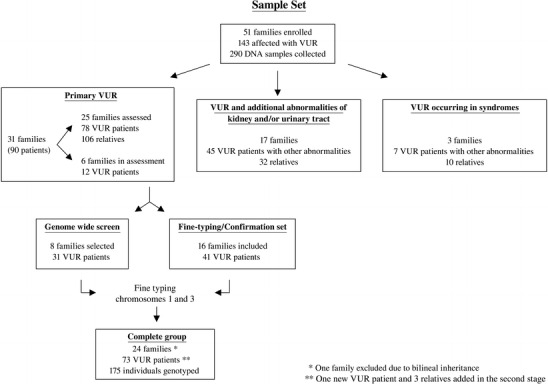
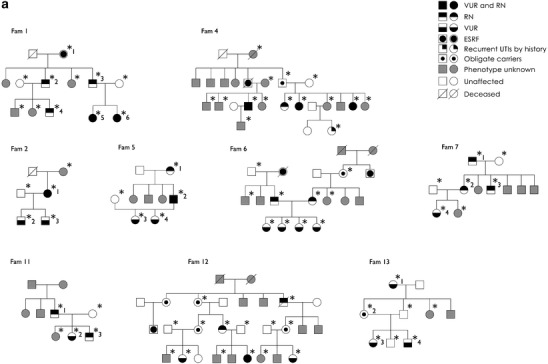
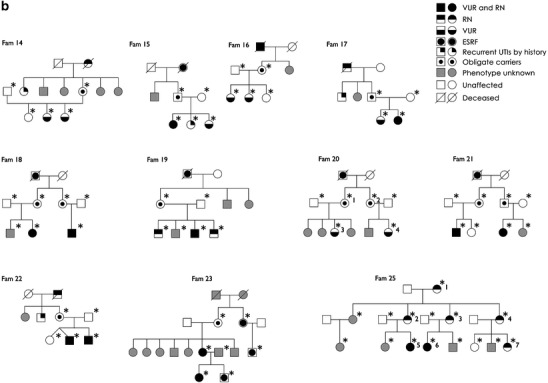
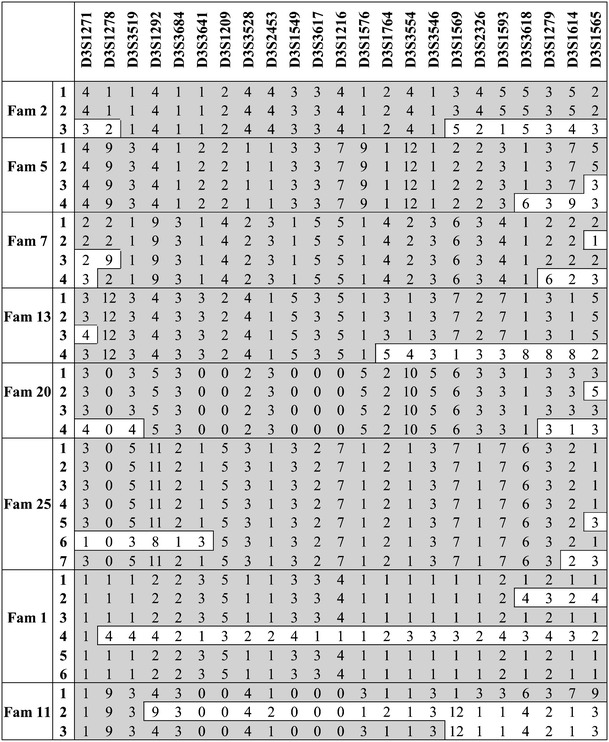
Vesicoureteral reflux (VUR) is the most common disease of the urinary tract in children. In order to identify gene(s) involved in this complex disorder, we performed a genome-wide search in a selected sample of 31 patients with primary VUR from eight families originating from southern Italy. Sixteen additional families with 41 patients were included in a second stage. Nonparametric, affected-only linkage analysis identified four genomic areas on chromosomes 1, 3, and 4 (p < 0.05); the best result corresponded to the D3S3681-D3S1569 interval on chromosome 3 (nonparametric linkage score, NPL = 2.75, p = 0.008). This region was then saturated with 26 additional markers, tested in the complete group of 72 patients from 24 families (NPL = 2.01, p = 0.01). We identified a genomic area on 3q22.2-23, where 26 patients from six multiplex families shared overlapping haplotypes. However, we did not find evidence for a common ancestral haplotype. The region on chromosome 1 was delimited to 1p36.2-34.3 (D1S228-D1S255, max. NPL = 1.70, p = 0.03), after additional fine typing. Furthermore, on chromosome 22q11.22-12.3, patients from a single family showed excess allele sharing (NPL = 3.35, p = 0.015). Only the chromosome 3q region has been previously reported in the single genome-wide screening available for primary VUR. Our results suggest the presence of several novel loci for primary VUR, giving further evidence for the genetic heterogeneity of this disorder.
Figures
References
-
- Scott JE, Swallow V, Coulthard MG, Lambert HJ, Lee RE. Screening of newborn babies for familial ureteric reflux. Lancet. 1997;350:396–400. - PubMed
-
- Hoberman A, Chao HP, Keller DM, Hickey R, Davis HW, Ellis D. Prevalence of urinary tract infection in febrile infants. J Pediatr. 1993;123:17–23. - PubMed
-
- Hodson CJ, Twohill SA. The time factor in the development of sterile renal scarring following high-pressure vesicoureteral reflux. Contrib Nephrol. 1984;39:358–369. - PubMed
-
- Ardissino G, Dacco V, Testa S, Bonaudo R, Claris-Appiani A, Taioli E, Marra G, Edefonti A, Sereni F. Epidemiology of chronic renal failure in children: data from the ItalKid project. Pediatrics. 2003;111:e382–e387. - PubMed
-
- Craig JC, Irwing LM, Knight JF, Roy LP. Does treatment of vesicoureteric reflux in childhood prevent end-stage renal disease attributable to reflux nephropathy? Pediatrics. 2000;105:1236–1241. - PubMed
Publication types
MeSH terms
Substances
LinkOut - more resources
Full Text Sources
