


Turbulent blood flow plays an essential localizing role in the development of atherosclerotic lesions in experimentally induced hypercholesterolaemia in rats
- PMID: 18197872
- PMCID: PMC2525757
- DOI: 10.1111/j.1365-2613.2007.00564.x
Turbulent blood flow plays an essential localizing role in the development of atherosclerotic lesions in experimentally induced hypercholesterolaemia in rats
Abstract
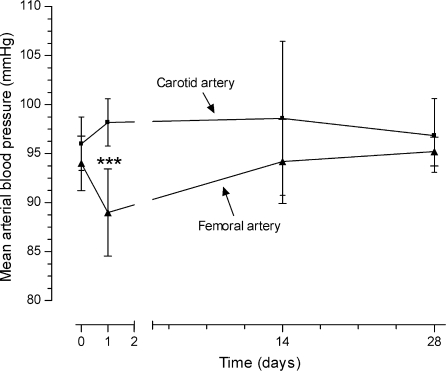
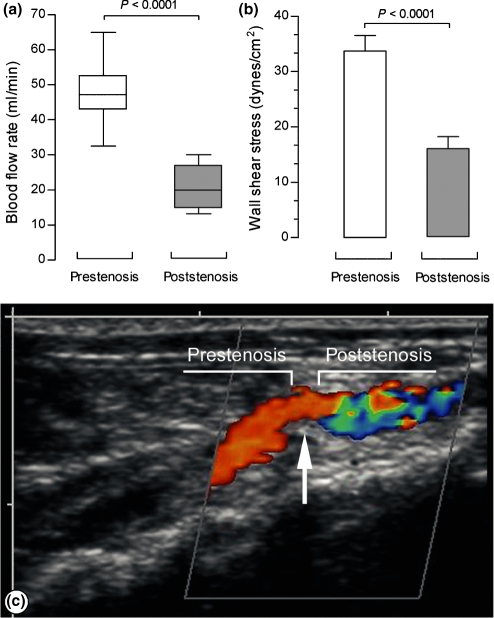
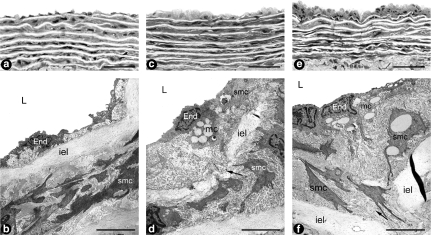
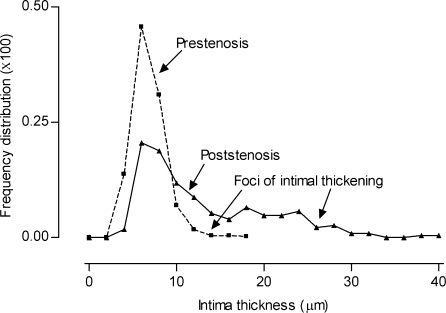
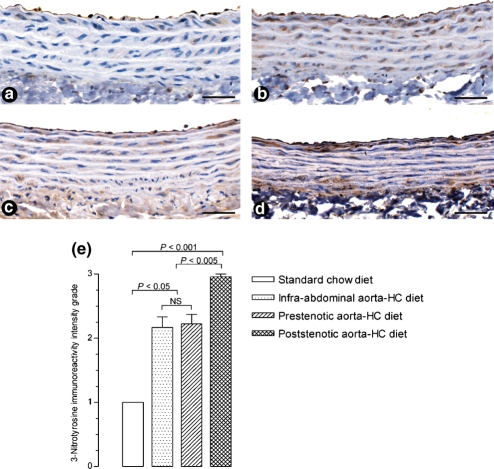
Taking into account that atherosclerosis is a focal disease and high levels of plasma cholesterol are closely correlated with its pathogenesis, it is a challenge to explain how equal concentrations of cholesterol bathing the endothelium can produce local, rather than global, effects on arteries. The focal distribution of atherosclerotic lesions has been considered to be dependent, at least in part, on hydrodynamic factors. The present study was carried out to further test the hypothesis that these forces are an important localizing factor in rats feeding a hypercholesterolaemic diet and submitted to infra-diaphragmatic aortic constriction. These animals develop a normotensive prestenotic region with laminar blood flow that serves as control for a normotensive poststenotic region with turbulent blood flow. Our findings clearly demonstrated that the combination of turbulent blood flow and low wall shear stress (WSS) in the presence of hypercholesterolaemia and oxidative stress creates conditions to the formation of focally distributed incipient atherosclerotic lesions observed in the poststenotic segment. In contrast, only diffuse fatty streaks could be observed in the normotensive prestenotic segment with laminar blood flow and normal WSS in the presence of hypercholesterolaemia and oxidative stress. Although haemodynamic forces are not by themselves responsible for the pathogenesis of atherosclerosis, they prime the local vascular wall in which the lesion develop. Further studies are required to establish how haemodynamic forces are detected and transduced into chemical signalling by the cells of the artery wall and then converted into pathophysiologically relevant phenotypic changes.
Figures
References
-
- Adachi T, Matsui R, Xu S, et al. Antioxidant improves smooth muscle sarco/endoplasmic reticulum Ca2+-ATPase function and lowers tyrosine nitration in hypercholesterolemia and improves nitric oxide-induced relaxation. Circ. Res. 2002;90:1114–1121. - PubMed
-
- Anderson KM, Castelli WP, Levy D. Cholesterol and mortality. 30 years of follow-up from the Framingham study. JAMA. 1987;257:2176–2180. - PubMed
-
- Anitschkow N, Chalatow S. Über experimentelle cholesterinsteatose und ihre bedeutung für die entstehung einiger pathologischer prozesse. Zentralbl. Allg. Pathol. 1913;24:1–9.
-
- Assmann G, Cullen P, Schulte H. Simple scoring scheme for calculating the risk of acute coronary events based on the 10-year follow-up of the prospective cardiovascular Munster (PROCAM) study. Circulation. 2002;105:310–315. - PubMed
-
- Barton CH, Ni Z, Vaziri ND. Enhanced nitric oxide inactivation in aortic coarctation-induced hypertension. Kidney Int. 2001;60:1083–1087. - PubMed
Publication types
MeSH terms
LinkOut - more resources
Full Text Sources
Medical
Research Materials
