. 2008 May 15;111(10):5028-36.
doi: 10.1182/blood-2007-06-097410. Epub 2008 Jan 15.

Platelet-mediated modulation of adaptive immunity: unique delivery of CD154 signal by platelet-derived membrane vesicles

Affiliations

Platelet-mediated modulation of adaptive immunity: unique delivery of CD154 signal by platelet-derived membrane vesicles

Daniel L Sprague et al. Blood. .

Abstract

Although mounting evidence indicates that platelets participate in the modulation of both innate and adaptive immunity, the mechanisms by which platelets exert these effects have not been clearly defined. The study reported herein uses a previously documented adoptive transfer model to investigate the ability of platelet-derived membrane vesicles to communicate activation signals to the B-cell compartment. The findings demonstrate for the first time that platelet-derived membrane vesicles are sufficient to deliver CD154 to stimulate antigen-specific IgG production and modulate germinal center formation through cooperation with responses elicited by CD4(+) T cells. The data are consistent with the hypothesis that platelets modulate inflammation and adaptive immunity at sites distant from the location of activation and that platelet-derived membrane vesicles are sufficient to mediate the effect.


Figures
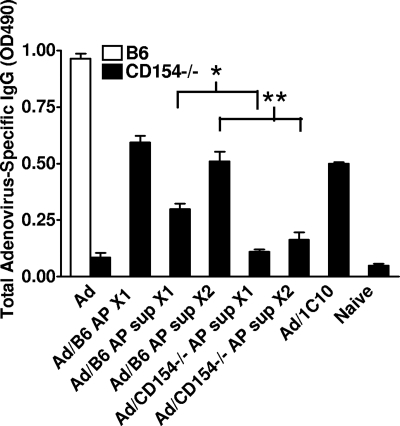
Figure 1
Figure 1
Whole platelets are not necessary for the delivery of CD154 signal. CD154−/− mice were injected with 5 × 10⁷ activated platelets (AP) or activated platelet supernatant (AP Sup) from 5 × 10⁸ wild-type (B6) or CD154−/− platelets. Positive controls were given 500 μg anti-CD40 antibody (1C10) IP. Mice were immunized on day (−1) with 108 pfu of adenovirus. On day 0, all mice received one injection of either AP or AP Sup. A second injection was given to half the mice on day 6 (X1 indicates mice receiving one injection; X2, mice receiving 2 injections). Serum was collected on day 9 for adenovirus-specific IgG analysis by ELISA. This experiment was performed 3 times with 5 mice per group. The graph is from a representative experiment (Wilcoxon rank sum test: *2-tailed P = .002, **2-tailed P = .006).
Figure 2
Figure 2
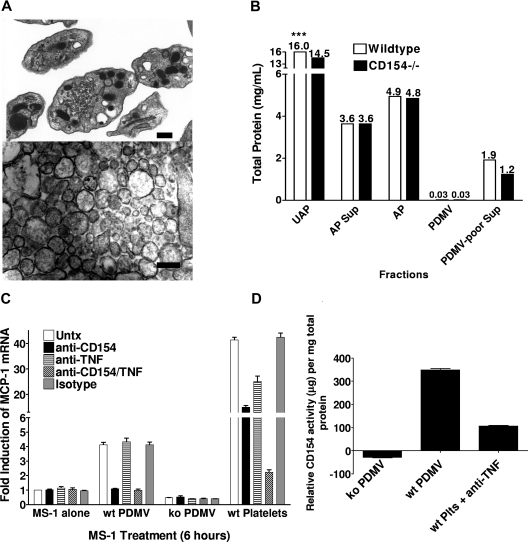
Characterization of PDMVs. PDMVs were isolated and visualized by TEM and analyzed for total protein. (A) TEM images of whole platelets (top) and PDMV (bottom). Bar represents 100 nm. (B) Total protein analysis was performed on 5 × 10⁸ unactivated platelets (UAP) and activated platelets (AP); and activated platelet supernatant (AP Sup), PDMV pellet (PDMV), and PDMV-poor supernatant (PDMV-poor Sup) made from 5 × 10⁸ platelets. ***Total protein values (mg/mL) above each bar. (C) 105 MS-1 cells were plated in each well of a 24-well plate and allowed to grow to near confluence over 2 days. PDMVs from 4.5 × 10⁸ CD154 wt or ko platelets, or 108 platelets were added to each well; 10 μg/mL of anti-CD154 and/or anti-TNF-α antibodies added to designated wells. The experiment was performed in triplicate. (D) Quantitative real-time PCR was performed using purchased primers for MCP-1 and 18S mRNA. Standard curve ranged from 10 μg/mL to 4.9 ng/mL.
Figure 3
Figure 3
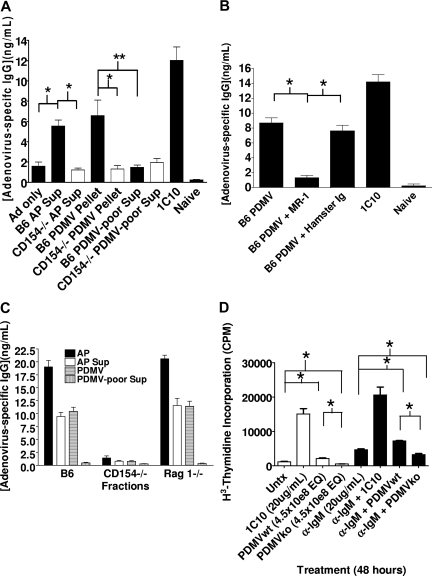
PDMV delivery of CD154 signal. (A) CD154−/− mice were immunized on day (−1) and then injected on days 0 and 6 with activated platelet supernatant (AP Sup), PDMV pellet, or PDMV-poor supernatant from 5 × 10⁸ wild-type (B6) or CD154−/− platelets, or 500 μg 1C10 intraperitoneally. Serum was collected on day 9 for quantification of total adenovirus-specific IgG using a commercially available mouse anti-adenovirus IgG standard. (B) PDMVs derived from 5 × 10⁸ B6 platelets were injected intravenously into CD154−/− mice 24 hours after immunization with 108 particles Ad-OVA; 10 μg/mL CD154 blocking antibody MR-1 was added to AP Sup before isolation of PDMVs and to PDMVs after resuspension. Mice were injected with 100 μg MR-1 just before receiving PDMV + MR-1. Serum was collected on day 7 for quantification of total adenovirus specific IgG production by ELISA. (C) PDMVs derived from 5 × 10⁸ platelets injected 24 hours after immunization. Serum collected on day 7. (D) Primary B cells were isolated from spleens of 8-week-old C57BL/6 mice by Percoll gradient enrichment and negative selection over magnetic beads (Miltenyi Biotec). 6 × 10⁵ B cells were plated in each well of a 96-well plate and PDMVs from 4.5 × 10⁸ wt or ko platelets added to each designated well, with or without anti-IgM, 5 wells per experimental condition. PDMVs and B cells were coincubated for 48 hours, with the final 6 hours in the presence of 1 μCi of 3H-T. Cells were harvested and thymidine incorporation measured (Wilcoxon rank sum test: *2-tailed P = .012, **2-tailed P = .019).
Figure 4
Figure 4
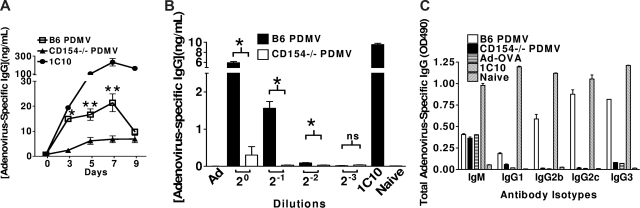
Characterization of PDMV-induced augmentation of IgG production. (A) Time course of PDMV response. CD154−/− mice injected with PDMV pellet from 5 × 10⁸ B6 or CD154−/− platelets. Serum collected on days 3, 5, 7, and 9. Total IgG quantified by ELISA using commercial mouse antiadenovirus IgG standard (Wilcoxon rank sum test: *2-tailed P = .020, **2-tailed P = .012 comparing the B6 PDMV time point to the corresponding CD154−/− PDMV time point). (B) Dose-response study. Neat samples contain PDMV from 4.5 × 10⁸ activated platelets. Dilutions made from resuspended PDMV pellets. Total IgG quantified by ELISA using commercial mouse antiadenovirus IgG standard (Wilcoxon rank sum test: *2-tailed P = .012, **2-tailed P = .012; ns indicates not significant). (C) Analysis of antibody isotypes produced. Samples pooled from neat groups in dose-response experiment. ELISAs were performed for each antibody isotype. Each experiment was performed with 5 mice per group and repeated once.
Figure 5
Figure 5
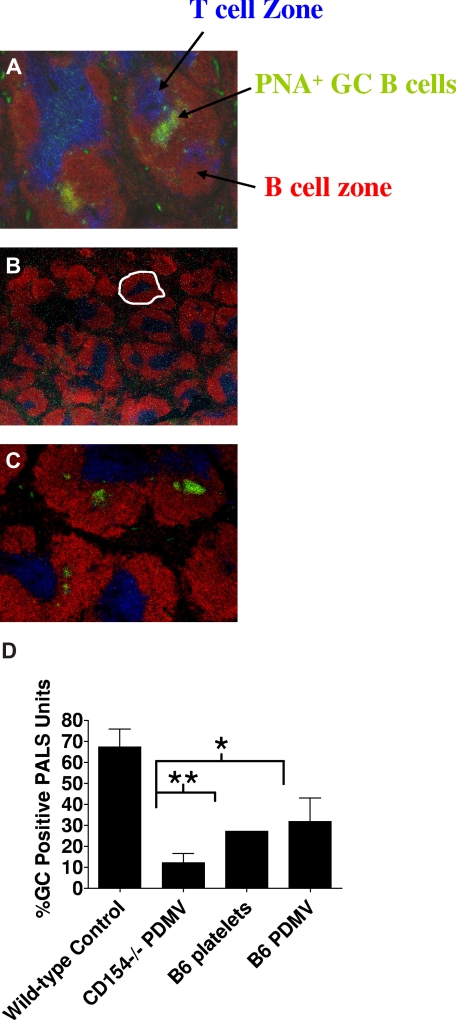
B6 PDMVs enable a limited number of normal B6 CD4+ T cells to induce GC reactions in CD154−/− mice depleted of platelets. Platelets were depleted using 10 μg p0p3/4 24 hours before intravenous adoptive transfer of 4 × 10⁶ negatively selected, naive B6 CD4+ T cells intravenously and 108 B6 platelets, B6 PDMV from 5 × 10⁸ platelets, or CD154−/− PDMV from 5 × 10⁸ platelets. Twelve days after injection, spleens were harvested and processed for histologic examination of frozen sections. Blue represents T-cell zone (anti-CD4 and CD8 staining); red, B-cell follicles (anti-B220); green, peanut agglutinin (PNA; GC B cells stain PNAhi). GCs are visualized as B220 PNA double-positive (green-yellow) areas of cells. Representative histology from the wild-type control consisting of B6 mice immunized with adenovirus alone (A) and CD154−/− mice immunized with adenovirus and treated with naive B6 CD4+ T cells with CD154−/− PDMV (B) or B6 PDMV (C). GCs were visualized and reported as GCs/PALS (D). A PALS unit consists of the follicular and T-cell zones surrounding a central arteriole. An example of a PALS unit is delineated in panel B with a dashed white line. The experiment was performed with 5 mice per group and repeated once (*2-tailed P = .014; **2-tailed P = .058).

Comment in

References

    1. George JN. Platelets. Lancet. 2000;355:1531–1539. - PubMed
    1. Klinger MH, Jelkmann W. Role of blood platelets in infection and inflammation. J Interferon Cytokine Res. 2002;22:913–922. - PubMed
    1. Weyrich AS, Zimmerman GA. Platelets: signaling cells in the immune continuum. Trends Immunol. 2004;25:489–495. - PubMed
    1. Elzey BD, Sprague DL, Ratliff TL. The emerging role of platelets in adaptive immunity. Cell Immunol. 2005;238:1–9. - PubMed
    1. Elzey BD, Tian J, Jensen RJ, et al. Platelet-mediated modulation of adaptive immunity: a communication link between innate and adaptive immune compartments. Immunity. 2003;19:9–19. - PubMed

Publication types