Key role for clumping factor B in Staphylococcus aureus nasal colonization of humans
- PMID: 18198942
- PMCID: PMC2194749
- DOI: 10.1371/journal.pmed.0050017
Key role for clumping factor B in Staphylococcus aureus nasal colonization of humans
Abstract
Background: Staphylococcus aureus permanently colonizes the vestibulum nasi of one-fifth of the human population, which is a risk factor for autoinfection. The precise mechanisms whereby S. aureus colonizes the nose are still unknown. The staphylococcal cell-wall protein clumping factor B (ClfB) promotes adhesion to squamous epithelial cells in vitro and might be a physiologically relevant colonization factor.
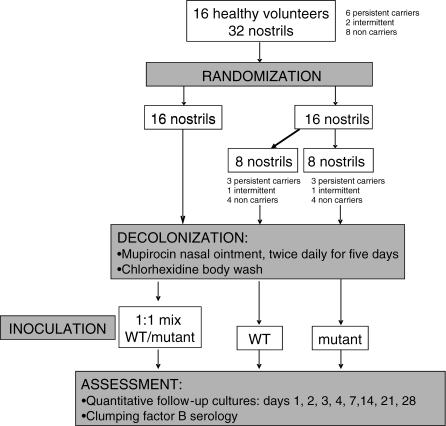
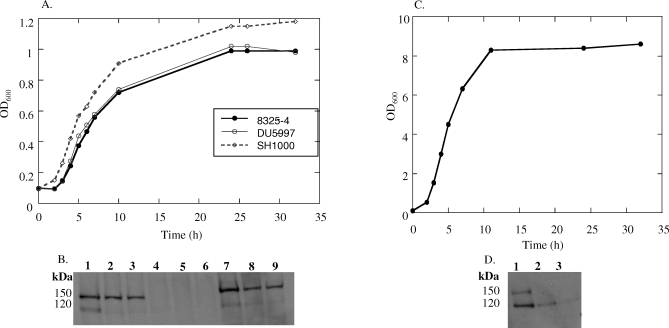
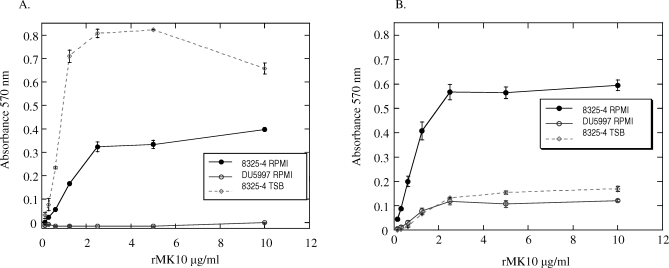
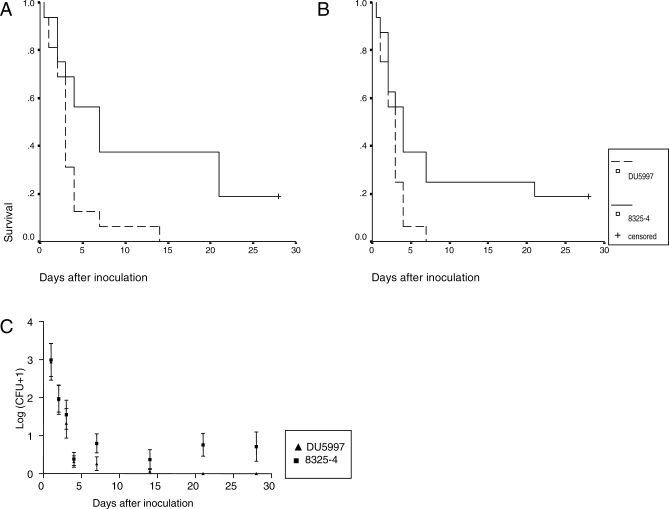
Methods and findings: We define the role of the staphylococcal cytokeratin-binding protein ClfB in the colonization process by artificial inoculation of human volunteers with a wild-type strain and its single locus ClfB knock-out mutant. The wild-type strain adhered to immobilized recombinant human cytokeratin 10 (CK10) in a dose-dependent manner, whereas the ClfB(-) mutant did not. The wild-type strain, when grown to the stationary phase in a poor growth medium, adhered better to CK10, than when the same strain was grown in a nutrient-rich environment. Nasal cultures show that the mutant strain is eliminated from the nares significantly faster than the wild-type strain, with a median of 3 +/- 1 d versus 7 +/- 4 d (p = 0.006). Furthermore, the wild-type strain was still present in the nares of 3/16 volunteers at the end of follow-up, and the mutant strain was not.
Conclusions: The human colonization model, in combination with in vitro data, shows that the ClfB protein is a major determinant of nasal-persistent S. aureus carriage and is a candidate target molecule for decolonization strategies.
Conflict of interest statement
Figures
References
-
- Pan ES, Diep BA, Charlebois ED, Auerswald C, Carleton HA, et al. Population dynamics of nasal strains of methicillin-resistant Staphylococcus aureus—and their relation to community-associated disease activity. J Infect Dis. 2005;192:811–818. - PubMed
-
- Moran GJ, Krishnadasan A, Gorwitz RJ, Fosheim GE, McDougal LK, et al. Methicillin-resistant S. aureus infections among patients in the emergency department. N Engl J Med. 2006;355:666–674. - PubMed
-
- von Eiff C, Becker K, Machka K, Stammer H, Peters G. Nasal carriage as a source of Staphylococcus aureus bacteremia. Study Group. N Engl J Med. 2001;344:11–16. - PubMed
-
- Wertheim HF, Vos MC, Ott A, van Belkum A, Voss A, et al. Risk and outcome of nosocomial Staphylococcus aureus bacteraemia in nasal carriers versus non-carriers. Lancet. 2004;364:703–705. - PubMed
-
- Wertheim HF, Melles DC, Vos MC, van Leeuwen W, van Belkum A, et al. The role of nasal carriage in Staphylococcus aureus infections. Lancet Infect Dis. 2005;5:751–762. - PubMed
Publication types
MeSH terms
Substances
Grants and funding
LinkOut - more resources
Full Text Sources
Other Literature Sources
Medical
Molecular Biology Databases
Research Materials