Comparative Study
. 2008;10(1):R6.
doi: 10.1186/ar2354. Epub 2008 Jan 16.

Anti-inflammatory effect of antidiabetic thiazolidinediones prevents bone resorption rather than cartilage changes in experimental polyarthritis

Affiliations
Comparative Study

Anti-inflammatory effect of antidiabetic thiazolidinediones prevents bone resorption rather than cartilage changes in experimental polyarthritis

Meriem Koufany et al. Arthritis Res Ther. 2008.

Abstract

Background: Rosiglitazone and pioglitazone are high-affinity peroxisome proliferator-activated receptor (PPAR)-gamma agonists with potent anti-diabetic properties and potential anti-inflammatory effects. We compared the ability of a range of oral doses of these thiazolidinediones, including those sufficient to restore insulin sensitization, to inhibit the pathogenesis of adjuvant-induced arthritis (AIA).

Methods: AIA was induced in Lewis rats by a subcutaneous injection of 1 mg of complete Freund's adjuvant. Rats were treated orally for 21 days with pioglitazone 3, 10 or 30 mg/kg/day, rosiglitazone 3 or 10 mg/kg/day, or with vehicle only. The time course of AIA was evaluated by biotelemetry to monitor body temperature and locomotor activity, by clinical score and plethysmographic measurement of hindpaw oedema. At necropsy, RT-PCR analysis was performed on synovium, liver and subcutaneous fat. Changes in cartilage were evaluated by histological examination of ankle joints, radiolabelled sulphate incorporation (proteoglycan synthesis), glycosaminoglycan content (proteoglycan turnover) and aggrecan expression in patellar cartilage. Whole-body bone mineral content was measured by dual-energy X-ray absorptiometry.

Results: The highest doses of rosiglitazone (10 mg/kg/day) or pioglitazone (30 mg/kg/day) were required to reduce fever peaks associated with acute or chronic inflammation, respectively, and to decrease arthritis severity. At these doses, thiazolidinediones reduced synovitis and synovial expression of TNF-alpha, IL-1beta and basic fibroblast growth factor without affecting neovascularization or the expression of vascular endothelial growth factor. Thiazolidinediones failed to prevent cartilage lesions and arthritis-induced inhibition of proteoglycan synthesis, aggrecan mRNA level or glycosaminoglycan content in patellar cartilage, but reduced bone erosions and inflammatory bone loss. A trend towards lower urinary levels of deoxipyridinolin was also noted in arthritic rats treated with thiazolidinediones. Rosiglitazone 10 mg/kg/day or pioglitazone 30 mg/kg/day increased the expression of PPAR-gamma and adiponectin in adipose tissue, confirming that they were activating PPAR-gamma in inflammatory conditions, although an increase in fat mass percentage was observed for the most anti-arthritic dose.

Conclusion: These data emphasize that higher dosages of thiazolidinediones are required for the treatment of arthritis than for restoring insulin sensitivity but that thiazolidinediones prevent inflammatory bone loss despite exposing animals to increased fatness possibly resulting from excessive activation of PPAR-gamma.


Figures
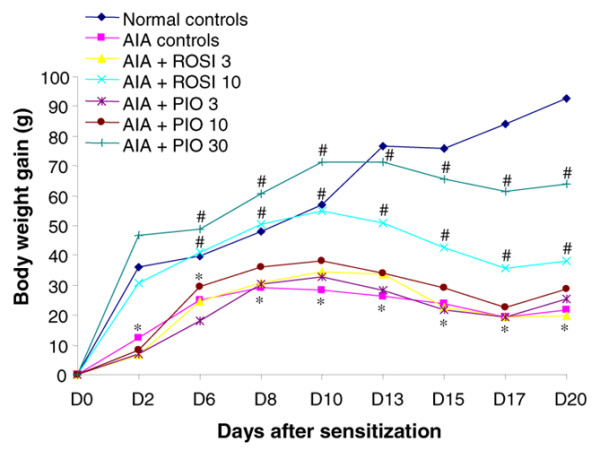
Figure 1
Figure 1
Modulation of body weight gain by rosiglitazone and pioglitazone in the course of adjuvant-induced arthritis. Male Lewis rats were sensitized subcutaneously on the basis of the tail with a single injection of 1 mg of M. tuberculosis. Animals were treated daily with 3 mg/kg (n = 6) or 10 mg/kg (n = 12) of rosiglitazone (ROSI) or 3 mg/kg (n = 6), 10 mg/kg (n = 6) or 30 mg/kg (n = 12) of pioglitazone (PIO) by oral administration. Arthritic (adjuvant-induced arthritis (AIA)) (n = 11) and normal controls (n = 10) were given 0.5% carboxymethylcellulose alone. Data are expressed as means ± SEM. *, P < 0.05 compared with normal controls; #, P < 0.05 compared with AIA controls (ANOVA and Fisher's PLSD post-hoc test). Dn, day n.
Figure 2
Figure 2
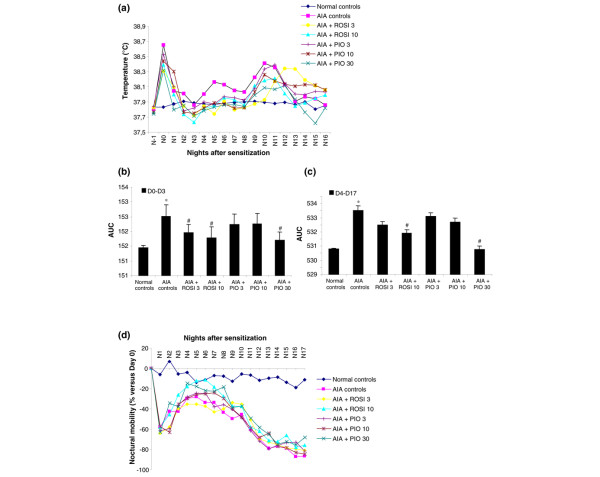
Modulation of body temperature and locomotive activity by rosiglitazone and pioglitazone treatment during adjuvant-induced arthritis. Animals were treated daily with 3 or 10 mg/kg of rosiglitazone (ROSI) or 3, 10 or 30 mg/kg of pioglitazone (PIO) by oral administration. Effect on (a) mean nocturnal body temperature, (b) primary inflammation, expressed as area under the time curve (AUC) of body temperature from day 0 to day 3 after sensitization, (c) secondary immunological inflammation, expressed as area under the time curve (AUC) of body temperature from day 4 to day 17 after sensitization, and (d) mean locomotive activity. Data are expressed as means ± SEM for at least five animals (ROSI 3, PIO 3 and 10) or 10 animals (normal controls, adjuvant-induced arthritis (AIA) controls, ROSI 10 and PIO 30). *, P < 0.05 compared with normal controls; #, P < 0.05 compared with AIA controls (ANOVA and Fisher's PLSD post-hoc test). Dn, day n; Nn, night n.
Figure 3
Figure 3
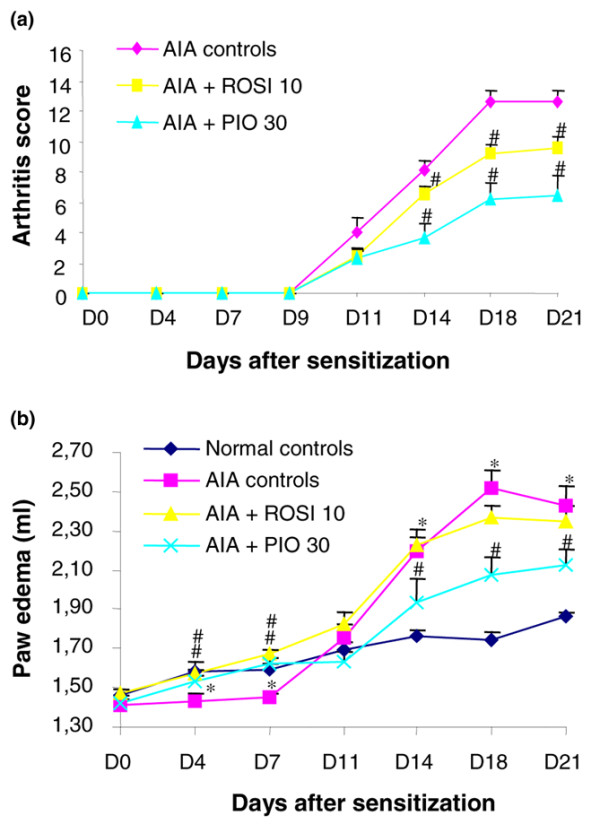
Modulation of disease severity by rosiglitazone and pioglitazone treatment during adjuvant-induced arthritis. Animals were treated daily with rosiglitazone (ROSI) 10 mg/kg (n = 8) or pioglitazone (PIO) 30 mg/kg (n = 8) by oral administration. Arthritic (adjuvant-induced arthritis (AIA)) (n = 7) and normal controls (n = 7) were given 0.5% carboxymethylcellulose alone. Arthritis score (a) and paw oedema (b) were assessed three times a week after onset of arthritis. For paw volume, each data point represents the mean of both hind paws. Data are expressed as means ± SEM. *, P < 0.05 compared with normal controls; #, P < 0.05 compared with AIA controls (Mann–Whitney U test (arthritis score) or ANOVA and Fisher's PLSD post-hoc test (oedema)). Dn, day n.
Figure 4
Figure 4
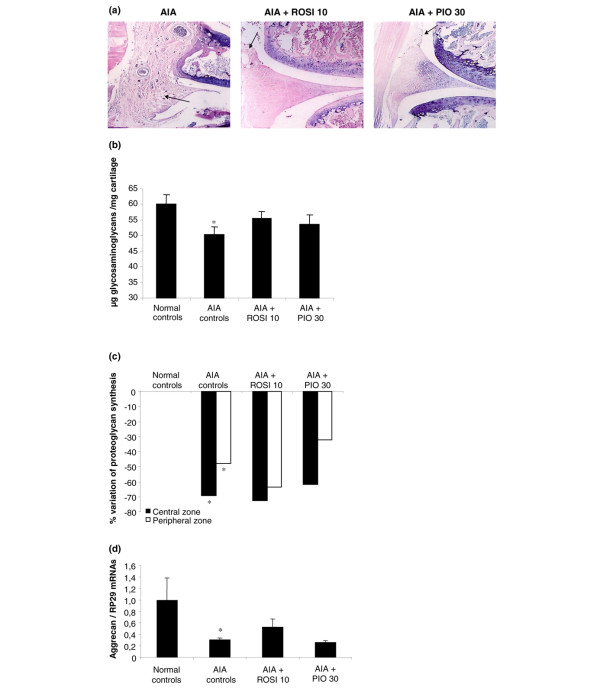
Effect of rosiglitazone and pioglitazone treatment on cartilage changes in arthritic knees. Animals were treated daily for 21 days with rosiglitazone (ROSI) 10 mg/kg (n = 8) or pioglitazone (PIO) 30 mg/kg (n = 8) by oral administration. Control animals with adjuvant-induced arthritis (AIA) (n = 7) and normal controls (n = 7) were given 0.5% carboxymethylcellulose alone. (a) A representative frontal section of the knee joint showing synovial membrane hyperplasia (MGG [May Grunwald Giemsa] staining, day 21 after sensitization). (b, c) Changes in proteoglycan metabolism in patellar cartilage: (b) sulphated glycosaminoglycan content by the 1,9-dimethylmethylene blue method expressed as μg of glycosaminoglycan per mg of cartilage. Data are expressed as means ± SEM; (c) radiolabelled sulphate incorporation expressed as mean percentage of normal controls. (d) Expression of aggrecan mRNA level normalized to RP29 in cartilage from tibial plateaux (RT-quantitative polymerase chain reaction). Data are expressed as means ± SEM of 4 animals per group. *, P < 0.05 compared with normal controls (ANOVA and Fisher's PLSD post-hoc test).
Figure 5
Figure 5
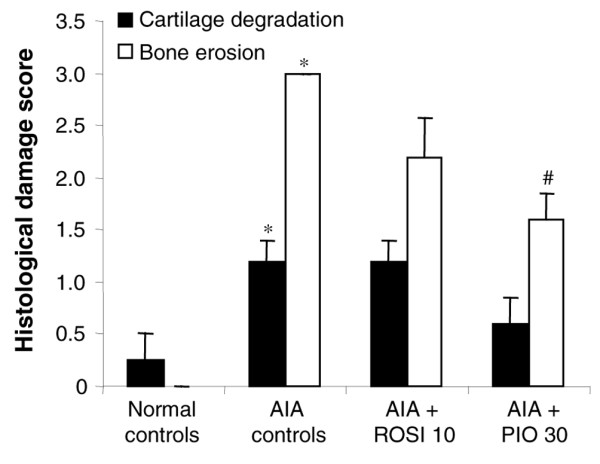
Effect of rosiglitazone and pioglitazone treatment on histological grading of ankle lesions during adjuvant-induced arthritis. Animals were treated daily for 21 days with rosiglitazone (ROSI) 10 mg/kg (n = 8) or pioglitazone (PIO) 30 mg/kg (n = 8) by oral administration. Arthritic (adjuvant-induced arthritis (AIA)) (n = 7) and normal controls (n = 7) were given 0.5% carboxymethylcellulose alone. Cartilage degradation and bone erosion were graded as indicated in the Materials and methods section. Data are expressed as means ± SEM for five representative animals per group. *, P < 0.05 compared with normal controls; #, P < 0.05 compared with AIA controls (Mann–Whitney U test).
Figure 6
Figure 6
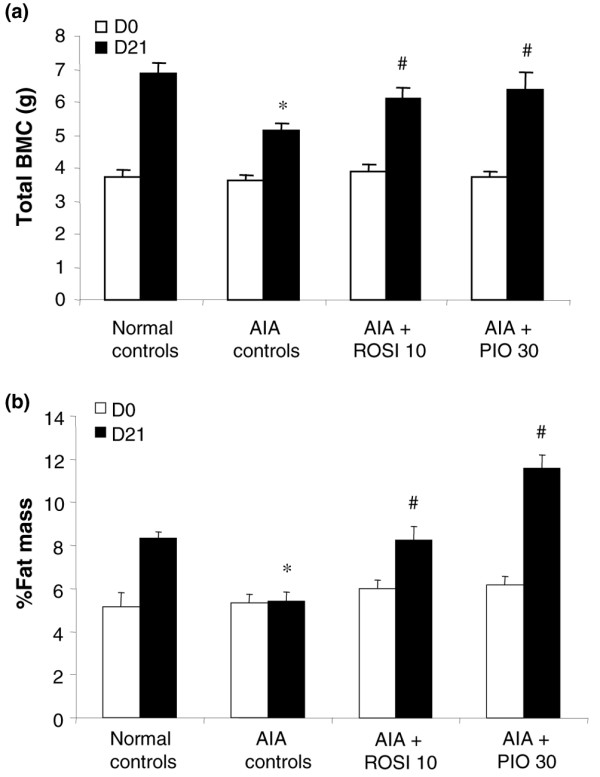
Effect of rosiglitazone and pioglitazone treatment on dual-energy X-ray absorptiometry changes during adjuvant-induced arthritis. Animals were treated daily for 21 days with rosiglitazone (ROSI) 10 mg/kg (n = 8) or pioglitazone (PIO) 30 mg/kg (n = 8) by oral administration. Arthritic (adjuvant-induced arthritis (AIA)) (n = 7) and normal controls (n = 7) were given 0.5% carboxymethylcellulose alone. Dual-energy X-ray absorptiometry analysis was performed in vivo the day before arthritis induction (day 0) and before necropsy (day 21). (a) Changes in whole-body bone mineral content (BMC); (b) changes in fat mass percentage. Data are expressed as means ± SEM. *, P < 0.05 compared with normal controls; #, P < 0.05 compared with AIA controls (ANOVA and Fisher's PLSD post-hoc test). Dn, day n.
Figure 7
Figure 7
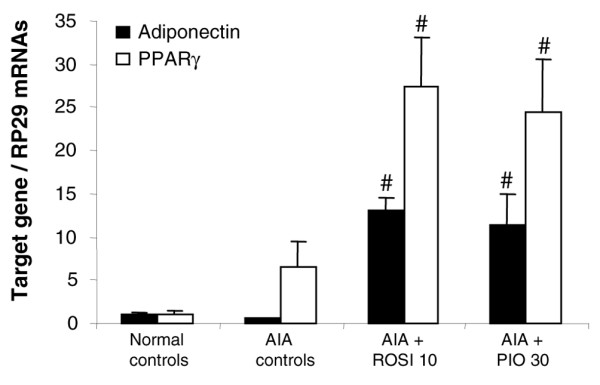
Effect of rosiglitazone and pioglitazone treatment on expression of PPAR target genes during adjuvant-induced arthritis. Animals were treated daily for 21 days with rosiglitazone (ROSI) 10 mg/kg or pioglitazone (PIO) 30 mg/kg by oral administration. Arthritic (adjuvant-induced arthritis (AIA)) and normal controls were given 0.5% carboxymethylcellulose alone. mRNA levels of adiponectin and peroxisome proliferator-activated receptor (PPAR)-γ normalized to RP29 in adipose tissue were assessed by RT-quantitative polymerase chain reaction. Data are expressed as means ± SEM for three representative samples per group (arthritis score close to the mean score of the group). #, P < 0.05 compared with AIA controls (ANOVA and Fisher's PLSD post-hoc test).

References

    1. Holmdahl R, Lorentzen JC, Lu S, Olofsson P, Wester L, Holmberg J, Pettersson U. Arthritis induced in rats with nonimmunogenic adjuvants as models for rheumatoid arthritis. Immunol Rev. 2001;184:184–202. doi: 10.1034/j.1600-065x.2001.1840117.x. - DOI - PubMed
    1. Wooley PH. Animal models of rheumatoid arthritis. Curr Opin Rheumatol. 1991;3:407–420. doi: 10.1097/00002281-199106000-00013. - DOI - PubMed
    1. Szekanecz Z, Halloran MM, Volin MV, Woods JM, Strieter RM, Haines KG, Kunkel SL, Burdick MD, Koch AE. Temporal expression of inflammatory cytokines and chemokines in rat adjuvant-induced arthritis. Arthritis Rheum. 2000;43:1266–1277. doi: 10.1002/1529-0131(200006)43:6<1266::AID-ANR9>3.0.CO;2-P. - DOI - PubMed
    1. McComb J, Gould T, Chlipala E, Sennelo G, Frazier J, Kieft G, Seely J, Edwards CK, Bendele A. Antiarthritic activity of soluble tumor necrosis factor receptor type I forms in adjuvant arthritis: correlation of plasma levels with efficacy. J Rheumatol. 1999;26:1347–1351. - PubMed
    1. Bendele A, Sennello G, McAbee T, Frazier J, Chlipala E, Rich B. Effects of interleukin 1 receptor antagonist alone and in combination with methotrexate in adjuvant arthritic rats. J Rheumatol. 1999;26:1225–1229. - PubMed

Publication types

MeSH terms