Review
. 2008 Feb;31(2):74-81.
doi: 10.1016/j.tins.2007.11.007. Epub 2008 Jan 15.

GPCR monomers and oligomers: it takes all kinds

Affiliations
Review

GPCR monomers and oligomers: it takes all kinds

Vsevolod V Gurevich et al. Trends Neurosci. 2008 Feb.

Abstract

Accumulating evidence of G-protein-coupled receptor (GPCR) oligomerization on the one hand and perfect functionality of monomeric receptors on the other creates an impression of controversy. However, the GPCR superfamily is extremely diverse, both structurally and functionally. The life cycle of each receptor includes many stages: synthesis, quality control in the endoplasmic reticulum, maturation in the Golgi, delivery to the plasma membrane (where it can be in the inactive or active state, in complex with cognate G protein, G-protein-coupled receptor kinase or arrestin), endocytosis and subsequent sorting in endosomes. Different GPCR subtypes, and even the same receptor at different stages of its life cycle, most likely exist in different oligomerization states, from monomers to dimers and possibly higher-order oligomers.


Figures
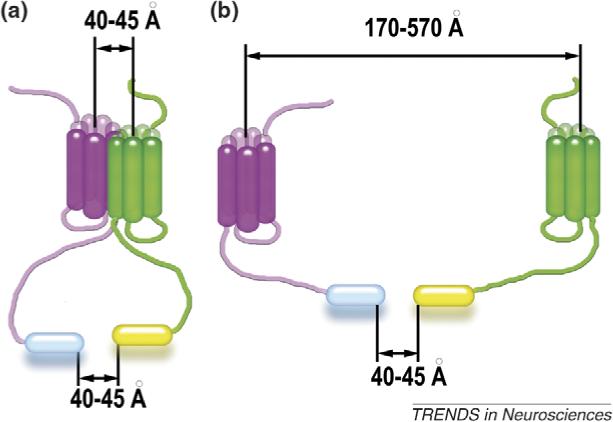
Figure I
Figure I
Inter-receptor distance during energy transfer.
Figure 1
Figure 1
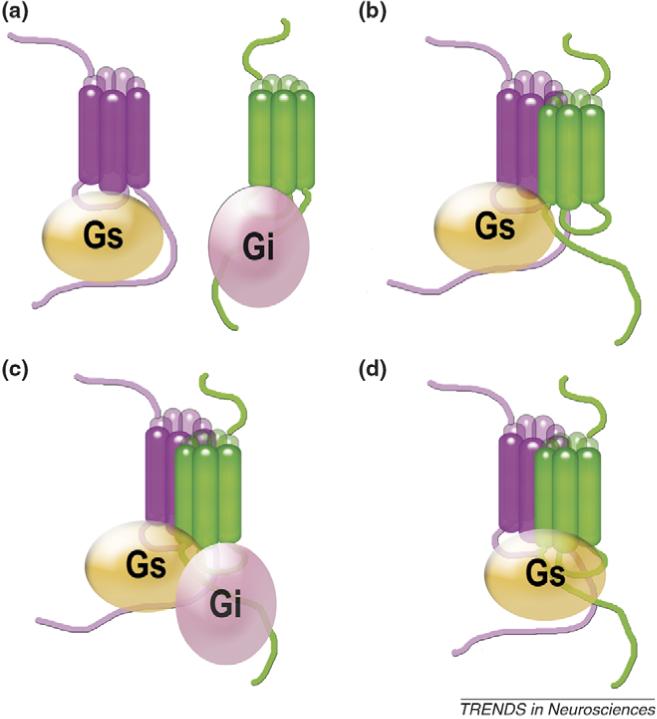
How do GPCRs activate G proteins? Every conceivable model of G protein activation by GPCRs has been proposed: (a) by receptor monomer; (b) by one receptor in a GPCR dimer; (c) by both receptors in a dimer acting via their cognate G proteins; and (d) by both receptors in a dimer docking to a single G protein. These models have important implications for GPCR signaling. Model (a) [9] predicts full functionality of a monomeric receptor, whereas model (d) [29] predicts the opposite, that a receptor dimer is required for G protein activation. Recent conclusive evidence for three different class A GPCRs, rhodopsin [35,39], β2-adrenergic [40] and NTS1 neurotensin receptor [20], demonstrates that a single receptor molecule is sufficient for efficient G protein activation and formation of receptor–G protein complexes with high agonist affinity, strongly supporting model (a) and ruling out model (d). Studies of obligatory heterodimeric class C receptors [38] and the leukotriene receptor [37] suggest that only one receptor within a dimer binds G protein, as in model (b). A two receptor–one G protein complex, as described for the leukotriene receptor in detergent [36], is also compatible with model (b). Reports that the activities of dimeric rhodopsin [35] and the neurotensin receptor [20] are lower than those of the monomeric forms makes model (c) unlikely for these GPCRs. These models equally apply to homo- and heterodimers (for simplicity, only the latter are shown).
Figure 2
Figure 2
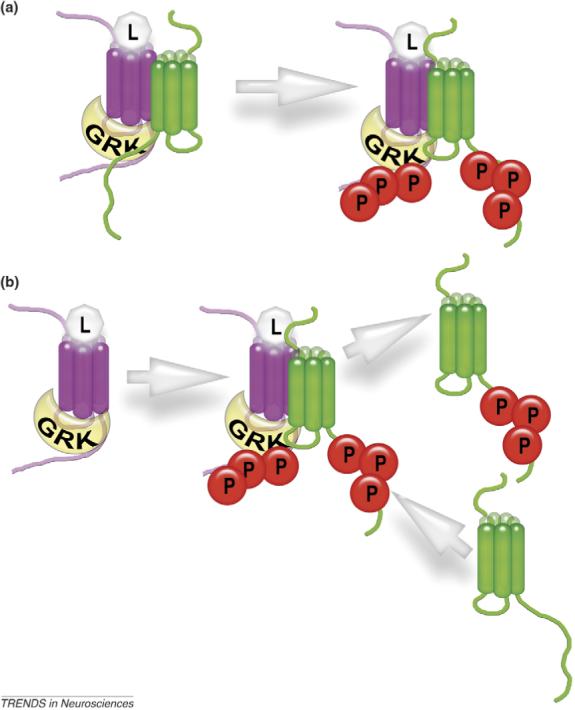
Detecting GPCR oligomerization by crossphosphorylation. The binding to the active receptor dramatically enhances GRK enzymatic activity, even toward exogenous substrates [41]. Thus, when one receptor (magenta) is activated and binds GRK, the other (green) in close proximity is likely to also be phosphorylated. If two receptors form a stable heterodimer (a), one ‘green’ receptor would be phosphorylated for each activated ‘magenta’ receptor, and the efficiency of crossphosphorylation would be independent of the absolute expression level. By contrast, if the half-life of the heterodimer is shorter than the half-life of the receptor–GRK complex, the GRK bound to the magenta receptor would sequentially phosphorylate multiple green receptors (b). In this case, the efficiency of crossphosphorylation would be directly proportional to the expression levels of both receptors. Using receptor mutants that do not have their own phosphorylation sites can simplify the readout of these experiments, ensuring that only crossphosphorylation of the putative dimerization partner is measured. Abbreviations: L in light gray octagon, ligand (agonist); P in red circle, receptor-attached phosphate.
Figure 3
Figure 3
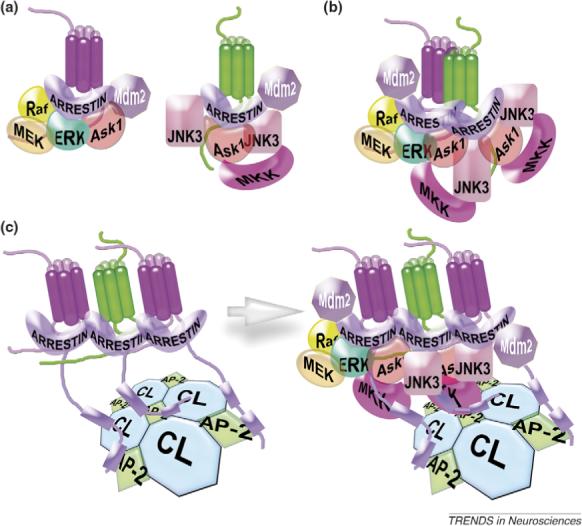
Possible role of GPCR oligomerization in arrestin-mediated signaling. Receptor-bound arrestins were shown to recruit >20 different trafficking and signaling proteins to the complex [7,58]. (a) A comparison of the size of the receptor, arrestin and arrestin interaction partners suggests that a unitary arrestin–receptor complex cannot bind more than four to six proteins at the same time [59]. Arrestin-mediated scaffolding of each MAP kinase pathway (c-Raf-1→MEK1→ERK1/2 or ASK1→MKK4→JNK3) requires simultaneous recruitment of three proteins, where members of the same cascade must be close enough and correctly oriented relative to each other to make these complexes productive. For example, ASK1 in the left complex and one JNK3 in the right complex cannot participate in signaling because their necessary additional partners are absent. (b) It is tempting to speculate that receptor oligomers (a dimer is shown for simplicity), with each receptor bound to its own arrestin [50], increase the size of the scaffolding surface, thereby making the assembly of productive complexes more likely. For example, three complete MAP kinase cascades are assembled here, as opposed to only two on a pair of separate arrestin–receptor complexes shown in (a). Multi-arrestin scaffolds may also ensure ‘economies of scale’: for example, one molecule of E3 ubiquitin ligase Mdm2 might ubiquitinate both arrestins in the complex, saving room for additional partners. (c) Internalization can serve as an alternative mechanism yielding a similar increase in the scaffolding surface. Receptor binding induces the release of the arrestin C tail, which carries clathrin and AP-2-binding sites (shown as blue boxes on the arrestin C tail). Arrestin-mediated GPCR recruitment to the coated pit may create evenly spaced arrays of many arrestin–receptor complexes reproducing spatial organization of the clathrin coat. These multicomplex assemblies might be large enough to recruit the components of both MAP kinase cascades along with other signaling molecules. Finally, mechanisms illustrated in (b) and (c) are not mutually exclusive: arrestin-mediated receptor organization in the coated pit may work together with receptor oligomerization to enable efficient arrestin-mediated signaling. Abbreviations: CL, clathrin; AP-2, clathrin adaptor AP-2 (also termed adaptin2).

References

    1. Kobilka BK. G protein coupled receptor structure and activation. Biochim. Biophys. Acta. 2007;1768:794–807. - PMC - PubMed
    1. Moore CA, et al. Regulation of receptor trafficking by GRKs and arrestins. Annu. Rev. Physiol. 2007;69:451–482. - PubMed
    1. Gurevich VV, Gurevich EV. The molecular acrobatics of arrestin activation. Trends Pharmacol. Sci. 2004;25:105–111. - PubMed
    1. Goodman OB,, Jr, et al. β-Arrestin acts as a clathrin adaptor in endocytosis of the β2-adrenergic receptor. Nature. 1996;383:447–450. - PubMed
    1. Laporte SA, et al. The β2-adrenergic receptor/barrestin complex recruits the clathrin adaptor AP-2 during endocytosis. Proc. Natl. Acad. Sci. U. S. A. 1999;96:3712–3717. - PMC - PubMed

Publication types

MeSH terms

Substances