


Primary human immunodeficiency virus type 1 (HIV-1) infection during HIV-1 Gag vaccination
- PMID: 18199650
- PMCID: PMC2259011
- DOI: 10.1128/JVI.01720-07
Primary human immunodeficiency virus type 1 (HIV-1) infection during HIV-1 Gag vaccination
Abstract
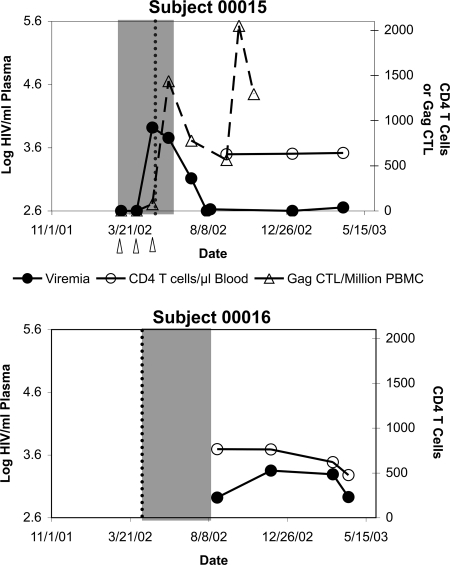
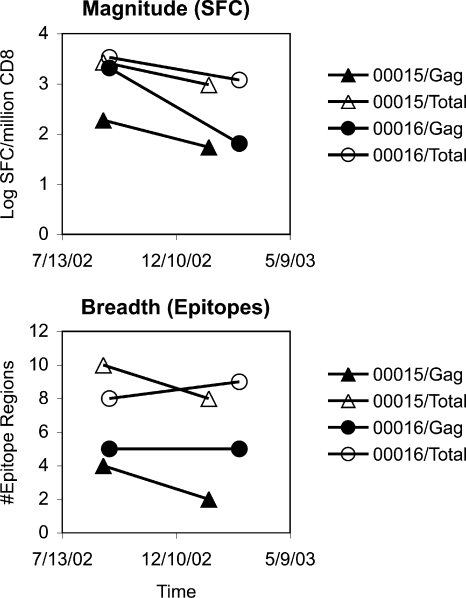
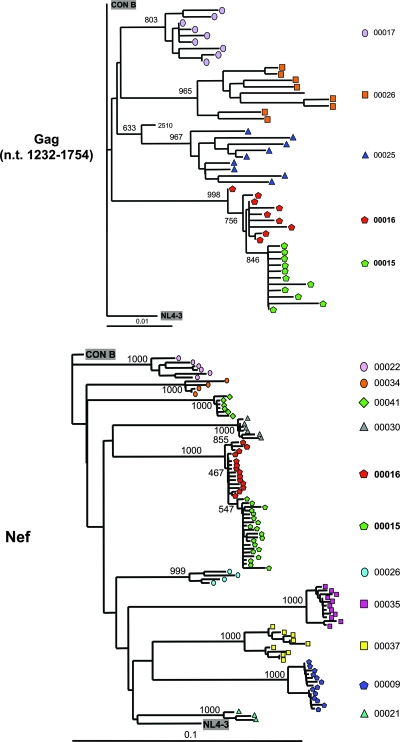
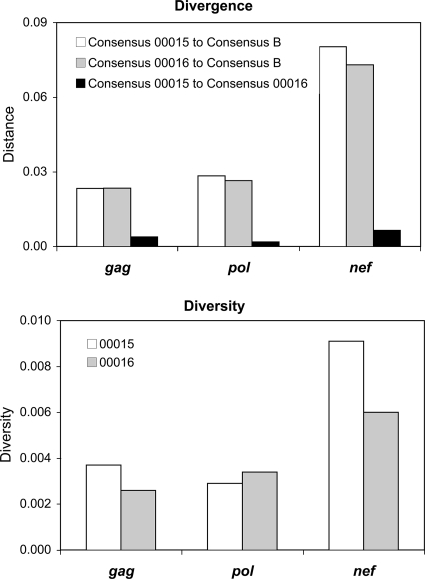
Vaccination for human immunodeficiency virus type 1 (HIV-1) remains an elusive goal. Whether an unsuccessful vaccine might not only fail to provoke detectable immune responses but also could actually interfere with subsequent natural immunity upon HIV-1 infection is unknown. We performed detailed assessment of an HIV-1 gag DNA vaccine recipient (subject 00015) who was previously uninfected but sustained HIV-1 infection before completing a vaccination trial and another contemporaneously acutely infected individual (subject 00016) with the same strain of HIV-1. Subject 00015 received the vaccine at weeks 0, 4, and 8 and was found to have been acutely HIV-1 infected around the time of the third vaccination. Subject 00016 was a previously HIV-1-seronegative sexual contact who had symptoms of acute HIV-1 infection approximately 2 weeks earlier than subject 00015 and demonstrated subsequent seroconversion. Both individuals reached an unusually low level of chronic viremia (<1,000 copies/ml) without treatment. Subject 00015 had no detectable HIV-1-specific cytotoxic T-lymphocyte (CTL) responses until a borderline response was noted at the time of the third vaccination. The magnitude and breadth of Gag-specific CTL responses in subject 00015 were similar to those of subject 00016 during early chronic infection. Viral sequences from gag, pol, and nef confirmed the common source of HIV-1 between these individuals. The diversity and divergence of sequences in subjects 00015 and 00016 were similar, indicating similar immune pressure on these proteins (including Gag). As a whole, the data suggested that while the gag DNA vaccine did not prime detectable early CTL responses in subject 00015, vaccination did not appreciably impair his ability to contain viremia at levels similar to those in subject 00016.
Figures
References
-
- Addo, M. M., X. G. Yu, A. Rathod, D. Cohen, R. L. Eldridge, D. Strick, M. N. Johnston, C. Corcoran, A. G. Wurcel, C. A. Fitzpatrick, M. E. Feeney, W. R. Rodriguez, N. Basgoz, R. Draenert, D. R. Stone, C. Brander, P. J. R. Goulder, E. S. Rosenberg, M. Altfeld, and B. D. Walker. 2003. Comprehensive epitope analysis of human immunodeficiency virus type 1 (HIV-1)-specific T-cell responses directed against the entire expressed HIV-1 genome demonstrate broadly directed responses, but no correlation to viral load. J. Virol. 772081-2092. - PMC - PubMed
-
- Altfeld, M., T. M. Allen, X. G. Yu, M. N. Johnston, D. Agrawal, B. T. Korber, D. C. Montefiori, D. H. O'Connor, B. T. Davis, P. K. Lee, E. L. Maier, J. Harlow, P. J. Goulder, C. Brander, E. S. Rosenberg, and B. D. Walker. 2002. HIV-1 superinfection despite broad CD8+ T-cell responses containing replication of the primary virus. Nature 420434-439. - PubMed
-
- Betts, M. R., D. R. Ambrozak, D. C. Douek, S. Bonhoeffer, J. M. Brenchley, J. P. Casazza, R. A. Koup, and L. J. Picker. 2001. Analysis of total human immunodeficiency virus (HIV)-specific CD4+ and CD8+ T-cell responses: relationship to viral load in untreated HIV infection. J. Virol. 7511983-11991. - PMC - PubMed
-
- Betts, M. R., B. Exley, D. A. Price, A. Bansal, Z. T. Camacho, V. Teaberry, S. M. West, D. R. Ambrozak, G. Tomaras, M. Roederer, J. M. Kilby, J. Tartaglia, R. Belshe, F. Gao, D. C. Douek, K. J. Weinhold, R. A. Koup, P. Goepfert, and G. Ferrari. 2005. Characterization of functional and phenotypic changes in anti-Gag vaccine-induced T cell responses and their role in protection after HIV-1 infection. Proc. Natl. Acad. Sci. USA 1024512-4517. - PMC - PubMed
Publication types
MeSH terms
Substances
Grants and funding
LinkOut - more resources
Full Text Sources
Medical
Molecular Biology Databases
Research Materials
