Haplotype analyses of CYP19A1 gene variants and breast cancer risk: results from the Shanghai Breast Cancer Study
- PMID: 18199708
- PMCID: PMC2633134
- DOI: 10.1158/1055-9965.EPI-07-0688
Haplotype analyses of CYP19A1 gene variants and breast cancer risk: results from the Shanghai Breast Cancer Study
Abstract
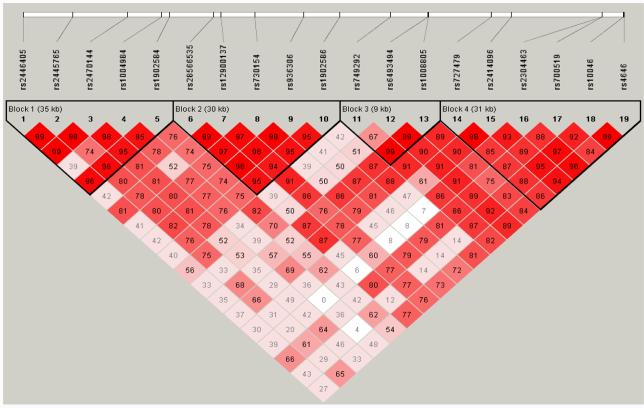
Estrogens play a central role in the etiology of breast cancer. The CYP19A1 gene encodes aromatase, a key enzyme in the biosynthesis of estrogens. Several single nucleotide polymorphisms (SNP) or haplotypes in the CYP19A1 gene have been evaluated in relation to breast cancer risk. However, the results have been inconsistent. In this study, we constructed haplotypes of the CYP19A1 gene using 19 haplotype-tagging SNPs in Chinese women and evaluated the variation of this gene in relation to breast cancer risk in a population-based case-control study involving 1,140 cases and 1,244 community controls of the Shanghai Breast Cancer Study. Five common haplotypes in block 1, three common haplotypes in block 2, five common haplotypes in block 3, and four common haplotypes in block 4 were identified. No apparent association was observed between common haplotypes and breast cancer risk in analyses including all subjects nor in analyses stratified by menopausal status. Similarly, no statistically significant differences were found between cases and controls in the genotype distributions of the 19 individual SNPs and the (TTTA)(n) repeat polymorphism evaluated in the study. No overall association of breast cancer risk with common CYP19A1 gene variants among Chinese women was observed in this large-scale, comprehensive study. Further studies are needed to explore CYP19A1 gene-environment interactions in relation to breast cancer risk.
Figures
References
-
- Colditz GA, Baer H, Tamimi RM. Breast Cancer. In: Schottenfeld D D, Fraumeni JF Jr, editors. Cancer Epidemiology and Prevention. Oxford University Press; New York: 2006. pp. 995–1012.
-
- Dunning AM, Healey CS, Pharoah PD, Teare MD, Ponder BA, Easton DF. A systematic review of genetic polymorphisms and breast cancer risk. Cancer Epidemiol Biomarkers Prev. 1999;8:843–54. - PubMed
-
- Haiman CA, Stram DO, Pike MC, Kolonel LN, Burtt NP, Altshuler D, et al. A comprehensive haplotype analysis of CYP19 and breast cancer risk: the Multiethnic Cohort. Hum Mol Genet. 2003;12:2679–92. - PubMed
-
- Probst-Hensch NM, Ingles SA, Diep AT, Haile RW, Stanczyk FZ, Kolonel LN, et al. Aromatase and breast cancer susceptibility. Endocr Relat Cancer. 1999;6:165–73. - PubMed
Publication types
MeSH terms
Substances
Grants and funding
LinkOut - more resources
Full Text Sources
Medical